

Quick Answer: What are Qualified Services for the Vermont R&D Tax Credit?
Qualified services for the Vermont Research and Development Tax Credit consist of three specific categories of employee activity: direct performance (engaging in research), immediate supervision of the research, and essential support for the research. Defined under Internal Revenue Code (IRC) § 41(b)(2)(B) and adopted by Vermont statute 32 V.S.A. § 5930ii, these services determine eligible wage-based expenditures. Wages paid to employees performing these services within Vermont borders are eligible for a nonrefundable credit equal to 27% of the federal research credit amount attributable to those in-state activities.
Qualified services comprise the three specific categories of employee activity—direct performance, immediate supervision, and essential support—that enable wage-based expenditures to qualify for the Vermont research and development tax credit. Under state law, these services are eligible for a nonrefundable credit equal to twenty-seven percent of the federal research credit amount attributable to activities conducted physically within Vermont borders.
Comprehensive Overview of the Vermont Research and Development Incentive
The Vermont Research and Development (R&D) Tax Credit, authorized under 32 V.S.A. § 5930ii and administered by the Vermont Department of Taxes, serves as a cornerstone of the state’s fiscal policy to encourage technological innovation and high-value employment. This incentive is structurally tethered to the federal research credit under Internal Revenue Code (IRC) Section 41, creating a system of selective conformity where federal definitions of qualified activities and expenditures are adopted but restricted to a Vermont-specific geographic nexus. The state provides a nonrefundable incentive that offsets personal income, business, or corporate income tax liabilities, offering a ten-year carryforward period for unused credits.
The fiscal impact of this credit is significant, as Vermont’s 27% proration rate of the federal credit ranks among the highest in the United States. However, this generosity is paired with stringent documentation requirements and a unique transparency provision, where the Department of Taxes publishes an annual report containing the names of all claimants to ensure public accountability. To navigate this landscape, taxpayers must master the concept of "Qualified Services," as wages paid to employees performing these services typically constitute the largest portion of a claimant's Qualified Research Expenditures (QREs).
Legislative Foundation and Regulatory Alignment
The Vermont credit is calculated as a percentage of the federal credit allowed in the taxable year for eligible R&D expenditures made within the state. This necessitates a "recomputation" of the federal credit using only Vermont-sourced data. Central to this recomputation is the definition of qualified services found in IRC § 41(b)(2)(B), which specifies that services must consist of engaging in qualified research, or engaging in the direct supervision or direct support of research activities which constitute qualified research.
Statutory Context of 32 V.S.A. § 5930ii
The Vermont legislature intentionally designed the R&D credit to mirror the federal standards to simplify compliance for businesses operating across state lines while maintaining a robust incentive for local activity. The statute stipulates that the credit is 27% of the federal amount under 26 U.S.C. § 41(a) for expenditures made within Vermont. This implies that if a company performs R&D in multiple states, it must apportion its QREs to identify the portion attributable to Vermont employees and materials.
The transition to the current 27% rate occurred effective January 1, 2014, following a previous rate of 30%. This adjustment reflects the state’s ongoing calibration of its tax expenditure budget. For businesses, this means that every dollar of federal credit generated by Vermont-based qualified services yields an additional $0.27 in state tax reduction.
Integration with Federal IRC Section 41
Because Vermont leverages federal rules, the "Four-Part Test" is the primary filter for determining whether an activity qualifies as research in the first place. Once an activity is deemed qualified research, the services associated with that activity must be categorized. The federal definition of qualified services is broad but precisely tiered into conduct, supervision, and support.
| Provision | Vermont Application | Federal Source |
|---|---|---|
| Qualified Services Definition | Adopts IRC § 41(b)(2)(B) without modification. | IRC § 41(b)(2)(B) |
| Geographic Nexus | Strictly limited to services performed in Vermont. | N/A (Federal credit is US-wide) |
| Credit Percentage | 27% of recomputed federal credit. | 20% (Regular) or 14% (ASC) |
| Reporting Form | Schedule BA-404. | Form 6765. |
Deep Dive: The Three Pillars of Qualified Services
The meaning of qualified services is effectively a three-pronged test of an employee's functional role relative to a research project. For the Vermont Department of Taxes, the critical determination is whether the employee's daily tasks directly contribute to the "experimentation" required by the law.
Engaging in Qualified Research (Direct Conduct)
The first and most fundamental tier of qualified services is the actual conduct of the research. This involves the technical work performed by scientists, engineers, and developers who are on the "front lines" of innovation. In the context of Vermont’s key industries, direct conduct includes activities such as:
- Software Engineering: Writing source code for a new encryption algorithm, developing proprietary software architecture, and performing unit testing to resolve technical bugs in a new product.
- Mechanical and Electrical Engineering: Designing prototypes for high-performance machinery, creating CAD models for experimental aerospace components, and performing thermal stress tests.
- Life Sciences and Biotech: Conducting laboratory experiments, monitoring chemical reactions in a trial-and-error process, and analyzing biological data to develop new formulas or techniques.
Direct conduct is distinguished by the direct application of the "hard sciences"—physics, biology, chemistry, engineering, and computer science. Routine data collection or cosmetic design changes do not constitute direct conduct because they lack the required technical uncertainty.
Direct Supervision (First-Line Management)
Direct supervision represents the immediate management of individuals engaging in the direct conduct of research. The term "direct" is a significant limiter; it does not extend to upper-level executives who manage the company but are disconnected from the technical nuances of the research.
The IRS Audit Techniques Guide, which informs Vermont state audits, clarifies that direct supervision is the first-line management of the research scientist or engineer. For instance, a research director who oversees a laboratory, sets experimental protocols, and reviews technical findings to decide which design alternatives to pursue is performing direct supervision. However, a CEO who receives a monthly high-level report on the project’s progress but does not participate in the technical decision-making process is not performing a qualified service.
The qualification of supervision often requires an analysis of the manager’s technical background. While a degree is not strictly required, the supervisor must possess the technical expertise necessary to evaluate the experimental results and provide guidance on resolving technical uncertainties.
Direct Support (Ancillary but Essential Services)
Direct support is the third category of qualified services and includes tasks that are essential to the research process but do not involve the actual experimentation or its immediate management. This category is often underutilized by Vermont businesses due to a lack of clarity on where "support" ends and "general administration" begins.
The regulatory standard for direct support requires a "direct benefit" to the research activities. Examples of qualifying direct support include:
- Technical Documentation: A clerk or secretary who compiles raw research data or types up laboratory reports describing experimental results.
- Laboratory and Equipment Maintenance: A technician who cleans specialized laboratory equipment used exclusively for R&D trials or a machinist who fabricates a component for an experimental model.
- Prototyping Assistance: Employees involved in the assembly of a "pilot model" or prototype used to test design assumptions.
- Technical Sales Interaction: In certain cases, technical sales staff who work with company engineers to define the technical requirements for a new product may qualify as providing direct support, provided their role is purely technical and not focused on marketing or commercial feasibility.
Conversely, services that are only "indirectly" of benefit to research do not qualify. This exclusion list is extensive and includes:
- General and Administrative (G&A) Services: Payroll personnel preparing checks for researchers, accountants tracking R&D budgets, and HR staff recruiting new engineers.
- Facility Services: Janitors cleaning the general office building (as opposed to the specific research lab) and security personnel.
- Legal and Financial Oversight: Corporate officers supervising financial or personnel matters.
The "Substantially All" Rule: A Taxpayer-Friendly Provision
A critical mathematical component of the qualified services definition is the "substantially all" rule. Under both federal and Vermont standards, if at least 80% of an employee’s services during the taxable year consist of qualified services (any combination of conduct, supervision, or support), then 100% of that employee’s wages are treated as qualified research expenses.
This rule is designed to reduce the administrative burden of tracking every single minute of an employee’s day. However, if the employee’s qualified services fall below the 80% threshold, the company may only include the actual percentage of their wages in the credit calculation. For example, if a developer spends 70% of her time on qualified coding and 30% on routine customer support, the company can only include 70% of her wages as Vermont QREs.
Calculating Total Services for the 80% Rule
When determining whether an employee meets the 80% threshold, the "performance of services" (the denominator) is the total time spent working. Crucially, non-service time—such as vacation, sick leave, and holidays—is excluded from both the numerator and the denominator. This adjustment often makes it easier for key technical staff to meet the "substantially all" requirement.
Vermont State Revenue Office Guidance and Local Application
The Vermont Department of Taxes provides specific instructions through Schedule BA-404 and associated bulletins. The state’s primary concern is ensuring that the R&D credit is applied only to work performed in Vermont. This geographic requirement introduces complexity for modern businesses with remote workers or multi-state operations.
Geographic Proration and the Recomputation Requirement
If a company’s federal R&D credit includes expenditures from other states, it must perform a recomputation for Vermont. This process involves:
- Identifying Vermont QREs: Filtering payroll to include only wages paid to employees for qualified services performed physically in Vermont.
- Apportioning Supplies and Contracts: Including only supplies used in Vermont and payments to contractors for research conducted in Vermont.
- Applying the Federal Method: Using the same method (Regular or Alternative Simplified Credit) that was used on the federal Form 6765, but applying it to the Vermont-specific QREs.
- The 27% Multiplier: Once the "hypothetical federal credit" for Vermont is determined, it is multiplied by 27% to find the Vermont R&D tax credit.
This recomputation can lead to significant differences between federal and state filings. For example, a software firm with a head office in Burlington and a satellite team in Massachusetts must exclude the Massachusetts wages from its Vermont calculation entirely, even if the research results are owned by the Vermont entity.
Documentation and Audit Standards
The Vermont Department of Taxes emphasizes that "accurate records and documentation must be kept to determine eligible expenses." State audits typically align with federal documentation standards under IRC § 41, but with a specific focus on the accuracy of Vermont proration.
Recommended documentation for substantiating qualified services in Vermont includes:
- W-2 and Payroll Registers: To verify taxable wages (Box 1).
- Employee Surveys and Worksheets: Periodic surveys where employees estimate the percentage of their time spent on specific projects, describing the technical uncertainties they addressed.
- Project Documentation: Contemporaneous records such as design specs, test logs, source code commits (with timestamps), and meeting minutes that prove the work occurred in Vermont during the tax year.
- Time-Stamped Metadata: Electronic files and version control systems (e.g., Git) that provide evidence of when and where the work was performed.
Failure to provide these records can lead to the disallowance of the credit. Because the credit can be carried forward for ten years, businesses should retain these records for at least thirteen years to cover the carryforward window plus the standard statute of limitations.
Nuanced Application: Software Development and Internal Use Software
In Vermont’s growing tech sector, the application of qualified services to software development is particularly nuanced. While writing code for a new product for sale generally qualifies, software developed for "internal use" (IUS) must meet a higher threshold.
The High Threshold of Innovation (HTI) Test
Software developed primarily for use in the taxpayer’s own general and administrative functions (such as accounting or HR software) is considered IUS. For the services associated with IUS to be qualified, they must satisfy a three-part High Threshold of Innovation (HTI) test:
- Innovation: The software must be intended to be innovative and result in a reduction in cost or improvement in speed that is substantial.
- Significant Economic Risk: The taxpayer must commit substantial resources and there must be technical risk that those resources will not result in a functional program.
- Commercial Availability: The software must not be commercially available for use by the taxpayer.
However, software developed to support a non-software research project (such as a program used by a Vermont manufacturing firm to run experimental robotic trials) is generally not subject to the IUS restrictions and follows the standard rules for qualified services.
Detailed Analysis of Compensation and Wages
The term "wages" for the purpose of the R&D credit is specifically defined by IRC § 3401(a). In Vermont, this generally refers to the taxable wages reported in Box 1 of Form W-2.
Components of Qualifying Wages
To calculate the credit, the company must identify the portion of taxable compensation paid for qualified services. This includes:
- Base Salaries: The primary compensation for work performed.
- Performance Bonuses: Bonuses paid to employees for their work on research projects.
- Stock Option Exercises: The "spread" (the difference between the fair market value and the exercise price) of non-qualified stock options at the time of exercise, provided the work performed during the grant year was a qualified service.
Excluded Items
Certain forms of compensation are strictly excluded from the QRE definition because they do not meet the IRC § 3401(a) definition of taxable wages subject to withholding. These include:
- Fringe Benefits: Company-paid health insurance premiums, life insurance, and 401(k) matching contributions.
- Non-Taxed Income: Amounts that are not subject to withholding, even if paid for research services.
- Relocation and Travel: Reimbursements for moving or travel expenses are not considered part of the wage-based credit.
Comparative View of Vermont Research Incentives
While the 27% R&D credit is the primary incentive, Vermont also offers an R&D credit through the Enterprise Zone (EZ) program. It is critical for businesses to understand which program they are applying for, as the rules and rates differ significantly.
| Feature | Vermont Standard R&D Credit | Enterprise Zone (EZ) R&D Credit |
|---|---|---|
| Statute | 32 V.S.A. § 5930ii | 32 V.S.A. § 5930z (via EZ) |
| Rate | 27% of federal credit. | 3% of incremental expenses. |
| Eligibility | Statewide, based on IRC § 41. | Limited to 16 designated zones. |
| Claim Period | Earned and reported annually. | Claimed 25% each year for 4 years. |
| Requirement | Mirror federal QREs. | 3-year presence in the zone. |
For most high-growth Vermont companies, the 27% standard credit is more lucrative, but the EZ credit can provide additional benefits for businesses focused on community revitalization in designated high-unemployment areas.
Detailed Example: Green Mountain Robotics Corp
To demonstrate the practical application of qualified services, consider "Green Mountain Robotics Corp," a hypothetical manufacturer of specialized automated logging equipment located in St. Johnsbury, Vermont.
The 2024 Research Project
The company is developing a new robotic arm capable of sensing wood density to optimize cutting patterns. This project involves significant technical uncertainty regarding the integration of laser sensors with hydraulic controls.
Employee Service Analysis
The company evaluates the services of its five key employees to determine their Vermont QREs.
-
Dr. Sarah (Chief Engineer):
- Services: Spends 85% of her time writing control algorithms and testing them on prototypes in the St. Johnsbury lab.
- Wages: $140,000 W-2 Box 1.
- Analysis: She is "Engaging in Research" (Direct Conduct). Because her time exceeds the 80% threshold, 100% of her wages ($140,000) are qualified.
-
Mark (Project Manager):
- Services: Spends 75% of his time in the lab with Sarah, reviewing the technical failures of the hydraulic system and assigning daily design tasks. The other 25% is spent on client relations and budgeting.
- Wages: $100,000 W-2 Box 1.
- Analysis: He is "Directly Supervising" the research. Because he falls below the 80% threshold, only his actual research time is qualified. $100,000 × 75% = $75,000.
-
Kevin (Technical Machinist):
- Services: Spends 100% of his time machining unique parts for the robotic arm prototype.
- Wages: $60,000 W-2 Box 1.
- Analysis: He is providing "Direct Support" (machining parts for an experimental model). 100% of his wages ($60,000) are qualified.
-
Linda (Office Administrator):
- Services: Spends 10% of her time typing up Sarah’s research notes and 90% on general bookkeeping and HR.
- Wages: $50,000 W-2 Box 1.
- Analysis: While typing notes is "Direct Support," it is a minor part of her role. Because she is below 80%, only 10% qualifies. $50,000 × 10% = $5,000.
-
Tom (CEO):
- Services: Reviews a weekly summary of the project and approves the final budget.
- Wages: $200,000 W-2 Box 1.
- Analysis: His involvement is "Indirect" and "General and Administrative." 0% of his wages qualify.
Total Vermont Qualified Research Wages for 2024: $280,000.
Calculation of the Vermont Credit
Assume Green Mountain Robotics uses the ASC method and their average Vermont QREs for the prior three years (2021-2023) were $200,000.
| Step | Calculation | Result |
|---|---|---|
| 1. Current Year VT QREs | $280,000 (Wages) + $20,000 (Supplies) | $300,000 |
| 2. ASC Base Amount | 50% of 3-year average ($200,000) | $100,000 |
| 3. Incremental Expenses | $300,000 - $100,000 | $200,000 |
| 4. Hypothetical Federal Credit | $200,000 × 14% ASC Rate | $28,000 |
| 5. Vermont R&D Tax Credit | $28,000 × 27% VT Rate | $7,560 |
Green Mountain Robotics would report $7,560 on their Vermont Schedule BA-404. If they are a pass-through entity (S-Corp or LLC), this credit will flow to the owners’ personal income tax returns via the K-1VT and Schedule BA-406.
Strategic Considerations and Future Outlook
The Vermont R&D tax credit is a powerful tool for cash flow management, but it requires a strategic approach to personnel management and documentation.
The Impact of Federal Section 174 Changes
A significant challenge facing Vermont taxpayers is the federal requirement, effective for tax years beginning after December 31, 2021, to capitalize and amortize research expenses over five years (or fifteen years for foreign research) instead of expensing them immediately. While this primarily affects taxable income, it underscores the importance of the R&D credit as a mechanism to offset the resulting increase in tax liability.
Transparency and Public Oversight
Taxpayers should be aware that Vermont’s transparency requirement is unique. Every year, by January 15, the Department of Taxes publishes a list of every taxpayer who claimed the credit in the previous year. For some private companies, this disclosure is a consideration in their tax planning. However, for most, the substantial 27% benefit outweighs the lack of anonymity.
Audit Resilience
The most common reasons for credit disallowance in Vermont are:
- Failure to prove the "Process of Experimentation": Not having test logs or records of failed designs.
- Inclusion of non-Vermont wages: Including remote workers who are not physically working in Vermont.
- Over-claiming supervision: Including high-level managers who do not provide "immediate" oversight.
By maintaining a "compliance-ready" posture—meaning records are created during the research process rather than reconstructed years later—Vermont businesses can secure their innovation incentives and fuel their future growth.
Nuances of Contract Research vs. Qualified Services
While this report focuses on in-house "qualified services," businesses often supplement their internal teams with outside contractors. The rules for contractors differ from employees in several critical ways:
- Wages vs. Payments: While 100% of an employee’s qualified wages can be claimed (subject to the 80% rule), only 65% of payments to third-party contractors are eligible QREs.
- Research Consortia: If the payment is made to a qualified research consortium (such as certain non-profit scientific organizations), the rate increases to 75%.
- Control and Risk: For a contractor’s services to be qualified, the company must retain the "rights" to the research and bear the "economic risk" of failure. If a contractor is paid regardless of whether they succeed, the company may not be able to claim the credit.
In the Vermont recomputation, these contractor expenses must also be filtered for work performed in the state. If a Vermont company hires a consulting firm in Boston to do the design work, those expenses are generally excluded from the Vermont credit calculation.
Final Thoughts
The meaning of qualified services in Vermont is a functional, geographically-bounded definition that rewards companies for high-value technical labor performed within the state. To succeed in claiming the 27% credit, businesses should implement the following best practices:
- Map Every Technical Role: Explicitly categorize every R&D-involved employee as conduct, supervision, or support, and document the specific Vermont-based tasks that justify that classification.
- Implement Time-Tracking Protocols: Even if the 80% rule is expected to apply, having actual data to support that threshold is critical for audit defense.
- Perform a Rigorous Vermont Recomputation: Do not simply take 27% of your federal credit. You must re-run the federal formula using only Vermont-specific wages and supplies to be compliant with Schedule BA-404 instructions.
- Educate Technical Staff: Ensure that engineers and scientists understand the need for contemporaneous documentation, such as project logs and design change records, which form the qualitative foundation of the claim.
By treating the R&D credit as a rigorous scientific and accounting exercise rather than a mere tax filing, Vermont firms can effectively leverage this significant state incentive to drive technological advancement and competitive superiority in the global market.
Who We Are:
Swanson Reed is one of the largest Specialist R&D Tax Credit advisory firm in the United States. With offices nationwide, we are one of the only firms globally to exclusively provide R&D Tax Credit consulting services to our clients. We have been exclusively providing R&D Tax Credit claim preparation and audit compliance solutions for over 30 years. Swanson Reed hosts daily free webinars and provides free IRS CE and CPE credits for CPAs.
Are you eligible?

Why choose us?

Pass an Audit?

What is the R&D Tax Credit?
The Research & Experimentation Tax Credit (or R&D Tax Credit), is a general business tax credit under Internal Revenue Code section 41 for companies that incur research and development (R&D) costs in the United States. The credits are a tax incentive for performing qualified research in the United States, resulting in a credit to a tax return. For the first three years of R&D claims, 6% of the total qualified research expenses (QRE) form the gross credit. In the 4th year of claims and beyond, a base amount is calculated, and an adjusted expense line is multiplied times 14%. Click here to learn more.
Never miss a deadline again

Stay up to date on IRS processes

Discover R&D in your industry

R&D Tax Credit Preparation Services
Swanson Reed is one of the only companies in the United States to exclusively focus on R&D tax credit preparation. Swanson Reed provides state and federal R&D tax credit preparation and audit services to all 50 states.
If you have any questions or need further assistance, please call or email our CEO, Damian Smyth on (800) 986-4725.
Feel free to book a quick teleconference with one of our national R&D tax credit specialists at a time that is convenient for you.
R&D Tax Credit Audit Advisory Services
creditARMOR is a sophisticated R&D tax credit insurance and AI-driven risk management platform. It mitigates audit exposure by covering defense expenses, including CPA, tax attorney, and specialist consultant fees—delivering robust, compliant support for R&D credit claims. Click here for more information about R&D tax credit management and implementation.
Our Fees
Swanson Reed offers R&D tax credit preparation and audit services at our hourly rates of between $195 – $395 per hour. We are also able offer fixed fees and success fees in special circumstances. Learn more at https://www.swansonreed.com/about-us/research-tax-credit-consulting/our-fees/



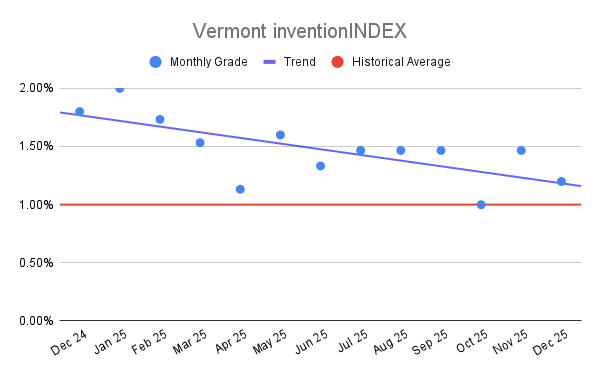 Vermont inventionINDEX December 2025:
  Vermont inventionINDEX November
