

Vermont Form IN-119 is the supplemental schedule used by individual taxpayers to claim nonrefundable tax credits and report tax adjustments against their state income liability. Within the specific context of the Research and Development tax credit, this form serves as the final reporting mechanism to apply credits earned through business activities to an individual’s personal tax obligations.
The administration of the Vermont Research and Development (R&D) Tax Credit requires a comprehensive understanding of the nexus between state statutes and federal tax definitions. As a nonrefundable incentive, the credit serves as a primary tool for the State of Vermont to foster innovation and technological advancement within its borders. The mechanism for this incentive is codified under 32 V.S.A. § 5930ii, which offers a credit equal to 27 percent of the federal credit allowed for qualified expenditures conducted specifically within Vermont. For individual taxpayers, particularly those who are shareholders, partners, or members of pass-through entities, Form IN-119 is the essential vehicle for realizing these benefits. The complexity of the credit lies not only in its calculation—which requires a hypothetical re-computation of federal figures—but also in its administrative lifecycle, moving from entity-level reporting to individual-level application.
The Statutory Architecture of the Research and Development Tax Credit
The Vermont Research and Development Tax Credit is anchored in 32 V.S.A. § 5930ii, a statute that reflects the state's strategic intent to align its fiscal policy with federal standards for innovation while maintaining a strictly local focus. The statute provides that a taxpayer of the state shall be eligible for a credit against the tax imposed under Chapter 151. The magnitude of this credit is fixed at 27 percent of the federal tax credit allowed under 26 U.S.C. § 41(a) for the taxable year. Crucially, the statute mandates that these expenditures must be "made within this State," establishing a geographical boundary that distinguishes the Vermont incentive from its broader federal counterpart.
The legislative history of this provision illustrates a responsive approach to state competitiveness. Prior to January 1, 2014, the credit rate was positioned at 30 percent. The subsequent reduction to 27 percent was a result of broader fiscal adjustments within the Vermont General Assembly, yet the revised rate remains high enough to place Vermont among the top states for R&D incentives in the country. This high prorated rate is a deliberate policy choice designed to drive high utilization in the technology and manufacturing sectors, which contribute significantly to the state’s economic base.
The statute also addresses the longevity of the credit through a 10-year carryforward provision. This allows businesses and individual owners who may not have sufficient tax liability in the year of the expenditure—common in capital-intensive research phases—to preserve the value of the credit for use in future, more profitable years. Furthermore, the law incorporates a transparency requirement, mandating that the Department of Taxes publish an annual list of taxpayers who claim the credit. This public reporting serves as a balancing mechanism, providing public oversight in exchange for the substantial tax relief granted to innovative firms.
Table 1: Statutory Summary of 32 V.S.A. § 5930ii| Provision | Legal Specification | Administrative Impact |
|---|---|---|
| Credit Rate | 27% of Federal Credit | High state-level incentive vs. national average. |
| Eligible Basis | 26 U.S.C. § 41(a) | Full conformity to federal "Four-Part Test." |
| Geographic Limit | "Made within this State" | Requires rigorous proration of expenses. |
| Carryforward | 10 Years | Long-term value preservation for startups. |
| Publicity | Annual list of claimants | Required transparency for tax expenditures. |
Federal Conformity and the Internal Revenue Code Linkage
The Vermont R&D credit is essentially a "piggyback" incentive, relying heavily on the definitions and methodologies established by the Internal Revenue Service (IRS) under Section 41 of the Internal Revenue Code. To be eligible for the Vermont credit, a taxpayer must first qualify for the federal credit. This creates a high bar for documentation, as the state will look to federal standards for determining what constitutes "qualified research."
Under IRC § 41, qualified research must meet the "Four-Part Test," which Vermont adopts without modification. The first requirement is a "Permitted Purpose," meaning the research must be intended to develop a new or improved business component. This is followed by the "Elimination of Uncertainty" requirement, where the taxpayer must seek to resolve technical questions regarding the capability, method, or design of the product or process. The third pillar is the "Process of Experimentation," necessitating a systematic evaluation of alternatives, such as trial and error, modeling, or simulation. Finally, the research must be "Technological in Nature," relying on the principles of physical or biological science, engineering, or computer science.
Recent federal changes under the Tax Cuts and Jobs Act (TCJA), specifically the requirement to amortize research and experimentation (R&E) expenditures under Section 174 over five years rather than expensing them immediately, have profound implications for the state level. While Vermont generally links its tax law to the federal definitions as of a specific date (often the end of the preceding calendar year), the underlying calculation for the credit remains tied to the expenditures incurred. For tax years beginning after 2024, the interplay between Section 174 amortization and Section 41 credit generation will be a focal point for the Vermont Department of Taxes as it assesses the timing of credit realization versus deduction timing.
Regulatory Guidance from the Vermont Department of Taxes
The Vermont Department of Taxes provides a hierarchy of guidance to assist taxpayers in navigating Form IN-119 and the R&D credit. This guidance ranges from formal Technical Bulletins to line-by-line instructions for the relevant schedules.
Technical Bulletins and Administrative DirectivesTechnical Bulletins represent the Department's interpretation of tax law and provide clarity on complex subjects. For instance, while Technical Bulletin TB-66 provides deep analysis for the Higher Education Investment credit (also found on IN-119), the R&D credit is governed by the specific instructions found in the 119 and BA-404 booklets. The Department emphasizes that the credit is nonrefundable, meaning it can only offset a taxpayer's liability for the current year. If a credit exceeds the liability, it cannot be refunded but can be carried forward, a rule that distinguishes it from refundable credits like the Vermont Earned Income Tax Credit (EITC).
The Department's guidance on Form IN-119 also specifies the physical requirements for filing. Taxpayers are instructed to print in blue or black ink only and to provide the name and Federal Employer Identification Number (FEIN) of any pass-through entity from which they earned a credit. If an individual receives credits from multiple entities, they must fill out a separate Form IN-119 for each entity. This administrative requirement ensures that the Department can trace the credit from the entity-level return (Form BI-471 or CO-411) to the individual return (Form IN-111).
Specific Guidance for Pass-Through EntitiesFor owners of pass-through entities, the Department provides a clear workflow. The entity must first calculate the credit on Schedule BA-404 and then allocate it to owners via Schedule BA-406. The individual then receives a Schedule K-1VT, which acts as the official notification of their share of the credit. The individual must then transcribe this amount to Part II of Form IN-119. In 2024, the R&D credit is typically located on Line 4 of Form IN-119, requiring the taxpayer to track "Earned," "Carryforward," and "Applied" amounts in separate columns.
Defining Qualified Research Activities (QRA) and Expenditures (QRE)
A detailed understanding of what constitutes a "Qualified Research Expenditure" (QRE) in the eyes of the Vermont revenue office is essential for a successful claim on Form IN-119. QREs are the raw inputs used to calculate the federal credit, which is then re-computed for the Vermont-specific portion.
Wage ExpendituresThe largest component of most R&D claims is wages. These are defined as salaries and benefits paid to employees for "qualified services." This includes not only the primary researchers but also those who are directly supervising or supporting the research. For a Vermont claim, these wages must be paid to employees for activities performed within Vermont. If a Vermont-based engineer spends 20% of their time on administrative tasks and 80% on qualified research, only 80% of their W-2 wages can be included in the QRE pool.
Supply and Material CostsSupplies include any tangible property used in the research process, provided they are not depreciable assets or land. Common examples in the Vermont context include chemicals used in laboratory experiments, materials consumed in the creation of prototypes, and specialized components for testing. General administrative supplies, such as office paper or utilities, are explicitly excluded.
Contract Research ExpensesVermont allows for the inclusion of 65% of the costs paid to third parties for research performed on the taxpayer's behalf. To qualify for the Vermont R&D credit, the contract research must be performed within the state. This often involves partnerships with local institutions like the University of Vermont (UVM) or specialized private laboratories.
Table 2: Eligible vs. Ineligible Expenditures for Vermont R&D Credit| Expenditure Category | Qualified (Must be in Vermont) | Non-Qualified / Excluded |
|---|---|---|
| Labor | Direct research, direct supervision, direct support. | General G&A, HR, marketing, routine maintenance. |
| Supplies | Prototype materials, chemicals, testing components. | Depreciable property, land, general office supplies. |
| Contracts | 65% of fees to third-party VT researchers. | Out-of-state contract research, legal patent fees. |
| Computing | Cloud/server costs used >80% for research. | General hosting, website maintenance, email. |
The Administrative Lifecycle: From Entity to Individual
The journey of an R&D credit from the point of discovery to the individual's Form IN-119 is a multi-step administrative process governed by specific filing mandates. For most individuals, this process begins at the entity level.
Entity Level: Form BA-404 and BA-406The entity conducting the research must first file Form BA-404, "Tax Credits Earned, Applied, Expired, and Carried Forward." This form requires the entity to report the total credit earned during the year and provides a breakdown of any carryforwards from previous years. The entity must attach a recomputed federal Form 6765 that isolates the Vermont-based QREs.
Once the total credit is established, the entity uses Form BA-406, "Credit Allocation Schedule," to distribute the credit among its owners. This allocation must match the owner's share of income as reported for federal purposes. Each owner is then provided with a Schedule K-1VT, which includes the credit amount in a designated box for credits.
Individual Level: Form IN-111 and IN-119The individual taxpayer receives their K-1VT and prepares their Vermont Individual Income Tax Return, Form IN-111. The R&D credit cannot be entered directly on the IN-111. Instead, it must be reported on Form IN-119.
On the 2024 version of Form IN-119, the taxpayer identifies the credit on Line 4. The form is structured as a matrix:
- Column A (Earned): This is the credit amount received from the current year's K-1VT.
- Column B (Carryforward): This represents unused credits from the prior 10 tax years that are still within their eligibility window.
- Column C (Applied): This is the amount of credit the taxpayer is actually using to reduce their tax liability for the current year.
The sum of all "Applied" credits from Part II of Form IN-119 is then carried over to Form IN-111, Line 19 (or its equivalent in other tax years), where it is subtracted from the total tax due.
Proration and the Hypothetical Credit Calculation
The core technical challenge of the Vermont R&D credit is the proration requirement. Because the state credit is defined as 27% of the federal credit for Vermont expenditures, a taxpayer cannot simply take 27% of their total federal credit if they conduct research in multiple states.
The Department of Taxes requires a re-computation of the federal credit as if the company's only research activities were those conducted in Vermont. This means the taxpayer must take their Vermont-only QREs and apply the federal credit formula (Regular or ASC method). This involves identifying Vermont-sourced gross receipts for the prior four years to establish a state-specific base amount.
The formula for the Vermont R&D credit can be expressed as:
CreditVT = 0.27 × Federal Credit Calculated Using Only VT QREs
If the taxpayer has received grants or other public/private assistance for financing the expenditures, the basis for the credit calculation must be adjusted downward to account for that assistance. This prevents "double-dipping" where a company would receive a tax credit for spending money it received from a state or federal grant.
The 10-Year Carryforward and Nonrefundability
The Vermont R&D credit is strictly nonrefundable. This is a critical distinction that individual taxpayers must understand when filing Form IN-119. A nonrefundable credit can reduce a tax liability to zero, but it cannot create a negative tax balance that results in a payment back to the taxpayer.
Carryforward MechanicsBecause research is often a pre-profit activity, the 10-year carryforward is the credit’s most valuable feature. Taxpayers must apply credits using a First-In-First-Out (FIFO) method. The oldest credits in the carryforward pool should be used first on Form IN-119 to prevent them from expiring. Any credit not used within the ten-year period following the year it was earned is permanently lost.
Interaction with Minimum TaxesFor entities that are subject to the Corporate Minimum Tax under 32 V.S.A. § 5832, the R&D credit cannot reduce the tax below the minimum threshold. While the minimum tax for a small corporation can be as low as $100, larger entities with Vermont gross receipts over $300 million face a $100,000 minimum tax. For individuals, the credit applied on Form IN-119 only reduces the personal income tax liability generated by the flow-through of business income; it does not offset the minimum tax paid by the entity itself.
Table 3: Vermont Corporate Minimum Tax Tiers (Post-2023)| Vermont Gross Receipts Tier | Annual Minimum Tax |
|---|---|
| Less than $500,000 | $100 |
| $500,001 to $1,000,000 | $500 |
| $1,000,001 to $5,000,000 | $2,000 |
| $5,000,001 to $300,000,000 | $6,000 |
| Over $300,000,000 | $100,000 |
Comparison with Other Credits on Form IN-119
To understand the context of the R&D credit, it must be compared to other incentives found on Form IN-119. This context reveals that the R&D credit is one of the most generous and flexible credits available to Vermont individuals.
Higher Education Investment (VT529)Line 1 of Form IN-119 is used for the Vermont Higher Education Investment Plan (VHEIP) credit. This credit is limited to 10% of the first $2,500 of contributions per beneficiary. Unlike the R&D credit, it has no carryforward provision and carries a unique "recapture" risk; if the funds are withdrawn for non-educational purposes, the taxpayer must repay the credit to the state.
Vermont Entrepreneur's Seed Capital FundLine 10 (or Line 4 in older versions) provides a credit for investments in the state-chartered Seed Capital Fund. This credit is more restrictive than the R&D credit, limited to the lesser of 4% of the contribution or 50% of the taxpayer's liability. It also has a much shorter carryforward period of only four years.
Table 4: Form IN-119 Credit Comparison Matrix| Credit Type | Form Line (2024) | Carryforward | Notable Restriction |
|---|---|---|---|
| R&D Tax Credit | Line 4 | 10 Years | VT-based expenditures only. |
| Higher Education | Line 1 | None | Subject to 10% recapture on non-qual withdrawals. |
| Charitable Housing | Line 2 | 3 Years | Requires housing commissioner calculation. |
| Mobile Home Park | Line 3 | 3 Years | Cannot exceed total VT tax liability. |
| Seed Capital Fund | Line 10 | 4 Years | Capped at 50% of prior year liability. |
| Solar Energy | Part I, Line 5 | 5 Years | Requires 24% ITC reduction logic. |
Corporate Reform and the Finnigan Method
A major shift in Vermont tax law occurred in 2023 with the adoption of the "Finnigan Method" for unitary reporting and the repeal of the "80/20" rule. These changes have ripples for individuals claiming R&D credits through large corporate structures.
Under the Finnigan Method, a unitary group is treated as a single taxpayer for apportionment. However, the 2023 reforms explicitly state that state tax credits are limited to the group member to which the credit is attributed. This means that while income can be combined, credits cannot be shared across all members of a corporate group to offset the total group liability. For an individual filing Form IN-119, this confirms that they can only claim the portion of the R&D credit that was directly earned by the entity in which they hold an ownership stake, regardless of that entity's relationship to a larger unitary group.
The repeal of the throwback rule and the shift to a single sales factor apportionment also change how the "base amount" for the R&D credit is calculated. Because the credit relies on a ratio of Vermont gross receipts, the new single-sales factor rules may either increase or decrease the state-specific base amount, thereby impacting the final credit figure reported on Form IN-119.
Comprehensive Example: GreenTech Solutions LLC
To demonstrate the application of these rules, consider GreenTech Solutions LLC, a Vermont-based startup developing specialized wind turbine software. The company is owned by two Vermont residents, Alice and Bob, each holding a 50% interest.
Year 1: Credit GenerationIn 2024, GreenTech Solutions incurs $500,000 in wages for Vermont engineers, $50,000 in software supplies, and $100,000 in contract research at a Vermont laboratory.
- Total Vermont QREs: $500,000 (wages) + $50,000 (supplies) + $65,000 (65% of contract research) = $615,000.
- Hypothetical Federal Credit: Using the Alternative Simplified Credit (ASC) method, and assuming no prior year QREs (startup rules), the hypothetical federal credit is 6% of the $615,000 = $36,900.
- Vermont R&D Credit: $36,900 × 27% = $9,963.
The company files Form BA-404 and allocates the $9,963 credit to Alice and Bob via Form BA-406.
- Alice receives a Schedule K-1VT showing $4,981.50 in R&D credits.
- Bob receives a Schedule K-1VT showing $4,981.50 in R&D credits.
Alice has a 2024 Vermont tax liability of $3,000.
- On her Form IN-119, Alice enters $4,981.50 in Line 4, Column A (Earned).
- She enters $3,000 in Line 4, Column C (Applied), as she cannot apply more than her total liability.
- The remaining $1,981.50 is carried forward to 2025 and will be reported on next year's IN-119 in Column B.
Bob has no tax liability in 2024 because he had significant losses from other ventures.
- On his Form IN-119, Bob enters $4,981.50 in Line 4, Column A.
- He enters $0 in Line 4, Column C.
- His entire $4,981.50 credit is carried forward. It will expire in 2034 if not used.
On January 15, 2026, the Vermont Department of Taxes publishes its "Research and Development Tax Credit Claimants" list for the 2024 tax year. Alice’s name appears on this list because she applied a portion of the credit to her return.
Audit Defense and Risk Mitigation Strategies
Because the R&D credit represents a high-dollar-value incentive, it is frequently scrutinized by the Vermont Department of Taxes. The risk is particularly acute for individuals claiming through pass-throughs, as an audit of the individual’s Form IN-119 often triggers a "desk audit" of the underlying business entity.
The Importance of Contemporaneous DocumentationThe Department of Taxes follows the federal "contemporaneous" standard, meaning records must be created at the time the research is being performed. Retrospective "studies" conducted years after the fact are often viewed with skepticism by state auditors.
Taxpayers should maintain:
- Innovation Logs: Daily or weekly summaries of the technical challenges faced and the experiments conducted to resolve them.
- Granular Payroll Data: W-2 records linked to specific project codes or timesheets that delineate "qualified" vs. "non-qualified" hours.
- Expense Substantiation: Invoices for supplies and contract research, clearly showing the Vermont address where the materials were used or the services were performed.
A common pitfall in Vermont audits is the failure to properly prorate the "base amount." Auditors will look for evidence that out-of-state gross receipts were properly excluded from the state credit calculation. Documentation must be able to withstand a review of the company's entire sales ledger to verify that only Vermont-sourced income was used to calculate the credit’s incremental value.
Economic Impact and Legislative Justification
The Research and Development Tax Credit is one of Vermont’s primary economic development tools. The state's investment in this credit is justified by the high-wage jobs and secondary economic activity generated by research-intensive firms. As of 2011, research-related jobs paid nearly double the national average wage, a trend that has continued as Vermont expands its biotechnology and aerospace sectors.
Legislative reports indicate that while the credit results in millions of dollars in foregone revenue, it acts as a stabilizer, preventing Vermont companies from moving their research divisions to neighboring states like Massachusetts or New York, which offer their own competitive R&D incentives. For the individual taxpayer, Form IN-119 is the bridge between this high-level economic policy and their personal financial planning.
Final Thoughts
The Vermont Form IN-119 serves as the critical junction where individual tax liability meets state-level industrial policy. In the context of the Research and Development Tax Credit, the form is the final administrative step in a process that begins with scientific discovery and rigorous financial accounting. By offering a 27% credit with a 10-year carryforward, Vermont has established a robust framework for incentivizing innovation.
For the taxpayer, the path to successfully claiming this credit involves navigating the complexities of federal IRC § 41 conformity, performing a meticulous proration of Vermont-based expenditures, and maintaining a clear administrative trail from the business entity to the individual return. As Vermont continues to reform its corporate tax structure through the Finnigan Method and single-sales factor apportionment, the importance of accurate reporting on Form IN-119 will only grow. Individuals who master the interplay between these rules will be well-positioned to leverage the state’s incentives to support their innovative ventures and manage their tax liability over the long term.





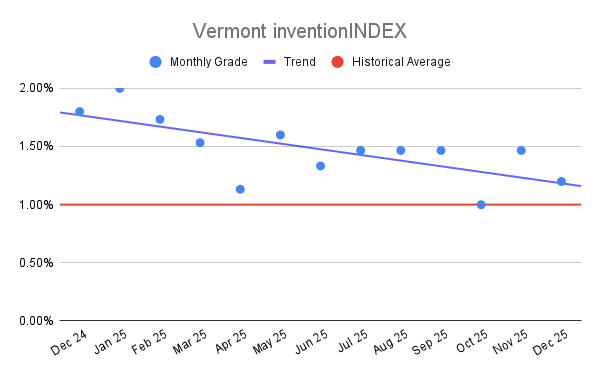 Vermont inventionINDEX December 2025:
  Vermont inventionINDEX November
