

The taxable year is defined as the calendar year or the fiscal year ending during that calendar year, serving as the mandated reporting period for which a tax is imposed or a return is filed. In the context of the Vermont Research and Development tax credit, this period establishes the temporal boundary for identifying qualified expenditures and synchronizing state-level incentives with the federal credit allowed under the Internal Revenue Code.
The concept of the taxable year in Vermont tax law acts as the foundational temporal anchor for the assessment of corporate and individual income tax liabilities and the subsequent application of various incentives, most notably the Research and Development (R&D) tax credit. Under 32 V.S.A. § 5811(16), the taxable year is not merely a bookkeeping convention but a statutory requirement that defines the scope of income earned, expenses incurred, and credits allowed. This definition becomes particularly nuanced when applied to the R&D credit authorized under 32 V.S.A. § 5930ii, as the credit is intrinsically linked to the federal tax credit allowed under 26 U.S.C. § 41(a) for the same period. The interplay between state and federal reporting periods necessitates a precise alignment of accounting methods and expenditure localization. Because Vermont adopts a “piggyback” approach to the R&D credit, the meaning of the taxable year extends beyond a simple calendar duration; it encompasses the specific tax characterization of that period as recognized by the Internal Revenue Service, including provisions for short taxable years resulting from mergers, acquisitions, or changes in accounting periods. Consequently, the “taxable year” serves as the mandatory window for the recomputation of hypothetical federal credits based solely on Vermont-sourced qualified research expenditures (QREs), thereby determining the final state-level tax benefit.
Statutory Architecture of the Taxable Year in Vermont
To understand the Vermont R&D tax credit, one must first dissect the legal definitions that govern the reporting intervals. The Vermont Statutes, under Title 32, Chapter 151, provide the definitive framework for how time is categorized for tax purposes.
The Legal Definition of Taxable Year
Under 32 V.S.A. § 5811(16), the “taxable year” is defined as the calendar year, or the fiscal year ending during the calendar year, with respect to which a tax is imposed under the state’s income tax chapter. This definition is inclusive of fractional parts of a year, which occurs when a return is filed for a period of less than twelve months. This inclusion of fractional years is critical for businesses that undergo structural changes, such as a “short taxable year” triggered by a change in ownership or a shift in the corporate fiscal cycle. For a corporation, the taxable year is the period for which it must report its Vermont net income, which is generally its federal taxable income with certain state-specific adjustments.
Corporate Income Tax Imposition and Rates
The imposition of tax is tied directly to these periods. Under 32 V.S.A. § 5832, a tax is imposed for each calendar year, or fiscal year ending during that calendar year, upon the income earned or received in that taxable year by every taxable corporation. The tax liability generated within this taxable year forms the base against which the R&D credit is applied. The marginal tax rates for corporations in Vermont follow a progressive structure, as detailed in the following table:
| Vermont Net Income of the Corporation | Base Tax | Plus Rate | Of Amount Over |
|---|---|---|---|
| $0 – $10,000.00 | $0 | 6.00% | $0 |
| $10,001.00 – $25,000.00 | $ 600.00 | 7.00% | $10,000.00 |
| $25,001.00 and over | $ 1,650.00 | 8.50% | $25,000.00 |
The “taxable year” also governs the application of minimum tax requirements. For every active corporation, a minimum annual tax is due regardless of net income, based on the volume of Vermont gross receipts during the taxable year.
| Vermont Gross Receipts | Minimum Tax |
|---|---|
| Less than $500,000 | $ 100 |
| $500,000 to $ 1,000,000 | $ 500 |
| $1,000,001 to $ 5,000,000 | $ 2,000 |
| $ 5,000,001 to $ 300,000,000 | $ 6,000 |
| Over $ 300,000,000 | $ 100,000 |
For the R&D tax credit, which is nonrefundable, the taxable year is the period in which the credit must first be applied to reduce the calculated tax down to, but not below, the minimum tax floor. Any credit remaining after reaching this floor must be carried forward to subsequent taxable years.
The Vermont Research and Development Tax Credit: Mechanism and Eligibility
Authorized under 32 V.S.A. § 5930ii, the Vermont Research and Development Tax Credit is designed to incentivize technological innovation within the state. The statute establishes a direct link between the state credit and the federal credit for increasing research activities.
Core Eligibility Criteria
A taxpayer is eligible for the Vermont credit if they are allowed a federal tax credit in the taxable year for eligible research and development expenditures under 26 U.S.C. § 41(a). This eligibility is contingent upon the expenditures being “made within this State.” This means that while the federal credit might encompass activities across the United States, the Vermont credit is strictly limited to the portion of research localized in Vermont.
The state defines qualified research activities (QRAs) and qualified research expenditures (QREs) by mirroring federal IRC § 41 standards. To qualify during the taxable year, an activity must pass the “four-part test”:
- It must be technological in nature, relying on hard sciences or engineering.
- It must be for a “permitted purpose,” such as developing a new or improved product, process, formula, or software.
- It must involve the “elimination of uncertainty” regarding the design, capability, or method of a business component.
- It must involve a “process of experimentation,” typically through trial and error, modeling, or simulation.
Credit Quantification and Calculation
The Vermont credit is equal to 27% of the “federal tax credit allowed in the taxable year” that is attributable to Vermont QREs. This percentage was previously 30% but was amended to 27% effective January 1, 2014.
Because Vermont does not calculate its own “base amount” for the credit, taxpayers must perform a hypothetical recomputation of their federal credit. This involves using federal Form 6765 but substituting Vermont-only figures for QREs and, if using the Regular method, Vermont-only gross receipts for the preceding four years. This recomputed federal credit amount is then multiplied by 0.27 to arrive at the Vermont credit.
| Calculation Component | Description |
|---|---|
| Total QREs | All federal-eligible research costs incurred in the taxable year. |
| Vermont QREs | Portion of total QREs incurred for activities performed in Vermont. |
| Hypothetical Federal Credit | The federal credit amount calculated using only Vermont QREs and base data. |
| Vermont Credit Amount | 27% of the Hypothetical Federal Credit. |
Revenue Office Guidance on Taxable Year Application
The Vermont Department of Taxes provides specific regulatory and form-based guidance on how the taxable year dictates the timing and claiming of the R&D credit.
Form BA-404: The Essential Credit Schedule
The primary vehicle for claiming and tracking the R&D credit across taxable years is Schedule BA-404, Tax Credits Earned, Applied, Expired, and Carried Forward. The form’s instructions clarify that the credit must be attached to the income tax return for the taxable year in which the credit is earned.
The taxable year serves as the reporting period for the following credit components on BA-404:
- Column A (Amount Carried Forward): Unused credits from the ten prior taxable years.
- Column B (Amount Earned): The 27% credit calculated for the current taxable year based on current Vermont QREs.
- Column C (Amount Applied): The portion of the credit used to offset the current taxable year’s income tax liability (limited to the amount over the minimum tax).
- Column D (Amount Carried Forward to Future Years): The mathematical result of (A + B) – C.
Localizing Expenditures to the Taxable Year
Revenue office guidance requires a strict “recomputation” for businesses with multi-state operations. If a taxpayer’s federal credit was earned based on expenditures both in and out of Vermont, they must provide a breakdown of the expenditure amounts for the taxable year and a recomputed credit calculation based only on the Vermont expenditures.
Furthermore, the basis for the credit calculation must be adjusted downward if the taxpayer received grants or assistance for financing the expenditures from any other public or private source during the taxable year. This ensures that the state is not subsidizing research that has already been funded by other government or institutional incentives.
Guidance for Pass-Through Entities
For partnerships, S-corporations, and LLCs, the credit is “earned” by the entity during its taxable year but is “claimed” by the individual shareholders, partners, or members. The credit flows through to these owners via Schedule K-1VT. Guidance indicates that the owners must claim their share of the credit on their personal Vermont income tax returns for the taxable year that includes the end of the pass-through entity’s taxable year.
Unitary and Combined Reporting: Temporal Complexities
Vermont’s requirement for “unitary” combined reporting introduces significant complexity regarding the taxable year and the R&D credit. A unitary business is one where affiliated corporations are engaged in an integrated, interdependent business.
The Separate Company Limitation
A critical distinction in Vermont’s unitary rules, found in 32 V.S.A. § 5862(d), is that while the income of the affiliated group is combined into a single return for the taxable year, tax credits are generally “separate company” in nature. The statute explicitly states that “a state tax credit shall not be combined and shall be limited to the member to which the credit is attributed.”
This means that during a given taxable year:
- The unitary group calculates its combined Vermont net income and the resulting total tax liability.
- The R&D credit earned by a specific affiliate (the “earning member”) can only offset the portion of the combined tax liability that is apportioned to that specific affiliate.
- If an affiliate generates more R&D credit in a taxable year than its own share of the group’s tax liability, the excess cannot be used by other members of the group and must instead be carried forward by the earning member.
This “separate entity” rule makes the definition of the taxable year and the legal entity structure paramount for strategic tax planning. Research activities must be carefully documented at the subsidiary level to ensure the credit is attributed correctly.
Combined Group Apportionment
The group must consolidate entries for all entities with activity in Vermont into a single Schedule BA-402 for the taxable year. The apportionment factor for each member is determined by using the separate company’s Vermont factors (payroll, property, sales) as the numerator and the entire group’s factors as the denominator. This fractional apportionment determines each member’s share of the combined tax, which in turn sets the limit for how much of that member’s R&D credit can be applied in the current taxable year.
Short Taxable Years and Accounting Method Changes
The “taxable year” is not always a twelve-month period. Short taxable years are common and have direct implications for the R&D credit.
Fractional Year Calculations
Under 32 V.S.A. § 5811(16), a taxable year includes a fractional part of a year for which a return is filed. Federal regulations, which Vermont follows, require that in a short taxable year, certain credit base amounts must be annualized to prevent artificial inflation or deflation of the credit.
For example, when using the Alternative Simplified Credit (ASC) method:
- If any of the three taxable years preceding the credit year was a short year, the QREs for that year must be “annualized” (multiplied by 365 and divided by the number of days in the short year).
- If the current credit year is a short year, the “average QREs” from the prior three years must be “short-year adjusted” (multiplied by the number of days in the short year and divided by 365).
Impact on Carryforward and Expiration
The Vermont R&D credit allows for a 10-year carryforward. Guidance suggests that each “taxable year” for which a return is filed counts as one of the ten years, regardless of whether that period was a full twelve months. Therefore, a business that files a short-period return due to a merger effectively consumes one year of its carryforward window in a shorter amount of time.
IRC Section 174 Conformity and the 2025 Transition
A significant recent development affecting the “taxable year” context of the R&D credit is the state’s conformity to federal IRC Section 174. This section governs the deduction or capitalization of research and experimental expenditures.
The Capitalization Era (2022-2024)
Following the Tax Cuts and Jobs Act (TCJA), businesses were required to capitalize and amortize R&D costs over five years (domestic) or fifteen years (foreign) for taxable years beginning after December 31, 2021. Because Vermont uses “static” conformity—adopting the IRC as of a specific date set by the legislature—it followed these federal changes. This meant that for the 2022, 2023, and 2024 taxable years, the “basis” of R&D activity in Vermont was subject to these amortization rules.
The OBBBA and 2025 Reform
On July 4, 2025, the “One Big Beautiful Bill Act” (OBBBA) was signed into law, introducing new Section 174A. For taxable years beginning after December 31, 2024, businesses can once again deduct domestic R&E expenditures immediately in the year they are incurred.
| Provision | TCJA (2022-2024) | OBBBA (2025+) |
|---|---|---|
| Domestic R&D | 5-Year Amortization | Immediate Expensing (or 60-month election) |
| Foreign R&D | 15-Year Amortization | 15-Year Amortization (Unchanged) |
| Software Dev | Must be Capitalized | Treated as R&E (Expensable) |
| Retroactive Option | N/A | Available for Qualified Small Businesses |
For Vermont taxpayers, the definition of the “taxable year” beginning in 2025 is critical. If the Vermont Legislature updates its static conformity date to include the OBBBA provisions, taxpayers will see a significant shift in their state taxable income and the “federal credit allowed” upon which the Vermont credit is based. If the state does not conform retroactively, taxpayers may have to manage different amortization schedules for federal and state purposes for the 2022-2024 “catch-up” period.
Documentation, Audits, and the Transparency List
Vermont’s administration of the R&D credit within the taxable year includes unique transparency and compliance requirements.
The Annual Publication Requirement
Under 32 V.S.A. § 5930ii(c), the Department of Taxes is required to publish a list each year containing the names of the taxpayers who claimed the R&D credit during the “most recent completed calendar year.” This transparency list is usually published by January 15th. This means that a business claiming a credit for the 2024 taxable year will have its name publicly associated with the incentive in early 2025.
Statute of Limitations and Record Retention
Revenue guidance suggests that documentation for the R&D credit should be retained for at least as long as federal rules require, typically 3 to 7 years. However, because the credit has a 10-year carryforward, and because an audit of the earning year can occur when the credit is applied many years later, taxpayers are advised to keep R&D records for at least twelve years (the 10-year carryforward plus the 2-year statute of limitations for the final carryforward year).
Audit focus areas for a given taxable year include:
- Proration Accuracy: Verifying that the payroll and supplies were actually located in Vermont.
- Consistency: Ensuring the same calculation method (Regular vs. ASC) was used for both the federal and state returns.
- Eligibility: Verifying that the activities meet the federal four-part test for the period in question.
A Detailed Look at the Taxable Year in Action
To demonstrate how the taxable year and revenue office guidance apply in practice, consider the hypothetical case of Northeast Aerospace Solutions (NAS), a Vermont-based manufacturer.
Scenario: Fiscal Year Shift and Multi-State QREs
NAS historically operated on a fiscal year ending September 30. In 2024, NAS was acquired and changed its taxable year to a calendar year-end. This resulted in a short taxable year from October 1, 2024, to December 31, 2024 (92 days).
Data for the Short Taxable Year (Oct-Dec 2024):
- Total Federal QREs: $500,000
- Vermont-Only QREs: $300,000 (60% of total)
- Federal Credit Method: Alternative Simplified Credit (ASC)
- Prior 3-Year Average VT QREs: $1,000,000 (based on full 12-month years)
- Vermont Tax Liability (before credit): $15,000
- Vermont Gross Receipts (for minimum tax): $800,000 (Minimum tax = $500)
Step 1: Short-Year Adjustment of the Base Amount
Because the current credit year is a short taxable year, NAS must adjust its prior-year average QREs according to federal consistency rules:
- Adjusted Base: $1,000,000 * (92 / 365) = $252,055
- 50% of Adjusted Base: $126,027
Step 2: Recompute the Hypothetical Federal Credit for Vermont
NAS calculates the hypothetical federal credit using only the $300,000 in Vermont QREs for the short period:
- Excess Vermont QREs: $300,000 – $126,027 = $173,973
- Hypothetical Federal Credit: $173,973 * 14% = $24,356
Step 3: Calculate the Vermont R&D Credit
- Vermont R&D Credit: $24,356 * 27% = $6,576
Step 4: Apply the Credit to the Taxable Year
NAS applies the credit to its tax liability, ensuring it does not drop below the minimum tax floor:
- Tax Liability: $15,000
- Minimum Tax Floor: $ 500
- Maximum Credit Utilizable: $15,000 – $500 = $14,500
- Credit Applied in 2024: $ 6,576 (Full amount)
- Net Tax Due: $ 8,424
- Carryforward to 2025: $ 0
Step 5: Compliance and Transparency
- Form BA-404: NAS reports the $6,576 earned and $6,576 applied.
- Documentation: NAS retains payroll records for the 92-day period showing its engineers worked in the Burlington facility.
- Transparency: The Department of Taxes will include “Northeast Aerospace Solutions” on the list of claimants published in January 2026.
Nuanced Insights: The Economic Ripple Effects of the Taxable Year
The definition and application of the “taxable year” for the Vermont R&D credit create several second-order consequences for the state’s fiscal policy and business environment.
The “Cliff” Effect of Short Taxable Years
Because each “taxable year”—no matter how short—counts as one of the ten carryforward years, corporations engaging in frequent mergers and acquisitions may find their R&D credits expiring faster than anticipated. A company that undergoes three ownership changes in five years might file eight different returns (three full years and five short periods), potentially losing three years of credit utility simply due to calendar math rather than economic performance.
Strategic Entity Localization
The “separate company” rule in unitary filing forces large technology firms to be strategic about where they “locate” their R&D talent during the taxable year. To maximize the current-year value of the 27% credit, it is often beneficial to ensure that the subsidiary employing the researchers also generates significant Vermont-apportioned revenue. If the research is performed in a subsidiary with zero sales, the credit will be trapped in a carryforward state for that subsidiary, even if the parent corporation is paying millions in Vermont tax.
The Future of Conformity (2025 and Beyond)
The move from TCJA amortization to OBBBA expensing in 2025 represents a major turning point. Businesses that were discouraged by the 5-year capitalization requirement may re-engage in Vermont-based R&D starting in the 2025 taxable year. However, the state’s “static” conformity model means that the Vermont Legislature must act each spring to confirm it will follow the new federal rules. This creates a “lag” in certainty that businesses must account for when budgeting their research activities for the first half of the taxable year.
Final Thoughts
The “taxable year” is the primary temporal lens through which the Vermont Research and Development tax credit is viewed, calculated, and regulated. From its statutory definition in 32 V.S.A. § 5811(16) to its role in the complex recomputation requirements of Form BA-404, the taxable year dictates the eligibility of expenditures and the timing of tax benefits. The state’s 27% credit offers a robust incentive for innovation, but its nonrefundable nature and the “separate company” limitations of unitary filing demand precise period-based accounting and strategic corporate structuring. As Vermont navigates the transition into the OBBBA expensing era in 2025, the taxable year will remain the critical synchronization point between federal law and state tax policy. For the professional taxpayer, a nuanced understanding of these temporal dynamics is not just a matter of compliance—it is an essential component of maximizing the long-term value of Vermont’s commitment to technological advancement.


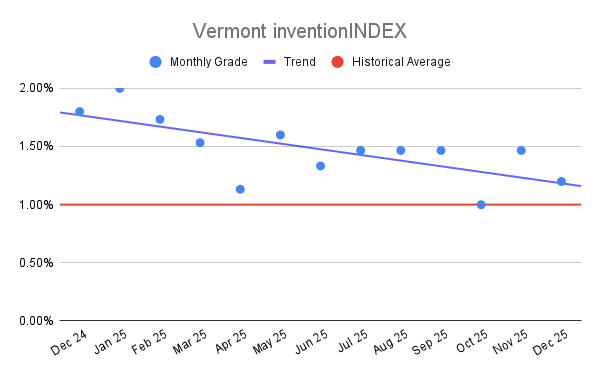 Vermont inventionINDEX December 2025:
  Vermont inventionINDEX November
