

Quick Answer: What is a “Taxpayer of This State” for Vermont R&D Credits?
A taxpayer of this state is defined as any individual, estate, trust, or business entity legally obligated to file a tax return or remit payments to the Vermont Department of Taxes due to residency, incorporation, or the generation of Vermont-source income. For the specific purpose of the Vermont Research and Development tax credit, this designation establishes the jurisdictional boundary for eligibility, ensuring that only entities with a verifiable tax nexus to Vermont may claim the incentive. The credit is strictly limited to Qualified Research Expenditures (QREs) incurred physically within the state’s borders, often requiring a hypothetical federal credit recomputation.
The Fundamental Taxonomy of Taxpayer Status in Vermont
The primary definition of a “taxpayer” in the state of Vermont is established under 32 V.S.A. § 5811(17), which identifies a taxpayer as any person obligated to file a return with or pay or remit any amount to the State under Chapter 151. This definition is intentionally expansive, designed to capture the full spectrum of legal entities that interact with the state’s fiscal apparatus. The term “person,” as utilized in this context, is further clarified by 32 V.S.A. § 5811(20) to include individuals, firms, partnerships, associations, joint stock companies, corporations, trusts, estates, or any other legal entity. When the phrase is augmented to “taxpayer of this state,” it implies a higher degree of connectivity, specifically emphasizing those who are subject to the primary taxing jurisdiction of Vermont through residency, domicile, or significant commercial presence.
The legal architecture distinguishing a “taxpayer of this state” from a transient or nonresident taxpayer is critical for the administration of credits like the Research and Development (R&D) incentive. For individuals, the threshold for becoming a taxpayer of this state is governed by residency rules outlined in 32 V.S.A. § 5811(11). An individual qualifies for residency—and thus becomes a resident taxpayer—if they are domiciled in Vermont or if they maintain a permanent place of abode and are present in the state for an aggregate of more than 183 days during the taxable year. This distinction is vital because resident individuals are generally taxed on their entire income, whereas nonresidents are taxed only on income derived from Vermont sources.
| Entity Category | Statutory Basis | Residency/Nexus Criteria |
|---|---|---|
| Resident Individual | 32 V.S.A. § 5811(11)(A) | Domicile or 183-day presence with permanent abode. |
| Taxable Corporation | 32 V.S.A. § 5811(15) | Incorporated in VT, authorized to do business, or receiving VT-allocated income. |
| Resident Trust | 32 V.S.A. § 5811(11)(B) | Property from VT decedent or VT-domiciled grantor. |
| Resident Estate | 32 V.S.A. § 5811(12) | Estate of a decedent domiciled in VT at the time of death. |
| Pass-Through Entity | 32 V.S.A. § 5866a(17) | S-Corps, Partnerships, and LLCs engaged in VT activities. |
In the corporate sector, the designation “taxpayer of this state” applies to any “taxable corporation” as defined by 32 V.S.A. § 5811(15). This includes entities incorporated under Vermont law, those possessing a certificate of authority to do business in the state, or those receiving income allocable or apportionable to Vermont under § 5833. The administrative reality is that any corporation filing Form CO-411, Corporate Income Tax Return, is functioning as a taxpayer of this state. Furthermore, for pass-through entities such as S-corporations and partnerships, the entity itself may only pay a $250 minimum tax, but it is the individual shareholders or partners who ultimately fulfill the role of the “taxpayer” when they report their distributive share of Vermont income and claim the associated R&D credits.
Statutory Context of the Research and Development Tax Credit
The Research and Development tax credit, codified at 32 V.S.A. § 5930ii, is a nonrefundable incentive designed to stimulate innovation within the state. The statute explicitly provides that “a taxpayer of this State shall be eligible for a credit against the tax imposed under this chapter.” This phrasing is deliberate; it links the credit directly to the income tax liabilities defined in Chapter 151, which includes personal income tax (§ 5822) and corporate income tax (§ 5832).
The 27 Percent Credit Rate and Apportionment
The value of the Vermont R&D credit is mathematically tied to the federal tax credit allowed under 26 U.S.C. § 41(a). For tax years beginning on or after January 1, 2014, the credit is equal to 27 percent of the amount of the federal tax credit attributable to qualified research expenditures (QREs) made within Vermont. This was a reduction from the previous rate of 30 percent, reflecting legislative adjustments to the state’s tax expenditure budget.
Because the credit is calculated as a percentage of the federal credit, the taxpayer must first be eligible for and claim the federal R&D credit to qualify for the Vermont counterpart. However, the state credit is strictly limited to research conducted physically within the geographic boundaries of Vermont. If a company performs research across multiple states, the federal credit must be “recomputed” or “apportioned” to isolate the Vermont-specific activities. This recomputation is not a simple division of the final federal credit amount; it requires a hypothetical federal calculation as if only the Vermont expenses were part of the claim.
Carryforward and Nonrefundability
The Vermont R&D credit is nonrefundable, meaning it cannot be used to generate a cash payment from the state if the credit amount exceeds the taxpayer’s liability. Instead, unused portions of the credit may be carried forward for up to 10 years. This 10-year window provides significant long-term value, allowing growing technology firms to accumulate credits during their research-heavy startup phase and apply them once they achieve consistent profitability and taxable income.
| Credit Element | Parameter | Legal Reference |
|---|---|---|
| Credit Percentage | 27% of Federal R&D Credit | 32 V.S.A. § 5930ii(a) |
| Carryforward Period | 10 Years | 32 V.S.A. § 5930ii(b) |
| Refundability | Nonrefundable | Standard for Business Credits |
| Expenditure Scope | Strictly within Vermont (QREs) | 32 V.S.A. § 5930ii(a) |
| Disclosure | Public List of Claimants | 32 V.S.A. § 5930ii(c) |
Procedural Guidance from the Local State Revenue Office
The Vermont Department of Taxes provides operational guidance through specific forms and instructions that implement the statutory requirements of § 5930ii. The central document for claiming this incentive is Schedule BA-404, “Tax Credits Earned, Applied, Expired, and Carried Forward.” This form acts as the master ledger for all business-related tax credits in Vermont.
Filing Requirements and Documentation
Guidance from the revenue office explicitly states that any taxpayer claiming the R&D credit must include a copy of their federal Form 6765, “Credit for Increasing Research Activities.” If the research was performed both in and out of state, the taxpayer must provide a detailed breakdown of expenditure amounts and the resulting recomputed credit calculation based only on Vermont-sourced QREs.
Furthermore, the Department of Taxes requires an adjustment if the taxpayer received grants or other financing assistance for the research. The basis expenditure amount for the Vermont credit calculation must be adjusted downward to account for any such public or private assistance, preventing the state from subsidizing research that has already been funded through other external mechanisms.
The BA-406 Credit Allocation Schedule
For pass-through entities like partnerships and LLCs, the entity calculates the total credit but cannot use it. Instead, the entity must report the allocation of credits earned using Schedule BA-406, “Credit Allocation Schedule.” This schedule documents the distribution of the R&D credit to each individual owner, shareholder, or member in proportion to their distributive share of the entity’s income or loss. This ensures that the Department of Taxes can trace the credit from the business conducting the research to the specific “taxpayer of this state” who ultimately applies the credit to their personal or corporate return.
Detailed Analysis of “Qualified Research Expenditures” (QREs)
To remain a valid claimant, a taxpayer of this state must ensure that their expenditures align with the definitions provided in IRC § 41(b). These expenditures typically fall into four distinct categories: wages, supplies, contract research, and computer rental/lease costs.
Vermont-Source Wages
Wages are often the largest component of an R&D credit claim. For the Vermont credit, only wages paid to employees directly involved in the performance, supervision, or direct support of qualified research within Vermont are eligible. The revenue office guidance emphasizes that if an employee splits their time between Vermont and another state, only the portion of their wages corresponding to time spent physically working on research in Vermont may be included in the recomputed credit base.
Supplies and Materials
Supplies include any tangible property—excluding land and depreciable property—that is consumed or used in the research process within Vermont. Examples include laboratory materials, chemicals, and prototypes. Guidance from the Department indicates that the physical location where the supply is consumed determines its eligibility for the Vermont credit, regardless of where the supply was purchased.
Contract Research Expenses
Payments to third-party contractors for research performed on behalf of the taxpayer are also eligible, subject to federal limitations. Generally, only 65 percent of the amount paid for contract research can be included in the QRE total. This increases to 75 percent for payments made to qualified research consortia. For the Vermont credit, the taxpayer must demonstrate that the contractor performed the research work within Vermont’s borders.
Cloud Computing and Computer Leases
Guidance related to the modern digital economy clarified that costs for computers or equipment leased exclusively for research activities—such as server time or specialized high-performance computing resources—can be included if the equipment is physically in Vermont or, in some cases, if the web hosting service is a computer service provider in this state as defined by § 5811.
The “Within This State” Mandate and Hypothetical Federal Recomputation
The core differentiator of the Vermont R&D credit is the requirement to calculate a “hypothetical federal credit.” This process ensures that the 27 percent state rate is applied only to the value of the federal incentive generated by Vermont-based efforts.
Step 1: Isolation of Vermont QREs
The taxpayer must audit their total nationwide QREs and extract only those dollars associated with Vermont labor, materials, and contractors. This requires a granular level of internal accounting, often necessitating project-based time tracking for employees and detailed shipping/consumption records for supplies.
Step 2: Identification of Vermont Base Receipts
Under the Regular Credit method, the credit is based on the current year’s QREs that exceed a “base amount.” To calculate the Vermont-only base amount, the taxpayer must identify Vermont-sourced gross receipts for the prior four tax years. If the business is a startup or lacks prior Vermont history, it must follow federal startup rules applied to its initial Vermont data.
Step 3: Application of the 50 Percent Rule
Federal law requires that the base amount be at least 50 percent of the current year’s QREs. Vermont adopts this standard for its hypothetical calculation. Therefore, even if a company’s historical Vermont research was zero, its hypothetical federal base for the Vermont calculation will be at least half of its current-year Vermont QREs.
Step 4: The ASC Alternative
Taxpayers may also use the Alternative Simplified Credit (ASC) method for their Vermont calculation if they use it on their federal return. This involves taking 14 percent of the current year’s Vermont QREs that exceed 50 percent of the average Vermont QREs for the three preceding years.
Pass-Through Entity Treatment and Nonresident Shareholders
The designation “taxpayer of this state” becomes particularly nuanced when applied to pass-through entities. Vermont’s tax code treats S-corporations, partnerships, and LLCs as conduits; the income and credits are attributed to the individual owners.
Filing Obligations for Entities
Every business entity engaged in activities in Vermont must file a return with the Commissioner of Taxes.
- Form BI-471: The standard Business Income Tax Return for pass-through entities.
- Form BI-476: A simplified return for entities owned exclusively by Vermont residents with income derived only from Vermont.
- Form WH-435: Estimated tax payments made by the entity on behalf of nonresident owners for income attributable to Vermont.
Rights of Nonresident Partners
Nonresident individuals who are partners or shareholders in a Vermont-based pass-through entity are considered “taxpayers of this state” regarding the income they receive from that entity. Consequently, they are entitled to their pro rata share of any R&D credits earned by the business. These credits are reported to them on Schedule K-1VT and are then used to offset the Vermont personal income tax they owe on their distributive share of the entity’s profits.
If an entity has more than 50 nonresident owners, it must file a composite return and pay the tax at the entity level on behalf of those owners. In this scenario, the R&D credits are applied directly to the composite return to reduce the total liability remitted by the entity.
Judicial Interpretations and Administrative Doctrines
The Vermont Supreme Court has provided a foundational framework for interpreting credit-related statutes, often balancing the need for business incentives against the mandate for fiscal responsibility.
The Principle of Strict Construction
The consistent judicial doctrine in Vermont is that tax credits and exemptions are to be strictly construed against the taxpayer. In David M. Stephens and Mary L. Stephens v. Vermont Department of Taxes (1976), the court emphasized that because tax credits reduce the revenue available for public purposes, the taxpayer bears the burden of proving that they meet every statutory requirement. For R&D claimants, this means any ambiguity in whether an expenditure was “made within this state” will likely be resolved in favor of the Department of Taxes during an audit.
Reasonable Interpretation and Statutory Purpose
While construction is strict, it must also be “reasonable and not such as would defeat the purposes of the statute,” as noted in Stephens and reaffirmed in later rulings. The statutory purpose of the R&D credit, per 32 V.S.A. § 5813(p), is to “encourage business investment in research and development within Vermont and to attract and retain intellectual-property-based companies.” This purpose statement acts as an interpretative guide for the Department, supporting the allowance of credits for innovative firms that can demonstrate real presence and activity in the state.
S-Corporation Parity
The case Tarrant v. Department of Taxes (1999) was seminal in establishing the pass-through nature of credits. The court held that individual shareholders were entitled to credits for their pro rata share of taxes paid by their S-corporation, even when the underlying credit statute was not explicitly detailed regarding pass-through mechanics at the time. This precedent ensures that a “taxpayer of this state” includes the owners of modern business structures, not just traditional C-corporations.
Detailed Procedural Guidelines for Schedule BA-404
Claiming the R&D credit requires precise completion of Schedule BA-404, which serves as the formal reporting vehicle.
- Line Identification: The R&D credit is specifically listed on the schedule. For each year, the taxpayer must track the credit across four columns.
- Column A (Carryforward from Prior Years): This column tracks unused credits from previous tax periods that are still within their 10-year validity window.
- Column B (Amount Earned Current Year): This is where the results of the hypothetical federal credit recomputation (at the 27% rate) are entered.
- Column C (Amount Applied Current Year): The taxpayer enters the amount of the credit actually being used to reduce the current year’s liability. Note that business credits generally cannot reduce a taxpayer’s liability below zero or, in some cases, are capped as a percentage of the total tax attributable to the income generated by the entity.
- Column D (Amount Carried Forward to Future Years): Calculated as (Column A + Column B) – Column C. This amount must be verified each year to ensure it does not include credits that have exceeded the 10-year carryforward limit.
Unitary Business Filing Instructions
For taxpayers that are members of an affiliated group engaged in a unitary business, additional complexities arise. Guidance for Form CO-411 indicates that if multiple entities within a unitary group are reporting credits, they should attach a single Schedule BA-404 for the entire group. This single schedule must combine all credit amounts, but it must be accompanied by a statement that clearly breaks down the totals by individual entity. This allows the revenue office to monitor which specific entities are conducting research in Vermont versus which entities are merely members of the group receiving the tax benefit.
Comparison with Regional Innovation Incentives
Vermont’s R&D credit is often viewed as one of the most attractive in the Northeast due to its high prorated rate and generous carryforward. While other states may use a direct percentage of expenditures, Vermont’s link to the federal credit simplifies the audit process for businesses with sophisticated federal R&D documentation.
| State | Incentive Mechanism | Prorated Share of Fed Credit? | Carryforward Limit |
|---|---|---|---|
| Vermont | 27% of Federal R&D Credit | Yes | 10 Years |
| New Hampshire | 10% of excess QREs over base | No | 5 Years |
| Connecticut | Tiered (1% to 6%) of QREs | No | 15 Years |
| Delaware | 10% of excess QREs | No | Indefinite |
| Massachusetts | 10% of incremental QREs | No | 15 Years |
The transparency requirement in Vermont, which involves the publication of a list containing the names of all credit recipients, is a unique feature not found in every regional neighbor. This data, published annually by January 15, serves as a public audit of the state’s investment in its intellectual property-based economy.
Economic Policy and the Future of Innovation in Vermont
The Vermont General Assembly has positioned the R&D credit as a primary tool for economic resilience. By specifically targeting intellectual-property-based companies, the state seeks to foster a high-wage workforce that is less susceptible to traditional manufacturing cycles.
Interaction with the $250 Minimum Tax
Every “taxpayer of this state” structured as a corporation or pass-through entity is generally subject to a $250 minimum tax for the privilege of doing business in Vermont. While the R&D credit can reduce a corporation’s liability derived from its net income, it usually cannot be used to reduce the tax below this $250 floor. This ensures that even the most R&D-intensive firms provide a baseline contribution to the state’s general fund.
Synergy with VEGI and VTP
Taxpayers of this state often leverage the R&D credit in conjunction with the Vermont Employment Growth Incentive (VEGI) and the Vermont Training Program (VTP).
- VEGI: A performance-based cash incentive for firms that meet specific job creation and payroll targets. A company conducting research in Vermont can qualify for VEGI based on the new engineers it hires, while simultaneously claiming the R&D credit for the innovation work those engineers perform.
- VTP: Provides grants for training newly hired workers or upgrading the skills of existing staff. This program offsets the human capital costs of starting an R&D project, while the tax credit offsets the operational costs.
The Challenge of Remote Work
The definition of a “taxpayer of this state” and the “within this state” requirement for expenditures are facing new tests in the era of remote and hybrid work. If a Vermont-based company employs developers who work from home in other states, those wages are ineligible for the state R&D credit. Conversely, if an out-of-state company hires remote workers residing in Vermont who perform R&D from their Vermont homes, those wages may become eligible if the company establishes a Vermont tax nexus and files as a taxpayer of this state.
Illustrative Example: Calculation for a Multi-State Technology Firm
To demonstrate the application of revenue office guidance and the recomputation process, we analyze a hypothetical scenario involving “InnovateVT Inc.,” a C-corporation headquartered in Winooski, Vermont, with a secondary research lab in New York.
Baseline Data (Tax Year 2024)
InnovateVT Inc. is a taxpayer of this state and files Form CO-411. For 2024, the firm’s total qualified research expenditures and federal gross receipts were as follows:
| Expenditure/Receipt Category | Total Nationwide | Vermont Portion Only |
|---|---|---|
| Current Year QREs (2024) | $2,000,000 | $1,200,000 |
| Avg. Gross Receipts (Prior 4 Years) | $10,000,000 | $6,000,000 |
| Fixed-Base Percentage (Calculated) | 5% | 5% |
| Federal R&D Credit Earned | $200,000 | N/A |
Step 1: Hypothetical Federal Recomputation
Per BA-404 instructions, the firm cannot simply take 27% of the $200,000 federal credit. It must recompute the federal credit using only the Vermont figures.
- Vermont Base Amount Calculation: Formula: (Fixed-Base %) x (Average Vermont Gross Receipts). Calculation: 0.05 x $6,000,000 = $300,000.
- Verification of the 50% Rule: Federal law (and Vermont) requires the base to be at least 50% of current QREs. 50% of $1,200,000 = $600,000. Since $600,000 is greater than $300,000, the recomputed base amount is $600,000.
- Hypothetical Incremental QREs: Current VT QREs ($1,200,000) – VT Base ($600,000) = $600,000.
- Hypothetical Federal Credit: 600,000 x 20% (federal rate) = $120,000.
Step 2: Application of the Vermont Credit Rate
The final state credit is determined by applying the 27 percent rate to the hypothetical federal amount.
- $120,000 x 0.27 = $32,400.
Step 3: Reporting on Schedule BA-404
The firm enters the following data on its Vermont tax return:
- Federal Form 6765 Attachment: Shows the total $200,000 credit.
- Schedule BA-404, Column B: Reports $32,400 as the current year earned amount.
- Form CO-411, Line 30: If the firm’s state liability is $40,000, it applies the full $32,400 to reduce its payment to $7,600 (plus any minimum tax obligations).
Interaction with Federal Tax Reform (Section 174 Amortization)
A significant recent development for R&D taxpayers is the federal change under the Tax Cuts and Jobs Act (TCJA) regarding the amortization of research expenditures. Starting in 2022, businesses can no longer immediately deduct QREs from their taxable income; instead, they must amortize these costs over five years for domestic research and fifteen years for foreign research.
Because Vermont generally conforms to federal tax laws (adoption of IRC), this change impacts the starting point for calculating Vermont taxable income. While this does not directly alter the credit calculation under § 5930ii (which remains tied to § 41), it fundamentally changes the cash-flow profile of a “taxpayer of this state.” The state revenue office has clarified that while Section 174 requires amortization for deductions, the R&D tax credit remains a powerful tool to provide a dollar-for-dollar offset against the resulting increased tax burden.
Transparency and Public Oversight Mechanisms
The Vermont Department of Taxes maintains a rigorous reporting standard for the R&D credit to ensure that it remains an effective economic development tool.
Annual Disclosure Mandate
Pursuant to 32 V.S.A. § 5930ii(c), the Commissioner of Taxes must publish a report containing the names of all taxpayers who claimed the credit in the previous calendar year. These reports, such as RP-1298, are typically released every January. This level of disclosure is designed to provide the legislature and the public with clear data on which industries and specific firms are benefiting from the state’s innovation incentives.
Audit Focus Areas
Revenue office guidance suggests that state audits focus heavily on the accuracy of proration between Vermont and out-of-state activities. Key audit targets include:
- Time Tracking: Verification that employees claimed as Vermont-based were physically present in the state during the performance of research.
- Consistency: Ensuring that the ASC or Regular method choice matches the federal filing.
- Grant Deduction: Confirming that the basis of the credit was reduced by any external grants or public financing received for the same projects.
Impact on Vermont’s Competitive Advantage
Vermont’s R&D credit plays a pivotal role in the state’s strategy to attract high-tech and “green” manufacturing sectors. By offering a 27 percent rate, the state effectively reinvests a significant portion of the federal innovation incentive back into the local economy. For businesses with high-paid technical staff, the credit serves as a wage subsidy that encourages the retention of specialized talent within the state.
Furthermore, the indefinitely open nature of the credit—unlike some other state programs that face periodic sunsets or require re-authorization—provides a stable fiscal environment for long-term project planning. When combined with the 10-year carryforward, the Vermont R&D credit creates a powerful incentive for intellectual property development that can sustain companies through multiple years of pre-profitability.
Synthesis of Definitional and Practical Entitlement
Ultimately, the designation “taxpayer of this state” is a functional gateway. It ensures that the fiscal benefits of § 5930ii are reserved for those who are meaningfully integrated into Vermont’s economic and regulatory environment. Whether through residency for individuals or commercial domicile and nexus for corporations, the claimant must demonstrate that they are part of the state’s tax base before they can seek the rewards of its innovation policy.
The interaction of federal standards (IRC § 41), state-specific recomputation (BA-404 instructions), and judicial strict construction creates a rigorous but rewarding framework for innovation. Taxpayers who navigate this system effectively can significantly reduce their state income tax burden, thereby freeing up capital for further investment in the research, development, and high-tech employment that drive Vermont’s 21st-century economy.
Final Thoughts
The meaning of “taxpayer of this state” in the context of the Vermont R&D tax credit is a complex intersection of residency law, nexus guidelines, and federal tax conformity. By anchoring the credit to a recomputed version of the federal IRC § 41 incentive, Vermont has created a high-value, nonrefundable tool that encourages local high-tech activity while maintaining rigorous standards for documentation and public transparency. For the eligible claimant, the credit represents a 27 percent reinvestment of their federal innovation efforts back into their Vermont-based projects. As the state continues to refine its definitions of residency and business nexus in response to shifting economic patterns, the R&D credit remains a cornerstone of the statutory effort to attract and retain intellectual-property-intensive businesses. Adherence to the revenue office’s guidance on Schedule BA-404 and meticulous attention to the “within this state” mandate are essential for any taxpayer seeking to leverage this significant fiscal incentive.
Who We Are:
Swanson Reed is one of the largest Specialist R&D Tax Credit advisory firm in the United States. With offices nationwide, we are one of the only firms globally to exclusively provide R&D Tax Credit consulting services to our clients. We have been exclusively providing R&D Tax Credit claim preparation and audit compliance solutions for over 30 years. Swanson Reed hosts daily free webinars and provides free IRS CE and CPE credits for CPAs.
Are you eligible?

Why choose us?

Pass an Audit?

What is the R&D Tax Credit?
The Research & Experimentation Tax Credit (or R&D Tax Credit), is a general business tax credit under Internal Revenue Code section 41 for companies that incur research and development (R&D) costs in the United States. The credits are a tax incentive for performing qualified research in the United States, resulting in a credit to a tax return. For the first three years of R&D claims, 6% of the total qualified research expenses (QRE) form the gross credit. In the 4th year of claims and beyond, a base amount is calculated, and an adjusted expense line is multiplied times 14%. Click here to learn more.
Never miss a deadline again

Stay up to date on IRS processes

Discover R&D in your industry

R&D Tax Credit Preparation Services
Swanson Reed is one of the only companies in the United States to exclusively focus on R&D tax credit preparation. Swanson Reed provides state and federal R&D tax credit preparation and audit services to all 50 states.
If you have any questions or need further assistance, please call or email our CEO, Damian Smyth on (800) 986-4725.
Feel free to book a quick teleconference with one of our national R&D tax credit specialists at a time that is convenient for you.
R&D Tax Credit Audit Advisory Services
creditARMOR is a sophisticated R&D tax credit insurance and AI-driven risk management platform. It mitigates audit exposure by covering defense expenses, including CPA, tax attorney, and specialist consultant fees—delivering robust, compliant support for R&D credit claims. Click here for more information about R&D tax credit management and implementation.
Our Fees
Swanson Reed offers R&D tax credit preparation and audit services at our hourly rates of between $195 – $395 per hour. We are also able offer fixed fees and success fees in special circumstances. Learn more at https://www.swansonreed.com/about-us/research-tax-credit-consulting/our-fees/



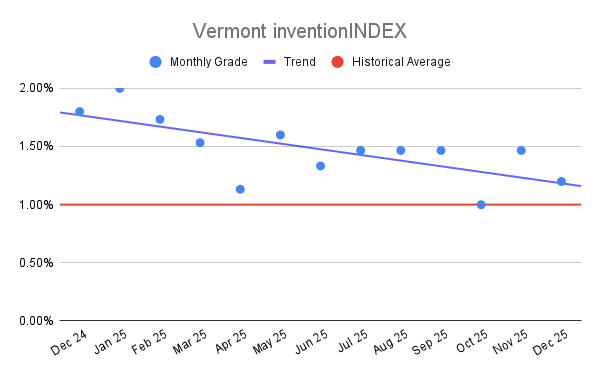 Vermont inventionINDEX December 2025:
  Vermont inventionINDEX November
