

[cite_start]
In Vermont, Wages for Qualified Services are taxable compensation paid to employees for direct conduct, supervision, or support of scientific research physically performed within Vermont[cite: 3]. [cite_start]These expenditures must align with federal IRC § 41 definitions and satisfy a strict geographic nexus to generate a 27 percent state tax credit[cite: 3].
[cite_start]
Wages for Qualified Services represent the taxable compensation paid to employees for direct involvement in, supervision of, or support for scientific research physically conducted within the borders of Vermont[cite: 3]. Under 32 V.S.A. [cite_start]§ 5930ii, these expenditures must align with federal definitions while satisfying a strict geographic nexus to generate a 27 percent state tax credit[cite: 3].
[cite_start]
The Vermont Research and Development (R&D) tax credit is a critical component of the state’s fiscal strategy to foster innovation, attract high-technology enterprises, and retain intellectual-property-based talent[cite: 3]. [cite_start]At its core, the credit is an expense-driven incentive, meaning its value is derived directly from the amount of money a business invests in qualifying activities[cite: 3]. [cite_start]Of the various categories of Qualified Research Expenditures (QREs), “Wages for Qualified Services” typically represents the largest and most scrutinized component[cite: 3]. [cite_start]This report provides an exhaustive examination of how Vermont defines, regulates, and audits these wage-based expenditures, drawing on the intersection of the Internal Revenue Code (IRC), Vermont Statutory Law, and administrative guidance from the Vermont Department of Taxes[cite: 3].
Statutory Foundation and the Mechanics of Conformity
The legal authority for the Vermont R&D tax credit resides in 32 V.S.A. [cite_start]§ 5930ii, which establishes a nonrefundable credit against personal income tax or business and corporate income tax[cite: 3]. [cite_start]The statute is intentionally brief, as it relies on “piggybacking” or conformity with the federal research credit guidelines established under IRC § 41[cite: 3].
Under Vermont law, the credit is calculated as 27% of the amount of the federal tax credit allowed in the taxable year for research and development expenditures defined under 26 U.S.C. [cite_start]§ 41(a)[cite: 3]. [cite_start]However, a vital distinction exists: the credit only applies to expenditures “made within this State”[cite: 3]. [cite_start]This requires a dual-track analytical process[cite: 3]. [cite_start]First, the taxpayer must determine if the activities and associated wages meet the rigorous federal standards for qualified research[cite: 3]. [cite_start]Second, the taxpayer must isolate the portion of those wages paid for services physically performed within Vermont’s borders[cite: 3].
The statutory purpose, as outlined in 32 V.S.A. [cite_start]§ 5813(p), is “to encourage business investment in research and development within Vermont and to attract and retain intellectual-property-based companies”[cite: 3]. [cite_start]This purpose informs how the Vermont Department of Taxes interprets “qualified services” and the evidentiary standards required to prove that labor occurred in-state[cite: 3].
The Federal Definition of Wages and Qualified Services
[cite_start]
Because Vermont leverages the federal definitions, any analysis of Vermont “Wages for Qualified Services” must begin with IRC § 41(b)[cite: 3]. [cite_start]The federal statute defines “in-house research expenses” to include “any wages paid or incurred to an employee for qualified services performed by such employee”[cite: 3].
[cite_start]
For the purposes of this credit, “wages” is defined under IRC § 3401(a), which generally encompasses all remuneration for services performed by an employee for an employer, including the cash value of all remuneration (including benefits) paid in any medium other than cash[cite: 3]. [cite_start]In practice, this aligns with the amounts reported in Box 1 of the employee’s Form W-2[cite: 3].
| Component of Compensation | Eligibility for R&D Credit | Statutory/Regulatory Basis |
|---|---|---|
| Base Salary / Hourly Wages | Eligible | IRC § 3401(a); § 41(b)(2)(D) |
| Cash Bonuses | Eligible | IRC § 3401(a); Included in W-2 Box 1 |
| Stock Option Exercises (NQSOs) | Eligible (subject to grant-year activity) | Sun Microsystems v. Commissioner; § 3401(a) |
| Vacation / Sick / Holiday Pay | Eligible (as part of taxable wages) | IRC § 41(b)(2)(D) |
| Employer 401(k) Match | Ineligible | Not subject to withholding under § 3401(a) |
| Health Insurance Premiums | Ineligible | Non-taxable fringe benefit |
| Work Opportunity Tax Credit Wages | Ineligible | Explicitly excluded by IRC § 41(b)(2)(D)(iii) |
[cite_start]
Qualified services are further categorized into three specific roles: direct conduct, direct supervision, or direct support of research activities[cite: 3].
[cite_start]
Direct Conduct: This refers to the actual performance of the research[cite: 3]. [cite_start]It involves the “boots on the ground” activities—the engineer designing a circuit, the software developer writing a new algorithm, or the scientist conducting a lab experiment[cite: 3].
[cite_start]
Direct Supervision: This applies to the immediate managers who oversee the researchers[cite: 3]. [cite_start]To qualify, the supervision must be “immediate” and technical in nature[cite: 3]. [cite_start]Higher-level executive oversight that focuses on budget, human resources, or general corporate strategy is excluded[cite: 3].
[cite_start]
Direct Support: This covers labor that assists researchers or supervisors[cite: 3]. [cite_start]Examples include a lab technician preparing a chemical solution for an experiment, a machinist creating a prototype part, or a data entry clerk specifically assigned to record results from a trial-and-error process[cite: 3].
The Vermont Geographic Mandate: “Within this State”
[cite_start]
The most significant compliance hurdle for Vermont taxpayers is the requirement that the services be performed “within this State”[cite: 3]. [cite_start]While a company may qualify for a substantial federal credit for research conducted across several states, the Vermont credit is strictly limited to the in-state portion of those activities[cite: 3].
Physical Presence vs. Employer Location
[cite_start]
The Vermont Department of Taxes provides clear guidance on the sourcing of service-related income[cite: 3]. [cite_start]Sourcing is determined by where the employee is physically located when the work is performed, not the location of the employer’s headquarters or the state where the project is managed[cite: 3].
[cite_start]
If a software company based in Burlington employs a remote developer who lives and works in New Hampshire, the wages paid to that developer—while perhaps qualifying for the federal R&D credit—are entirely ineligible for the Vermont R&D tax credit[cite: 3]. [cite_start]Conversely, if a New York-based firm has a dedicated research laboratory in Rutland, the wages paid to the researchers physically working in that laboratory qualify for the Vermont credit, provided the company has a Vermont tax liability to offset[cite: 3].
Apportionment for Multi-State Labor
[cite_start]
In the modern workforce, employees frequently split their time between different locations[cite: 3]. [cite_start]Vermont requires a precise apportionment of wages based on the ratio of hours worked in Vermont to total hours worked during the taxable year[cite: 3].
The formula for determining Vermont Qualified Wages for an individual employee is:
W_VT = W_Total * (H_VT / H_Total)
Where W_VT is the qualified Vermont wage; W_Total is the total taxable wages; [cite_start]H_VT is the hours in Vermont; and H_Total is the total hours worked[cite: 3].
The 80 Percent “Substantially All” Rule
[cite_start]
Vermont adopts the federal administrative convenience known as the “Substantially All” test[cite: 3]. [cite_start]Under IRC § 41(b)(2)(B), if “substantially all” of the services performed by an individual for the taxpayer during the taxable year consist of qualified services, then 100% of the wages paid to that individual may be treated as qualified research expenses[cite: 3]. [cite_start]Federal regulations and Vermont audit practice define “substantially all” as at least 80% of the employee’s time[cite: 3].
[cite_start]
Step One: Determine the total time spent on qualified research vs. non-qualified activities[cite: 3].
Step Two: If research time is >= 80%, all wages are potentially qualified. [cite_start]If < 80%, only the specific percentage of time is used[cite: 3].
[cite_start]
Step Three: Apply the geographic proration[cite: 3]. [cite_start]Only the time spent in Vermont on those qualified activities counts toward the Vermont credit[cite: 3].
The Four-Part Test: Qualifying the Service
[cite_start]
To determine if a wage payment is for a “qualified service,” the underlying activity must satisfy the IRS Four-Part Test, which Vermont follows without modification[cite: 3]. [cite_start]The labor must be: Technological in Nature, Permitted Purpose, Elimination of Uncertainty, and Process of Experimentation[cite: 3].
Distinguishing Qualified Labor from Ordinary Business Operations
[cite_start]
Department of Taxes guidance and federal precedent provide clarity on activities that do not constitute qualified services, even if performed by technical personnel[cite: 3]. [cite_start]Research after Commercial Production, Adaptation of Existing Components, Routine Data Collection and Quality Control, and Management Functions are specifically prohibited[cite: 3].
Local State Revenue Office Guidance and Forms
[cite_start]
The Vermont Department of Taxes provides a suite of forms and instructions to govern the claiming of the R&D credit[cite: 3].
Required Documentation and Forms
| Form | Title | Usage |
|---|---|---|
| Schedule BA-404 | Vermont Tax Credits | Used to report the amount of credit earned, applied, and carryforward. |
| Schedule BA-402 | Apportionment & Allocation | Required for entities with activity inside and outside Vermont. |
| Federal Form 6765 | Credit for Increasing Research Activities | Must be attached to provide underlying federal data. |
| Schedule IN-112/119 | Vermont Tax Adjustments | Used by individuals and pass-through owners to claim the credit. |
The “Recomputed” Federal Credit Instruction
[cite_start]
A critical and often misunderstood requirement is the “recomputation” of the federal credit[cite: 3]. [cite_start]The taxpayer must isolate Vermont QREs, re-run the federal credit calculation using only those Vermont QREs, and multiply the result by 0.27 to find the state credit[cite: 3].
Case Study: Analysis of a Burlington-Based Manufacturing Firm
[cite_start]
Consider a manufacturing company in Burlington conducting research into novel composite materials[cite: 3].
[cite_start]
Total Vermont wages for the credit calculation in this scenario would be: $140,000 (Scientist) + $160,000 (Manager) + $64,000 (Technician) = $364,000[cite: 3].
Compliance and Audit Risks: The Burden of Substantiation
[cite_start]
Success depends on the taxpayer’s ability to document the nexus between dollars spent and technological advancement[cite: 3].
Contemporaneous Record Keeping
[cite_start]
The Vermont Department of Taxes rejects after-the-fact reconstructions[cite: 3]. [cite_start]Taxpayers must maintain time tracking sheets, payroll registers, and technical documents[cite: 3].
The Role of Employee Surveys
[cite_start]
Employee surveys are a common alternative but are increasingly challenged if not supported by contemporaneous evidence like project notes[cite: 3].
The Transparency Requirement
Under 32 V.S.A. [cite_start]§ 5930ii(c), the Department of Taxes publishes annually a list of taxpayers who claimed the R&D credit[cite: 3].
Comparative State Landscape and Economic Context
[cite_start]
Vermont’s 27% credit rate is among the highest in the nation for states using a federal percentage model[cite: 3]. [cite_start]Comparative states include Minnesota, Maryland, and Connecticut, which have different structures and rates[cite: 3].
Advanced Technical Considerations: TCJA and Sec. 174 Amortization
[cite_start]
Following the TCJA, businesses must amortize R&D expenses over five years[cite: 3]. [cite_start]Vermont generally conforms to these changes[cite: 3].
Unitary Groups and Pass-Through Entities
[cite_start]
Vermont requires unitary groups to file combined returns, allowing credits to be shared among members[cite: 3]. [cite_start]For pass-through entities, the credit flows through to individual shareholders or partners[cite: 3].
Final Thoughts
[cite_start]
The definition of “Wages for Qualified Services” in Vermont is a blend of federal technicality and strict state-level geography[cite: 3]. [cite_start]Companies that maintain robust, contemporaneous records are best positioned to secure this valuable incentive[cite: 3].





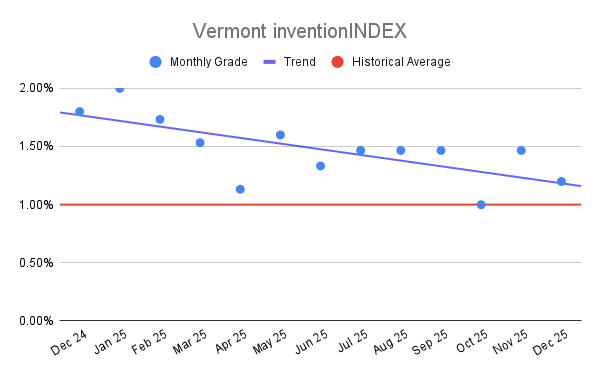 Vermont inventionINDEX December 2025:
  Vermont inventionINDEX November
