

The Vermont Research and Development Tax Credit is a nonrefundable incentive equal to 27 percent of the federal research credit attributable to qualified research expenditures (QREs) incurred within Vermont. It piggybacks on federal IRC Section 41 definitions but requires a specific recomputation using only Vermont-sourced data. The credit features a 10-year carryforward period and is reported on Schedule BA-404. Key compliance requirements include the "Four-Part Test" for eligibility and strict "in-state" activity limitations.
The Vermont Research and Development Tax Credit provides a nonrefundable incentive equal to 27 percent of the federal research credit attributable to qualified expenditures conducted within the state. This mechanism functions as a state-level piggyback on the federal innovation incentive, requiring a specific recomputation of the credit based only on Vermont-sourced qualified research expenditures and historical data.
The meaning of the 27 percent credit amount is inherently tied to the structural relationship between Vermont state law and the Internal Revenue Code (IRC). Unlike some states that calculate their research incentives as a flat percentage of total research spending, Vermont’s credit is a derivative of the federal credit allowed under IRC Section 41. This means that the 27 percent multiplier is applied not to the raw expenses incurred by a business, but to a hypothetical federal credit calculated as if the business’s activities were confined solely to the borders of Vermont. This nuance is critical for professional practitioners to understand, as it implies that the effective rate of the credit relative to total spending is significantly lower than 27 percent—typically ranging from 1.5 to 3.5 percent of total Vermont-sourced qualified research expenditures, depending on whether the taxpayer utilizes the federal Regular Research Credit method or the Alternative Simplified Credit method.
The primary statutory purpose of this credit, as codified in 32 V.S.A. § 5813(p), is to encourage business investment in research and development within Vermont and to attract and retain intellectual-property-based companies. This legislative intent serves as the guiding principle for the Vermont Department of Taxes when interpreting the application of the law to various industries, from traditional manufacturing in the Northeast Kingdom to emerging biotechnology and software development clusters in the Burlington area. The state's reliance on federal definitions creates a system where eligibility is largely determined at the federal level, but the valuation of the benefit is strictly localized to Vermont economic activity.
Statutory Foundation and the Evolution of the 27 Percent Rate
The Vermont Research and Development Tax Credit is authorized under 32 V.S.A. § 5930ii, which establishes the eligibility criteria and the mathematical basis for the incentive. This section of the Vermont Statutes Annotated represents a commitment to maintaining a competitive tax environment for firms engaged in high-value technical experimentation. The current 27 percent rate is the result of legislative adjustments designed to balance the state's fiscal requirements with its economic development goals.
Prior to January 1, 2014, the statutory rate for the Vermont R&D credit was 30 percent of the federal credit amount. The transition to the 27 percent rate was enacted through Act 174 of the 2013 legislative session, which revised the percentage for tax years beginning on or after the 2014 calendar year. This adjustment was not merely a reduction in benefit but was accompanied by increased reporting and transparency requirements to ensure that the state could accurately measure the return on its investment in private-sector innovation. Despite this reduction from 30 percent, Vermont's prorated rate remains one of the highest in the United States, placing it in a top-tier category of states that offer "piggyback" style R&D credits.
The legal framework of 32 V.S.A. § 5930ii operates by incorporating federal law through "static conformity." Specifically, the statute references 26 U.S.C. § 41(a) for the definition of the federal research credit and eligible expenditures. This creates a high degree of certainty for taxpayers already compliant with federal IRS standards, as the activities that qualify for the federal credit will, by extension, qualify for the Vermont credit, provided they occur within the state. However, this also means that if the federal credit were to expire or be significantly altered by Congress, the Vermont credit would be fundamentally impacted unless the state legislature chose to decouple from the federal code.
Summary of Statutory Features for the Research and Development CreditThe following table outlines the fundamental characteristics of the credit as established by 32 V.S.A. § 5930ii and interpreted by the Vermont Department of Taxes.
| Feature | Statutory and Administrative Specification |
|---|---|
| Current Credit Rate | 27% of the apportioned federal research credit |
| Historical Credit Rate | 30% for tax years prior to January 1, 2014 |
| Reference Code | 32 V.S.A. § 5930ii and 26 U.S.C. § 41 |
| Legal Purpose | Encourage in-state investment and IP retention |
| Refundability | Nonrefundable |
| Carryforward Period | 10 Years |
| Applicable Taxes | Personal Income, Business Income, Corporate Income |
| Reporting Form | Schedule BA-404 and Federal Form 6765 |
Meaning and Mechanism of the "27 Percent of Federal Credit" Rule
To understand the 27 percent rule, one must first deconstruct the federal research credit calculation. Under IRC Section 41, the federal credit is generally designed to reward "incremental" research—meaning it rewards companies that increase their research spending over time. The federal government offers two primary methods for this calculation: the Regular Research Credit (RRC) and the Alternative Simplified Credit (ASC).
When Vermont law specifies that the credit is "27 percent of the amount of the federal tax credit allowed," it necessitates a multi-step recomputation process for any taxpayer whose research activities are not 100 percent located in Vermont. For a multi-state corporation, the "federal credit allowed" for Vermont purposes is a fictional value. It is not 27 percent of the credit appearing on the taxpayer's federal return; rather, it is 27 percent of a recomputed federal credit that uses only Vermont data for all variables in the formula—including the base amount, the current year expenditures, and, where applicable, the historical gross receipts.
The Proration and Recomputation LogicThe requirement for recomputation is found in the instructions for Vermont Schedule BA-404 and in local revenue office guidance. This guidance mandates that if a taxpayer's federal credit was earned based on expenditures both in and out of Vermont, they must provide a breakdown of the expenditure amounts and a recomputed credit calculation based only on the expenditures that occurred in Vermont.
For many businesses, the recomputation is the most complex aspect of the filing process. It requires the taxpayer to isolate Vermont-specific payroll, supply costs, and contractor payments. Once isolated, these Vermont-only Qualified Research Expenditures (QREs) are inserted into the federal formula. If the company uses the Regular Method, it must also calculate a Vermont-specific "fixed-base percentage" and Vermont-specific "average annual gross receipts" for the four prior years. If the company uses the ASC method, it must calculate a three-year moving average of its Vermont-only QREs. The 27 percent multiplier is applied only after this hypothetical federal credit is determined.
Federal Methodology Alignment: Regular vs. ASC Recomputation
Vermont administrative guidance allows taxpayers to utilize the same methodology for state purposes that they have elected for federal purposes. This provides a level of administrative ease, as the underlying accounting systems used to track federal R&D will naturally support the state claim. However, the mechanical application of the 27 percent multiplier varies significantly between the two federal methods.
The Regular Research Credit Method in a Vermont ContextThe federal Regular Research Credit is 20 percent of the current year’s QREs that exceed a "base amount". The base amount is calculated by multiplying the company’s "fixed-base percentage" by its average annual gross receipts for the preceding four years. To compute the Vermont credit under this method, the taxpayer must perform the following:
- Calculate the Vermont Fixed-Base Percentage: This is the ratio of Vermont-sourced QREs to Vermont-sourced gross receipts for a specific historical period (usually 1984-1988 for established firms or a staggered schedule for newer "start-up" firms).
- Determine Vermont Average Annual Gross Receipts: The taxpayer averages its Vermont-only gross receipts for the four tax years preceding the credit year.
- Apply the 20 Percent Federal Rate: The hypothetical federal credit is 20 percent of the excess of current Vermont QREs over the Vermont base amount.
- Final Vermont Multiplier: The result is multiplied by 27 percent.
One critical safeguard in this calculation is the "base amount floor." Federal law stipulates that the base amount cannot be less than 50 percent of the current year's QREs. Consequently, even a company with very low historical spending will have its incremental benefit capped. In such a scenario, the effective Vermont credit becomes:
$$ \text{VT Credit} = 0.27 \times (\text{VT QREs} - (0.50 \times \text{VT QREs})) \times 0.20 $$ $$ \text{VT Credit} = 0.27 \times (0.50 \times \text{VT QREs}) \times 0.20 $$ $$ \text{VT Credit} = 0.027 \times \text{VT QREs} $$
In this "floor" scenario, the Vermont credit is exactly 2.7 percent of the total qualified spending in the state.
The Alternative Simplified Credit (ASC) Method in a Vermont ContextThe ASC method, which became increasingly popular at the federal level following the PATH Act of 2015, does not rely on gross receipts. Instead, the federal credit is 14 percent of the current year QREs that exceed 50 percent of the average QREs for the three preceding years. For Vermont taxpayers, the recomputation involves:
- Averaging Vermont QREs: Take the Vermont-only QREs for the three prior years and divide by two to find the 50 percent threshold.
- Isolating the Increment: Subtract this threshold from the current year's Vermont QREs.
- Applying Federal and State Rates: Multiply the increment by the federal 14 percent rate and then by the state 27 percent rate.
Because the federal ASC rate is 14 percent (lower than the 20 percent Regular rate), a taxpayer using the ASC method in Vermont will generally see a lower state credit unless their research spending has grown extremely rapidly. For an ASC taxpayer at the 50 percent floor, the effective Vermont credit is approximately 1.89 percent of their Vermont spending ($0.14 \times 0.50 \times 0.27 = 0.0189$).
Qualified Research Expenditures (QREs) and In-State Limitations
The 27 percent credit applies only to expenditures "made within this State". This "in-state" requirement is strictly enforced by the Vermont Department of Taxes and represents the most common area of adjustment during audits. To qualify as a Vermont expenditure, the costs must be for activities physically conducted in Vermont, regardless of where the company is headquartered or where the intellectual property is ultimately held.
Wage ExpendituresWages are typically the largest component of an R&D claim. Under Vermont guidance, these must be "salaries for employees performing, supervising, or supporting qualified research" within the state. This includes direct researchers (e.g., software engineers, chemists), first-line managers who supervise them, and direct support personnel who might assist in building prototypes or conducting tests.
For employees who split their time between Vermont and other jurisdictions, or for those who work remotely, the Department of Taxes requires a precise proration of wages based on the time spent physically performing research within Vermont's borders. If a Vermont-based firm employs a remote researcher living in New Hampshire, that researcher's wages are entirely ineligible for the Vermont credit, even if their work directly benefits the Vermont operation.
Supplies and ConsumablesEligible supply costs include "materials and prototypes consumed in the research process" within Vermont. These must be non-depreciable items used in experimentation. If a manufacturing company in Rutland develops a new composite material, the resins and fibers used to build the experimental prototypes in their Rutland lab are Vermont QREs. However, the purchase of a new laboratory furnace to test those materials is considered a capital expenditure and is excluded from the R&D credit, though it may qualify for the separate Vermont Investment Tax Credit.
Contract ResearchVermont follows the federal rule for third-party contractor payments, where only 65 percent of the amount paid for qualified research is eligible for the credit. For this to qualify for the Vermont credit, the research must be performed within Vermont. If a Burlington-based startup hires a Vermont-based engineering firm to perform testing, 65 percent of those payments qualify. If they hire an engineering firm in Massachusetts, zero percent of those payments qualify for the Vermont credit, although they would still be eligible for the federal credit.
Computer Rental and Cloud Computing CostsThe modern research environment often involves significant expenditures on cloud computing and server time. Vermont allows "costs for computers or equipment leased exclusively for research activities" to be included in the calculation. Federal guidance under IRC § 41(b)(2)(A)(iii) generally requires that the computer be located on-site, but modern interpretations frequently allow for cloud-hosting services where the servers are dedicated to research. For Vermont purposes, the nexus of the research activity—the location where the engineers are accessing and utilizing the computing power—must be Vermont.
The Four-Part Test: Vermont Compliance Standards
To determine if an activity qualifies for the 27 percent credit, Vermont taxpayers must demonstrate that it meets the four-part test established by the federal government and adopted by the state. Local revenue office guidance emphasizes that these tests must be met at the "business component" level, meaning each specific product, process, or software feature must be evaluated independently.
| Test Requirement | Vermont Regulatory and Technical Interpretation |
|---|---|
| Permitted Purpose | The activity must relate to a new or improved function, performance, reliability, or quality of a product or process. |
| Elimination of Uncertainty | The activity must be intended to discover information that would eliminate technical uncertainty regarding the capability, method, or design of a business component. |
| Process of Experimentation | Substantially all of the activities must involve a systematic process of evaluating one or more alternatives, such as trial and error, modeling, or simulation. |
| Technological in Nature | The research must fundamentally rely on principles of physical or biological science, engineering, or computer science. |
Vermont's guidance specifically excludes activities like market research, routine quality control, aesthetic changes, or the adaptation of existing business components to a particular customer's need without significant technical modification. The state's focus is on true technological advancement that occurs within its physical jurisdiction.
Local Revenue Office Guidance and Administrative Procedures
The Vermont Department of Taxes administers the R&D credit through several key administrative vehicles, including Technical Bulletins and specific tax schedules. Taxpayers are expected to maintain "accurate documentation" to avoid compliance issues, particularly given that the Department publishes a list of all credit claimants.
Schedule BA-404: The Credit Management LedgerThe most critical form for claiming the Vermont R&D credit is Schedule BA-404, "Tax Credits Earned, Applied, Expired, and Carried Forward". This form serves as the official record of the credit’s lifecycle.
- Column A: Amount Carried Forward from Prior Years. This is essential because the R&D credit has a 10-year carryforward period.
- Column B: Amount Earned Current Year. This is where the 27 percent of the recomputed federal credit is reported.
- Column C: Amount Applied Current Year. This is the portion of the credit used to offset the taxpayer’s current Vermont tax liability.
- Column D: Amount Carried Forward to Future Years. This is calculated as (A + B) - C.
Revenue office guidance requires that a copy of the federal Form 6765 be attached to the return. Furthermore, if the taxpayer is a unitary group, they must combine all credit amounts on a single Schedule BA-404 and provide a statement that breaks down the totals by each individual entity within the group.
Schedule BA-402: Apportionment and ReceiptsFor corporations that conduct business both within and outside Vermont, Schedule BA-402 is used to apportion income and determine "Vermont Gross Receipts". Because the R&D credit’s recomputation often requires Vermont-specific gross receipts for the "base amount" calculation, the data on BA-402 must be consistent with the data used for the R&D recomputation.
Revenue guidance specifically defines "Receipts" for these purposes, excluding items like litigation damages, contributions to capital, and forgiveness of indebtedness. Ensuring that "Vermont Gross Receipts" are calculated correctly is a prerequisite for a valid Regular Method R&D claim, as an incorrect denominator in the fixed-base percentage calculation can lead to a significant overstatement or understatement of the credit.
Taxpayer Services and Technical AssistanceThe Vermont Department of Taxes provides direct support for business taxpayers through its Business Tax section. Guidance suggests that taxpayers with complex R&D structures, particularly those involving unitary combined filing or multi-state proration, contact the Department at (802) 828-2551 or via email at tax.business@vermont.gov for clarification on specific project eligibility.
Transparency, Public Disclosure, and the "Claimant List"
Vermont is an outlier among U.S. states in its treatment of tax credit confidentiality. Under 32 V.S.A. § 5930ii(c), the Department of Taxes is mandated to publish an annual list containing the names of the taxpayers who have claimed the R&D credit during the most recent completed calendar year.
This "Transparency List" is published by January 15th each year. The public availability of this data serves as a significant oversight mechanism. It allows the public and the legislature to see which companies are benefiting from the state’s innovation subsidies. From a compliance perspective, this means that every claim for the 27 percent credit is inherently a matter of public record, which arguably heightens the importance of meticulous documentation and legal defensibility.
The Department has published these reports for every calendar year dating back to at least 2015. These reports typically list the company name and occasionally the amount of the credit claimed, providing a high level of accountability for the use of state revenue.
Interaction with the Vermont Corporate Minimum Tax
The Vermont Research and Development Tax Credit is nonrefundable and cannot be used to reduce a corporation's tax liability below the statutory minimum. This "floor" is established through a tiered minimum tax system based on the company’s Vermont Gross Receipts.
| Vermont Gross Receipts | Minimum Tax (Effective 2023+) |
|---|---|
| Less than $500,000 | $100 |
| $500,001 to $1,000,000 | $500 |
| $1,000,001 to $5,000,000 | $2,000 |
| $5,000,001 to $300,000,000 | $6,000 |
| Over $300,000,000 | $100,000 |
For example, a large corporation with $10 million in Vermont gross receipts would be subject to a minimum tax of $6,000. If that corporation earns an R&D credit of $50,000 but only has a total pre-credit tax liability of $55,000, the credit can only reduce the tax to the $6,000 minimum. The remaining $1,000 of the credit would be added to the carryforward balance on Schedule BA-404.
Special exceptions exist for small farm corporations, which have a reduced minimum tax of $75. This interaction ensures that all entities with nexus in Vermont contribute at least a nominal amount to the state’s general fund, regardless of the volume of their research activities.
Pass-Through Entities: S-Corporations, Partnerships, and LLCs
Vermont law allows the R&D tax credit to flow through from business entities to their owners. For an S-Corporation, Partnership, or LLC, the credit is calculated at the entity level but is then allocated among the shareholders, partners, or members in accordance with their ownership interest.
The K-1VT Reporting ProcessThe entity must provide each owner with a Vermont Schedule K-1VT, which lists the owner’s share of the R&D credit earned during the year. The individual owners then claim the credit on their personal income tax return (Form IN-111), utilizing Schedule IN-112 to report the credit amount.
If the entity operates in multiple states, it must perform the same recomputation described previously (isolating Vermont QREs and re-running the federal formula) before distributing the credit to its owners. Individual residents of Vermont are also eligible for a "Credit for Taxes Paid to Another State" if they are taxed on research income in a different jurisdiction, but the Vermont R&D credit itself is strictly limited to the Vermont-based activity.
Unitary Groups and Combined Filing Guidance
Vermont utilizes a combined reporting system for unitary groups, meaning that all corporations that are part of a single unitary business must file a single return. This has significant implications for the R&D credit, as the activities of all members must be analyzed collectively to determine the appropriate base amount and credit generation.
Credit Utilization in a Unitary GroupRevenue guidance on Schedule BA-404 indicates that credits generated by one member of a unitary group can generally be used to offset the tax liability of other members, provided they are part of the same combined filing. This is particularly beneficial for large organizations where one subsidiary may be the primary research hub (generating large credits) while another subsidiary is the primary sales hub (generating the majority of the tax liability).
The group must:
- Identify All QREs: Isolate the Vermont QREs for all members of the unitary group.
- Aggregate Gross Receipts: For the Regular Method, the Vermont gross receipts for all members are summed to determine the group’s fixed-base percentage and average gross receipts.
- Calculate at the Group Level: The hypothetical federal credit is calculated for the combined Vermont entity.
- Allocate the Applied Credit: On the combined return (Form CO-411), the credit is applied against the group’s combined Vermont tax.
Recent legislative changes in Vermont, such as the transition to a single-sales factor apportionment formula starting in 2023, have changed how income is attributed to the state, but the underlying mechanism of the 27 percent R&D credit remains tied to the physical performance of research within Vermont.
Audit Risks and Document Retention Requirements
The high rate of the Vermont R&D credit (27 percent of the federal amount) makes it a frequent subject of state audits. The Vermont Department of Taxes typically focuses its audits on three key areas: the "Four-Part Test" qualification, the accuracy of the recomputation, and the verification of in-state expenditure nexus.
Documentation StandardsTaxpayers are advised to maintain contemporaneous documentation that supports the research activities claimed. Vermont revenue office guidance aligns with federal record-keeping standards but adds the requirement for state-specific substantiation.
- Time Tracking: Detailed time-tracking logs or surveys for employees whose wages are included in the credit, proving that the time was spent in Vermont on qualified tasks.
- Project Documentation: Technical reports, lab notebooks, design specifications, and test results that show the "Process of Experimentation" occurred for each business component.
- Nexus Evidence: Payroll records (W-2s) showing the employee’s work location and invoices from contractors showing that the services were performed at a Vermont facility.
- Recomputation Worksheets: Detailed spreadsheets showing how the taxpayer arrived at the Vermont-specific base amount and hypothetical federal credit.
The general statute of limitations for state tax assessments is three years, but the Department may look back further if the taxpayer is utilizing a credit carryforward. Because the R&D credit can be carried forward for 10 years, it is theoretically possible for an auditor to review the records from the year the credit was earned, even if that year is technically closed to general assessment.
Comprehensive Example: The "Vermont Innovative Manufacturing" Scenario
To illustrate the full application of the 27 percent rule, consider a hypothetical company, Vermont Innovative Manufacturing (VIM), which operates a primary factory in St. Johnsbury and a sales office in New York.
Step 1: Identification of Research ActivitiesVIM develops a new energy-efficient heating element. The engineering work and prototype testing occur entirely in St. Johnsbury. They also pay a New York-based software consultant to develop a mobile app to control the heater.
- Burlington Engineering Wages: $200,000 (100% Qualified)
- St. Johnsbury Prototype Materials: $50,000 (100% Qualified)
- New York Consultant Payments: $100,000 (0% Vermont Qualified)
- Total Vermont QREs: $250,000
VIM uses the ASC method. Its total federal research spending (including the NY consultant) is $350,000. However, for the Vermont credit, it must re-run the ASC formula using only the $250,000 Vermont spend.
- Vermont-Only Historical Spending (3-year average): $150,000
- Vermont-Only Base Threshold (50% of average): $75,000
- Vermont Increment: $250,000 - $75,000 = $175,000
VIM applies the federal 14 percent ASC rate to the Vermont increment:
$175,000 x 14% = $24,500
Step 4: Application of the Vermont 27 Percent RateThe Vermont Research and Development Tax Credit is then calculated:
VT Credit = $24,500 x 27% = $6,615
Step 5: Applying the Credit to Tax LiabilityVIM has $1.5 million in Vermont Gross Receipts, placing it in the $2,000 minimum tax tier.
- Total Vermont Corporate Income Tax (pre-credit): $8,000
- R&D Credit Used: $8,000 - $2,000 = $6,000
- Remaining R&D Credit Carryforward: $6,615 - $6,000 = $615
VIM will report this on Schedule BA-404, with $6,615 in Column B, $6,000 in Column C, and $615 in Column D.
Final Thoughts and Strategic Outlook
The 27 percent credit amount established for the Vermont Research and Development Tax Credit is a robust mechanism that ensures the state remains a viable destination for technical investment. By leveraging the comprehensive framework of the federal research credit while requiring a localized recomputation, Vermont provides a benefit that is both high in value and targeted in scope. For professional practitioners, the key to maximizing this incentive lies in the precise isolation of Vermont-sourced activities and the rigorous application of federal calculation methodologies to state-level data.
As the global economy shifts toward increasingly mobile intellectual property, Vermont's statutory transparency and high prorated rate serve as critical anchors for its domestic business base. While the nonrefundable nature of the credit and the interaction with the corporate minimum tax floor provide essential fiscal protections for the state treasury, the 10-year carryforward period ensures that the incentive remains a long-term asset for companies during their early-stage research and growth phases. Understanding the detailed administrative guidance from the Department of Taxes—particularly the nuances of recomputation on Schedule BA-404—is essential for any enterprise seeking to successfully claim and defend its share of this significant innovation incentive.
Who We Are:
Swanson Reed is one of the largest Specialist R&D Tax Credit advisory firm in the United States. With offices nationwide, we are one of the only firms globally to exclusively provide R&D Tax Credit consulting services to our clients. We have been exclusively providing R&D Tax Credit claim preparation and audit compliance solutions for over 30 years. Swanson Reed hosts daily free webinars and provides free IRS CE and CPE credits for CPAs.
Are you eligible?

Why choose us?

Pass an Audit?

What is the R&D Tax Credit?
The Research & Experimentation Tax Credit (or R&D Tax Credit), is a general business tax credit under Internal Revenue Code section 41 for companies that incur research and development (R&D) costs in the United States. The credits are a tax incentive for performing qualified research in the United States, resulting in a credit to a tax return. For the first three years of R&D claims, 6% of the total qualified research expenses (QRE) form the gross credit. In the 4th year of claims and beyond, a base amount is calculated, and an adjusted expense line is multiplied times 14%. Click here to learn more.
Never miss a deadline again

Stay up to date on IRS processes

Discover R&D in your industry

R&D Tax Credit Preparation Services
Swanson Reed is one of the only companies in the United States to exclusively focus on R&D tax credit preparation. Swanson Reed provides state and federal R&D tax credit preparation and audit services to all 50 states.
If you have any questions or need further assistance, please call or email our CEO, Damian Smyth on (800) 986-4725.
Feel free to book a quick teleconference with one of our national R&D tax credit specialists at a time that is convenient for you.
R&D Tax Credit Audit Advisory Services
creditARMOR is a sophisticated R&D tax credit insurance and AI-driven risk management platform. It mitigates audit exposure by covering defense expenses, including CPA, tax attorney, and specialist consultant fees—delivering robust, compliant support for R&D credit claims. Click here for more information about R&D tax credit management and implementation.
Our Fees
Swanson Reed offers R&D tax credit preparation and audit services at our hourly rates of between $195 – $395 per hour. We are also able offer fixed fees and success fees in special circumstances. Learn more at https://www.swansonreed.com/about-us/research-tax-credit-consulting/our-fees/



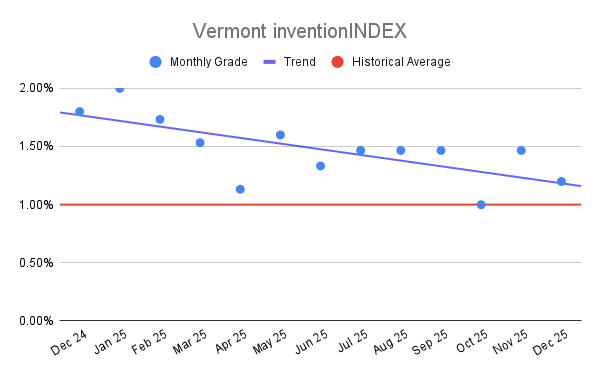 Vermont inventionINDEX December 2025:
  Vermont inventionINDEX November
