

The Current Year Research Credit represents the tax benefit derived from qualified R&D expenses incurred during the active tax year, calculated as a percentage of expenditures exceeding a historical base. Under Wisconsin law, this specific portion serves as the basis for calculating a refundable cash payment, providing immediate liquidity regardless of the taxpayer’s total liability.
The Wisconsin Research Credit is a cornerstone of the state’s economic development strategy, specifically designed to incentivize high-tech industries, manufacturing, and technical innovation within the state’s borders. It operates under a unique framework that integrates federal definitions with state-specific modifications, particularly regarding the timing of expenses and the mechanism of refundability. The distinction between a “Current Year Research Credit” and a “Credit Carryforward” is not merely semantic; it dictates the amount of actual cash a business can recover from the Wisconsin Department of Revenue (DOR). For taxable years beginning on or after January 1, 2024, the state has significantly enhanced the value of this incentive by allowing up to 25% of the current year’s credit to be refundable, a strategic move intended to support companies with high R&D spend but low current tax liability, such as startups in the biotechnology, energy, or software sectors.
The Regulatory and Statutory Landscape of Wisconsin R&D Incentives
The legal authority for the Wisconsin research credit is established across several sections of the Wisconsin Statutes, primarily Sections 71.07(4k) for individuals, 71.28(4) for corporations, and 71.47(4) for insurance companies. These statutes create a complex interplay between state law and the federal Internal Revenue Code (IRC). For the purposes of computing the Wisconsin credit, “Internal Revenue Code” generally refers to the IRC as amended to December 31, 2022. This date is critical because it signifies Wisconsin’s deliberate decision to decouple from certain federal changes introduced by the Tax Cuts and Jobs Act (TCJA) of 2017. Specifically, while federal law under IRC Section 174 now requires taxpayers to capitalize and amortize research and experimental expenditures over five or fifteen years, Wisconsin has not adopted these provisions. Consequently, for Wisconsin tax purposes, taxpayers continue to follow the pre-2022 federal rules, allowing for the immediate expensing of these costs when calculating the credit.
This decoupling creates a significant administrative divergence. A taxpayer may find themselves in a position where they must capitalize research expenses for their federal 1040 or 1120 filing while simultaneously treating those same expenses as current deductions and qualifying expenditures for the Wisconsin Schedule R. The Wisconsin Department of Revenue requires that only expenses incurred for research conducted within the state are eligible. If research is conducted both inside and outside Wisconsin, the taxpayer must employ a reasonable allocation method, often based on the ratio of Wisconsin-based research personnel to the total research workforce or the direct tracing of supplies and contract costs.
The Tiers of Research Activity
Wisconsin law categorizes research activities into different tiers, each offering a distinct credit rate. This hierarchy reflects the state’s prioritization of specific industrial sectors, notably the automotive and energy-efficiency industries.
| Research Category | Statutory Credit Rate | Startup Credit Rate (No Prior 3-Year QREs) | Applicable Activities |
|---|---|---|---|
| General Research | 5.75% of excess QREs | 2.875% of total current QREs | All qualified research under IRC § 41(d) conducted in Wisconsin. |
| Internal Combustion Engines | 11.5% of excess QREs | 5.75% of total current QREs | Designing internal combustion engines, vehicles powered by such engines, and related production processes. |
| Energy Efficient Products | 11.5% of excess QREs | 5.75% of total current QREs | Design and manufacture of energy-efficient lighting, building automation, and hybrid-electric vehicle batteries. |
The distinction between “General” and “Enhanced” (11.5%) rates is strictly interpreted. For the enhanced rate to apply to internal combustion engines, the research must relate to the engine itself or the vehicle’s drive train and control systems. In the case of trucks, for instance, the statute specifically excludes comfort features located in the cab or the tires from the “frame” definition that qualifies for the higher rate. This granular level of detail in the law requires taxpayers to meticulously categorize their labor and supply costs if they intend to claim the higher credit percentage.
The Concept of “Current Year Research Credit” vs. Carryforward
The term “Current Year Research Credit” refers specifically to the amount of credit generated by qualified research expenses paid or incurred during the specific taxable period for which the return is filed. This is mathematically distinct from the “Research Credit Carryforward,” which represents unused credits from the previous 15 taxable years.
The functional importance of this distinction lies in the calculation of the refundable portion of the credit. Wisconsin’s refundability mechanism is exclusively tied to the current year’s generation of credits. Under Section 71.07(4k)(e), only the credit computed for the active year is eligible for the 25% refund calculation (for years 2024 and beyond). Any credit amount that is carried forward from a prior year is strictly non-refundable and can only be used to offset tax liability in future years until it expires after the 15-year carryforward period.
The Evolution of Refundability Percentages
The transition from a purely non-refundable credit to a partially refundable one has been phased in by the Wisconsin Legislature over the last several years to mitigate the fiscal impact on the state budget while progressively increasing the benefit to taxpayers.
| Taxable Year Range | Refundable Percentage of Current Year Credit | Statutory Authority / Context |
|---|---|---|
| Before Jan 1, 2018 | 0% (Fully Non-refundable) | Traditional credit structure; only offsets liability. |
| 2018 – 2020 | 10% | Introduced by 2017 Wisconsin Act 59. |
| 2021 – 2023 | 15% | Expanded to incentivize pandemic-era innovation. |
| 2024 and Later | 25% | Latest expansion to boost state-wide R&D competitiveness. |
When a taxpayer computes their return, they must first determine the total current year credit. If this credit exceeds their tax liability for the year, the “unused” current year portion becomes the primary pool from which the refund is drawn. The DOR instructions for Schedule R clarify that the refundable portion is the lesser of the calculated percentage (25% of the total current year credit) or the actual amount of current year credit remaining after the tax liability has been reduced to zero.
Defining Qualified Research and Expenses (QREs)
The foundation of the Current Year Research Credit is the identification of “Qualified Research Expenses.” To be considered “qualified” for Wisconsin purposes, the activity must pass the federal “Four-Part Test” established under IRC Section 41(d), and the expenses must have a clear nexus to Wisconsin.
The Four-Part Test Analysis
- Permitted Purpose: The research must be intended to develop a new or improved business component. A business component can be any product, process, software, technique, formula, or invention to be held for sale, lease, or license, or used by the taxpayer in their trade or business. The goal must be to improve functionality, performance, reliability, or quality.
- Elimination of Uncertainty: At the outset of the research, there must be a degree of uncertainty regarding the capability or method of achieving the desired result, or the appropriate design of the product. If the solution is already known or can be arrived at through standard engineering practices with no risk of failure, it does not qualify.
- Process of Experimentation: The taxpayer must engage in a systematic process to evaluate one or more alternatives. This often involves the use of modeling, simulation, or a series of trials (testing, refining, retesting) to analyze data and arrive at a solution.
- Technological in Nature: The research must fundamentally rely on the principles of hard science, such as physical or biological sciences, engineering, or computer science. Research in the social sciences, arts, or humanities is explicitly excluded.
Categorization of Expenses
Once the activity is determined to be qualified research, the associated costs must be segregated into specific categories for reporting on Schedule R.
- Wages: This includes compensation paid to employees for direct performance, supervision, or support of qualified research. For Wisconsin purposes, only wages reported on a W-2 and earned for services performed in Wisconsin qualify.
- Supplies: These are tangible items (excluding land and depreciable property) used and consumed in the research process.
- Computer Lease/Rental Costs: Payments made for the right to use computers for research purposes, provided the computers are located in Wisconsin.
- Contract Research: Payments to third parties for research performed on the taxpayer’s behalf. Only 65% of the amount paid typically qualifies, although this increases to 75% for payments made to qualified research consortiums (typically non-profit scientific organizations).
Administrative guidance from the DOR emphasizes that “qualified research” does not include research conducted after the start of commercial production, adaptation of products to a specific customer’s needs, or routine data collection and market research. Furthermore, the “In-State Focus” is absolute; expenses incurred entirely outside Wisconsin cannot be allocated to the state, even if they were incurred for the benefit of a Wisconsin research project.
The Mechanics of the Credit Calculation
The Wisconsin research credit is an incremental credit. It is not calculated on the total R&D spend, but rather on the “increase” in spending over a historical base. This structure is intended to reward companies that are actively expanding their research footprint in the state.
The Calculation Formula
The standard calculation for an established business (one with research expenses in the prior three years) is:
Credit = Rate × (Current Year QREs – (0.50 × Average QREs of Prior 3 Years))
For the general research credit, the Rate is 5.75%. If the taxpayer is a “startup” and had no qualified research expenses in any of the three taxable years immediately preceding the current year, the calculation is simplified to:
Credit = 2.875% × Current Year QREs
Historical Average Nuances
The DOR instructions for Schedule R (Line 9) are very specific about the calculation of the prior-year average. Taxpayers must list their Wisconsin QREs for each of the three prior years. If a taxpayer had expenses in two of the three prior years but zero in the third, they cannot use the startup rate. Instead, they must still average the three years (including the zero) and use the 5.75% rate. The startup rate of 2.875% is strictly reserved for those with zero expenses across the entire three-year lookback period.
For corporations involved in acquisitions or dispositions, the prior-year QREs must be adjusted to reflect the change in the business structure. If a major portion of a trade or business is acquired, the acquirer must add the QREs of the acquired business to its own historical base. Conversely, a disposer must subtract those expenses. This ensures that the credit remains truly incremental relative to the combined historical activity of the entities.
Administrative Procedures for Different Entity Types
While the fundamental definition of the credit remains consistent, the administrative process for claiming it varies significantly depending on the taxpayer’s legal structure.
Corporations (C-Corporations and Insurance Companies)
C-corporations claim the credit directly on their franchise or income tax returns (Form 4, 5, or 6). They use Schedule R to compute the credit and then transfer the results to Schedule CR. A unique rule for corporations is that the credit itself must be included in their net income. Under Wisconsin Statute Section 71.26(2), the credit is considered an “add-back” to income, effectively meaning the business pays tax on the benefit it receives.
Pass-Through Entities (PTEs)
Partnerships, LLCs treated as partnerships, and Tax-Option (S) Corporations do not typically use the research credit to offset tax at the entity level. Instead, the entity completes Schedule R to determine the total credit generated by its Wisconsin activities and then allocates that credit to its partners, members, or shareholders based on their ownership interests.
These credits are reported to the owners on Schedule 3K-1 (for partners) or 5K-1 (for S-corp shareholders). The individual owners then claim the credit on their own Wisconsin Form 1 or Form 1NPR. If the individual owner’s share of the credit exceeds their personal tax liability, they are the ones who receive the refundable portion.
Combined Groups
For corporations that are part of a Wisconsin combined group, the research credit is generally an attribute of the separate corporation that performed the research. However, Section 71.255(6)(c) allows for the sharing of non-refundable research credits among members of the group.
| Sharing Provision | Limitation / Rule |
|---|---|
| Origin Rule | A member can only share its credit if it was a member of the same combined group in the year the credit was generated. |
| Utilization Order | A corporation must use its own credits to offset its own tax liability before it can share any remaining non-refundable credit with other group members. |
| Refundable Portion | Refundable credits are not shared; they are claimed on the combined return and refunded to the designated agent of the group. |
In the context of combined groups, “funded research” receives special treatment. If member A pays member B to conduct research, the expenses are considered QREs of member B (the one performing the work), and the reimbursement from member A is disregarded. This prevents the “funding” member from claiming a credit for research it did not physically conduct.
Estates, Trusts, and Fiduciaries
Fiduciary returns (Form 2) also allow for the claiming of the research credit. The credit is computed at the entity level and then prorated between the estate or trust and its beneficiaries based on the amount of income distributable to each. Fiduciaries must use Schedule R to calculate the credit and then indicate the portion allocated to beneficiaries on Line 16a.
Operational Application: A Comprehensive Example
To clarify the interaction between current year credits, carryforwards, tax liability, and the 25% refundability cap, consider the following scenario for a Wisconsin-based manufacturing firm in the 2024 tax year.
Scenario Parameters
- 2024 Wisconsin QREs: $3,000,000
- Prior 3-Year Average QREs: $2,000,000
- Historical Base: $1,000,000 (50% of $2,000,000 average)
- 2024 Tax Liability: $50,000
- Prior Year Research Credit Carryforward: $15,000
Step 1: Calculate the 2024 Current Year Research Credit
The credit is 5.75% of the excess QREs.
Excess QREs = $3,000,000 – $1,000,000 = $2,000,000
Current Year Credit = $2,000,000 × 0.0575 = $115,000
Step 2: Apply the “Order of Operations”
According to DOR guidance, non-refundable carryforwards must be used to offset current year tax liability before applying the current year credit.
- Initial Liability: $50,000
- Minus Carryforward: $15,000
- Remaining Liability: $35,000
Next, the current year credit is applied to the remaining liability.
- Liability Offset: $35,000
- Tax Due: $0
- Unused Current Year Credit: $115,000 – $35,000 = $80,000
Step 3: Determine the Refundable Portion
The refundable portion is the lesser of 25% of the total current year credit or the unused current year credit.
- 25% Limit: $115,000 × 0.25 = $28,750
- Unused Amount: $80,000
The lesser value is $28,750.
Step 4: Final Tax Result
- Wisconsin Tax Paid: $0
- Refund Received: $28,750
- New Carryforward to 2025: $80,000 – $28,750 = $51,250 (This $51,250 becomes a non-refundable carryforward).
Documentation and Audit Preparedness: State Guidance
The Wisconsin DOR is rigorous in its auditing of research credits. Because the credit can result in significant cash refunds, auditors often demand detailed substantiation for both the technical eligibility of the projects and the accuracy of the financial data.
The Documentation Checklist
The DOR recommends that taxpayers maintain a “contemporaneous record” of their research activities. Relying on post-hoc estimates or memory is a primary cause for credit disallowance during a field audit.
| Document Type | Specific Content Required |
|---|---|
| Innovation Logs | Descriptions of the technical challenges faced and the alternatives tested for each project. |
| Labor Time Tracking | Timesheets or project-specific labor allocations that tie specific employee hours to qualified research tasks. |
| Technical Evidence | Prototypes, test results, lab reports, bug fix logs, and design schematics. |
| Qualified Expense Ledger | A general ledger breakout that specifically identifies research-related supply purchases and contract payments. |
| Contracts | For contract research, agreements must specify that the research is performed in Wisconsin and that the taxpayer bears the financial risk. |
Auditors will particularly focus on the “Substantially All” rule for labor. If an employee spends more than 80% of their time on qualified research, 100% of their wages may be included in the QRE calculation. However, if the time spent is below 80%, only the actual percentage of time can be claimed. Documentation must be robust enough to support these percentages.
Common Audit Challenges
Taxpayers often struggle with the “Technological in Nature” requirement during audits. Auditors look for evidence that the research relied on the principles of the hard sciences. If the project was primarily a matter of artistic design or market positioning, the credit will be denied. Furthermore, the “Wisconsin-Only” requirement is a frequent target. If an employee worked remotely from another state for part of the year, those wages must be meticulously prorated to exclude out-of-state work.
Interaction with Other Wisconsin Credits
The Current Year Research Credit does not exist in a vacuum; it often interacts with other state incentives, requiring careful coordination on the tax return.
Development Zones Credits
If a taxpayer is also claiming the Wisconsin Development Zones Jobs Credit, they must adjust their research wages. Under Schedule R instructions, any wages used to compute the Development Zones credit must be subtracted from the total Wisconsin research wages on Line 7. This prevents the “double-dipping” of tax benefits for the same labor dollar.
The Federal Orphan Drug Credit
Similarly, if a taxpayer uses Wisconsin QREs for the federal Orphan Drug Credit, they must include these expenses on Schedule R. While the federal government may treat these costs differently, Wisconsin allows them to be included in the R&D credit base, provided they otherwise meet the definition of qualified research conducted in Wisconsin.
The “Credit as Income” Requirement
A point of frequent confusion for practitioners is the mandatory inclusion of the computed credit in Wisconsin taxable income. This requirement applies even if the credit is not used in the current year and is carried forward to future years.
For a corporation, the amount of research credit computed on Schedule R for the year must be reported as an “Addition” to federal income on the Wisconsin return. For individuals who are partners or shareholders, their share of the entity’s research credit must be added back to their Wisconsin income on Schedule AD. This mechanism ensures that the state effectively taxes the benefit of the credit, which reflects the legislative intent to provide a net incentive rather than a gross one.
Future Outlook: Legislative and Administrative Trends
The Wisconsin research credit is subject to ongoing legislative scrutiny and proposed expansions. As of early 2025, there are active bills in the Wisconsin Legislature (Senate Bill 482 and Assembly Bill 494) that propose extending the carryover period for unused research credits from 15 years to 50 years.
This proposed change reflects an understanding that innovation cycles in certain sectors, such as drug discovery or aerospace, can exceed the 15-year window currently allowed. A 50-year carryforward would essentially allow a startup company to retain the value of its early-stage research credits until it reaches long-term profitability, regardless of how many decades that transition takes.
Furthermore, the state continues to update its guidance on “internal use software.” Following federal guidelines, Wisconsin allows credits for software developed for internal use only if it meets a “High Threshold of Innovation” (HTI) test. This requires the software to be innovative, to involve significant economic risk, and to not be commercially available. As more Wisconsin businesses transition to digital-first models, the interpretation of the HTI test is becoming a central issue in DOR audits.
Final Thoughts
The Current Year Research Credit is a sophisticated fiscal tool that requires a deep understanding of both federal research standards and Wisconsin’s unique statutory modifications. By decoupling from federal capitalization requirements and offering a substantial 25% refundability rate, Wisconsin has positioned itself as a premier destination for technical innovation. However, the benefits of the credit are balanced by rigorous reporting requirements—most notably the “credit as income” add-back—and the necessity for meticulous documentation.
For the taxpayer, the key to maximizing the value of the credit lies in distinguishing the “current year” portion from carryforwards, understanding the tiered rate structure for engines and energy products, and maintaining a robust audit trail that satisfies the DOR’s interpretation of the four-part test. As the state looks toward potential 50-year carryforward periods, the Wisconsin Research Credit will remain a vital, if complex, element of the state’s industrial and technical landscape for the foreseeable future.





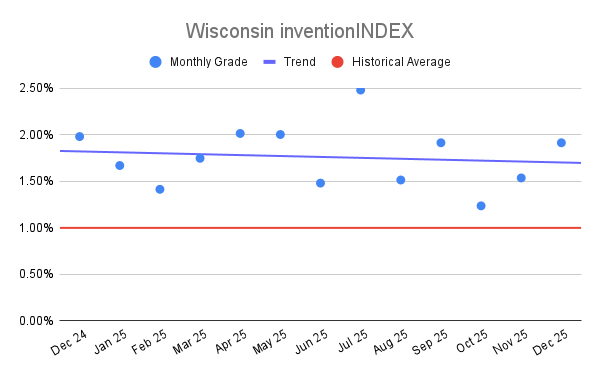 Wisconsin inventionINDEX December 2025
  Wisconsin inventionINDEX Novem
