

Quick Answer: Wisconsin Internal Combustion Engine Research Credit
The Wisconsin Internal Combustion Engine Research Credit offers a specific 5.75% credit rate for "new claimants" (entities with no qualified research expenses in the prior three years). This incentive targets the development of engines, including electric and hybrid drive systems. Unlike the standard incremental credit, this rate is applied to the total current-year qualified research expenses (QREs), providing significant immediate financial support for startups and companies entering the Wisconsin market.
The 5.75% credit rate for new claimants is a specialized Wisconsin tax incentive applied to the total qualified research expenses of entities initiating internal combustion engine R&D without a prior three-year expenditure history. It serves as a simplified entry-level benefit, effectively providing half of the enhanced 11.5% incremental credit available to established firms while eliminating the requirement for a historical base period.
Statutory Framework and the Evolution of the Research Expense Credit
The Wisconsin Research and Development (R&D) tax credit is a complex, tiered system of incentives codified primarily in Chapter 71 of the Wisconsin Statutes. While the state's general research credit has been a fixture of the tax code since 1984, the specialized provisions for internal combustion engines represent a more targeted industrial policy intended to protect and grow the state's significant manufacturing base. The 5.75% rate for new claimants is a critical component of this framework, designed to ensure that businesses entering the Wisconsin market or transitioning into advanced engineering can access capital recovery benefits immediately upon incurring expenses.
Under Wis. Stat. § 71.28(4)(ad)5.a., the law distinguishes between "established claimants" and "new claimants" based on their historical expenditure profiles. For corporations, individual taxpayers, and insurance companies that have maintained research operations in Wisconsin for at least three prior years, the credit is typically calculated as 11.5% of the increase in qualified research expenses (QREs) over a base amount. However, recognizing that startups and expanding firms may not have a three-year history to serve as a baseline, the legislature provided a safe-harbor rate of 5.75% applied to the entire current-year expenditure.
This specific rate is more than just a mathematical derivative; it represents a strategic decision by the Wisconsin Department of Revenue (DOR) and the legislature to lower the barriers for technological disruption in power systems. By allowing a flat 5.75% credit for those without a base period, the state effectively matches the net benefit that an established company would receive if its current research spending were double its historical average. This ensures that "Day 1" of a research project in Wisconsin is financially supported at an enhanced level compared to general research activities, which only offer a 2.875% rate to new claimants.
| Credit Type Category | Established Claimant Rate (Incremental) | New Claimant Rate (Flat % of Current QREs) |
|---|---|---|
| General Research Credit | 5.75% of expenses over 50% of 3-year average | 2.875% of total current year qualified expenses |
| Internal Combustion Engines | 11.5% of expenses over 50% of 3-year average | 5.75% of total current year qualified expenses |
| Energy Efficient Products | 11.5% of expenses over 50% of 3-year average | 5.75% of total current year qualified expenses |
The historical trajectory of these rates demonstrates a consistent effort to amplify the incentive for power-system engineering. For taxable years beginning before January 1, 2015, the credit was generally set at 5% for standard research and 10% for engine-related research. The shift to the current 11.5% and 5.75% structure reflected an upward adjustment in the state's commitment to industrial innovation.
Legal Definitions and the Scope of the Engine Credit
The application of the 5.75% rate depends entirely on the taxpayer's ability to classify their activities within the statutory definition of "internal combustion engine" research. Wisconsin law provides a definition that is significantly broader than the traditional mechanical engineering interpretation. Pursuant to Wis. Stat. § 71.28(4)(ab)2., the term "internal combustion engine" includes not only traditional fuel-burning engines but also "substitute products such as fuel cell, electric, and hybrid drives".
This expansive definition is a cornerstone of Wisconsin's modern tax policy, as it allows the state to support the transition from fossil fuels to renewable and electric propulsion under the same "engine" umbrella. For a new claimant, this means that research into battery management systems for electric vehicles or hydrogen fuel cell stacks for stationary power generation qualifies for the 5.75% rate rather than the lower general research rate.
The Definition of "Vehicle" and "Frame"The credit specifically applies to expenses related to "designing internal combustion engines for vehicles," as well as "designing vehicles that are powered by such engines" and "improving production processes for such engines and vehicles". The term "vehicle" is defined in Wis. Stat. § 71.28(4)(ab)3. to include any frame, part, accessory, or component technology in which or on which an engine is mounted for mobile or stationary applications.
| Vehicle Category | Statutory Examples and Included Technologies |
|---|---|
| On-Road Transport | Automobiles, vans, sports utility vehicles, motor homes, buses, and trucks (including control systems, fuel, and drive trains). |
| Off-Road & Specialized | Tractors, snowmobiles, all-terrain vehicles, construction equipment, and lawn and garden maintenance equipment. |
| Marine & Aviation | Boats, personal watercraft, and aircraft. |
| Power Generation | Generators (including control modules, fuel trains, fuel scrubbing processes, fuel mixers, heat exchangers, and exhaust trains). |
| Two-Wheeled | Motorcycles (defined as every part of the motorcycle except the tires). |
The inclusion of stationary applications like generators and industrial power units ensures that Wisconsin’s massive small-engine and power-equipment manufacturing sector is fully covered. For a new claimant developing a new type of micro-grid generator, every component from the fuel mixer to the heat exchanger falls within the scope of the 5.75% credit rate.
Administrative Guidance from the Department of Revenue
The Wisconsin Department of Revenue provides the operative framework for claiming the credit through official publications and tax form instructions. The primary source of guidance is Publication 131, "Tax Incentives for Conducting Qualified Research in Wisconsin," which details the qualification criteria and calculation methodologies. Additionally, the instructions for Schedule R, "Wisconsin Research Credits," provide the line-by-line mechanics necessary for a new claimant to secure the 5.75% rate.
The "New Claimant" Eligibility CriterionA fundamental aspect of DOR guidance is the definition of a "new claimant." According to Publication 131 and the Schedule R instructions, a claimant is considered "new" for the purposes of the simplified 5.75% calculation if they had "no qualified research expenses in any of the 3 taxable years immediately preceding the taxable year for which the claimant claims the credit".
It is important to note that the DOR interprets "no qualified research expenses" strictly. If a company had even a nominal amount of research spending in one of the three prior years, it must use the incremental method (11.5% of the increase) rather than the flat 5.75% rate. However, the instructions for the 2024 and 2025 Schedule R clarify that if a taxpayer had no expenses in one or more of the three prior years, they follow the specific calculation steps for new claimants to ensure they are not penalized by a mathematical anomaly in the averaging process.
Schedule R Filing RequirementsThe DOR mandates that taxpayers claiming the internal combustion engine credit must use a separate Schedule R specifically for that activity. A taxpayer cannot aggregate general research expenses and engine-related research expenses on a single form. This administrative requirement ensures that the higher 11.5% or 5.75% rates are applied only to the specific subset of expenditures that meet the "engine" definition.
For a new claimant to correctly file, they must follow these specific DOR guidelines:
- Identification: On Schedule R, the taxpayer must check the box on Line 13 indicating they are computing the credit for activities related to internal combustion engines.
- Prior Year Declaration: The claimant must enter their QREs for the three prior years. If those amounts are zero, they must check the box on Line 9.
- Simplified Calculation: New claimants are instructed to skip the standard incremental calculation lines (Lines 9a through 12). Instead, they enter their current year QREs on Line 13 and multiply by 5.75% (Line 13b).
Qualified Research Expenses: The Wisconsin Nexus
To qualify for the 5.75% credit, the research expenses must not only be "qualified" under federal law but must also satisfy the "Wisconsin Nexus" requirement. Wisconsin Stat. § 71.28(4)(ad)4.b. defines qualified research expenses by referencing Section 41 of the Internal Revenue Code (IRC), with the critical exception that the expenses must be "incurred for research conducted in this state".
The Four-Part Test for Activity QualificationThe DOR follows the federal four-part test to determine if an activity constitutes qualified research. For an internal combustion engine project, the activity must be:
- Technological in Nature: The research must fundamentally rely on principles of physical or biological sciences, engineering, or computer science.
- Permitted Purpose: The goal must be to create a new or improved business component's function, performance, reliability, or quality.
- Elimination of Uncertainty: The activity must be intended to discover information to eliminate uncertainty regarding the capability, method, or design of the product or process.
- Process of Experimentation: Substantially all of the activities must involve a systematic process of evaluating alternatives through modeling, simulation, or trial and error.
The 5.75% rate is applied to the sum of in-house research expenses and a portion of contract research expenses. The DOR provides clear guidance on what constitutes an eligible expense.
| Expense Type | Wisconsin Treatment & Limitations |
|---|---|
| Internal Wages | Wages paid to employees directly involved in research, including direct supervision or direct support of research in Wisconsin. |
| Supplies | The cost of tangible property (other than real property or depreciable property) used in the conduct of qualified research. |
| Contract Research | 65% of the amount paid to non-employees for research performed in Wisconsin. If the payment is to a qualified research consortium, the rate is 75%. |
| Computer Rentals | Amounts paid or incurred for the right to use computers to conduct qualified research. |
For a new engine claimant, a significant portion of their QREs often consists of prototype materials and engineering salaries. The DOR emphasizes that wages used to compute the Development Zones Credit cannot be "double-counted" toward the research credit.
The Mechanism of Refundability and Carryforwards
One of the most consequential aspects of the Wisconsin R&D credit for new claimants is the recent expansion of refundability. Historically, the credit was nonrefundable, meaning it could only be used to offset a taxpayer's existing income or franchise tax liability. For new companies and startups, which are often in a pre-profitability phase, this meant the credits were "trapped" as carryforwards.
The Evolution of Refundable PercentagesLegislative initiatives in 2017, 2021, and 2023 have systematically increased the "cash" value of these credits for businesses without current tax liability. For a new claimant earning the 5.75% engine credit, the refundable portion provides immediate liquidity to reinvest in further research.
| Tax Year Start Date | Max Refundable % of Total Credit | Relevant Legislation |
|---|---|---|
| Pre-2018 | 0% (Carryforward Only) | Standard nonrefundable regime. |
| 2018 - 2020 | 10% | 2017 Act 59. |
| 2021 - 2023 | 15% | 2021 Act 58. |
| 2024 and Later | 25% | 2023 Act 19 (SB 70). |
The refundable portion is calculated as the lesser of (1) the current year's research credit remaining after offsetting tax, or (2) the applicable percentage of the total credit earned for the year. This tiered approach ensures that companies with tax liability use the credit to offset it first, while those without liability receive a direct check from the state for a portion of their earned credit.
Carryforward RulesAny portion of the credit that is not used to offset tax and is not claimed as a refund can be carried forward for up to 15 years. For a new claimant, this 15-year window is a vital asset. If a startup earns a 5.75% credit on $1 million of spending today ($57,500 credit), they might receive $14,375 as a refund and carry the remaining $43,125 forward for use when they become profitable years later.
Detailed Case Study: New Engine Claimant Calculation
To demonstrate the application of the 5.75% rate and the associated DOR guidance, consider "GreenPropulsion Wisconsin Inc.," a newly formed C-corporation that began a research project in January 2024 to develop a high-density electric drive for commercial aircraft.
Step 1: Expense IdentificationIn its first year of operation, the company incurs the following Wisconsin-based expenses:
- Wages: $800,000 for aerospace and electrical engineers based in Milwaukee.
- Supplies: $250,000 for battery cell prototypes and specialized testing rigs.
- Contract Research: $200,000 paid to a local university laboratory (Qualified Research Consortium).
- Qualified Contract Amount: $150,000 (75% of $200,000).
- Total 2024 QREs: $1,200,000 ($800k + $250k + $150k).
Because the company was formed in 2024, it had zero research expenses in 2021, 2022, and 2023. Therefore, it is a "New Claimant". Since electric drives are explicitly included in the definition of internal combustion engines, the company qualifies for the enhanced 5.75% rate rather than the general 2.875% startup rate.
Step 3: Credit ComputationFollowing the Schedule R instructions for Line 13b:
- Calculation: $1,200,000 (Total QREs) × 5.75% = $69,000.
Suppose GreenPropulsion has a Wisconsin tax liability of $10,000 in its first year.
- Offset: The first $10,000 of the credit is used to reduce the tax liability to zero.
- Remaining Credit: $59,000 ($69,000 - $10,000).
- Refund Calculation: The maximum refund is the lesser of the remaining credit ($59,000) or 25% of the total credit ($69,000 × 0.25 = $17,250).
- Refund Issued: $17,250 check from the state.
- Carryforward: $41,750 ($59,000 - $17,250) remains available for the next 15 years.
Comparative Analysis: The "General" vs. "Engine" Credits
The disparity between the general research credit and the engine credit is designed to steer investment into high-value engineering. For a new claimant, the choice of which credit to claim is often determined by the "permitted purpose" of the research activity.
| Feature | General Research Credit (New Claimant) | Internal Combustion Engine Credit (New Claimant) |
|---|---|---|
| Applicable Rate | 2.875% of total QREs. | 5.75% of total QREs. |
| Technological Scope | Broad (Software, Biotech, etc.). | Narrow (Propulsion, Vehicles, Frames). |
| Administrative Tool | Schedule R (Checked for General). | Schedule R (Checked for Engine). |
| Max Refund (2024) | 25% of current year credit. | 25% of current year credit. |
The DOR requires that if a taxpayer's research could qualify for both (e.g., a software developer creating an AI-driven fuel management system for a hybrid truck), the taxpayer must document which specific credit they are choosing and ensure the expenses are only claimed once. The "engine" credit is almost always preferable due to the doubled rate.
Interactions with Pass-Through Entities
The 5.75% rate for new claimants is also applicable to partners in partnerships, members of LLCs, and shareholders of S-corporations (tax-option corporations). Under Wis. Stat. § 71.28(3wm)(c)1. and § 71.47(5g)(c), the credit is computed at the entity level based on the entity's research activities.
The entity-level computation is critical for "new claimant" status. If a partnership is in its first year of research, it uses the 5.75% rate. The resulting credit is then passed through to the owners on their respective K-1s in proportion to their ownership interests. Even if an individual partner has a personal history of research spending, the partnership's status as a "new claimant" dictates the rate used for the computation of the credit that flows through to that partner.
Entity-Level Tax ElectionFor taxable years beginning after December 31, 2020, partnerships and S-corporations can elect to pay tax at the entity level. If this election is made, the entity itself can claim the credit to offset its tax liability, rather than passing it through to the owners. However, the DOR guidance clarifies that if the credit is claimed at the entity level, the partners or shareholders cannot then claim the same credit on their individual returns.
Documentation and Audit Preparedness
Given the enhanced benefit of the 5.75% rate, the Wisconsin Department of Revenue maintains strict audit standards for claimants in the internal combustion engine sector. The DOR has "full power to administer" these credits and can conduct proceedings to verify that the research meets both the federal "four-part test" and the state's specific "engine and vehicle" criteria.
Necessary Records for New ClaimantsTo sustain a claim for the 5.75% rate, a business must maintain contemporaneous documentation including:
- Project Logs: Detailed descriptions of the research activities, clearly articulating the technological uncertainty being addressed in the engine or vehicle design.
- Wage Allocations: Records showing the specific hours and duties of employees whose wages are included in the QREs, ensuring they were engaged in qualified research in Wisconsin.
- Supplier Invoices: Documentation for prototype materials and supplies used in the experimentation process.
- Contractual Agreements: Copies of contracts for third-party research, ensuring the work was conducted in Wisconsin and that the taxpayer retained the substantial rights to the research.
For new claimants, the DOR may also scrutinize the "startup" nature of the company. If a business was formed via a reorganization or acquisition of an existing research-heavy firm, the DOR may argue that the company is not a "new claimant" and must instead use the 11.5% incremental rate with a carried-over base period.
Impact of Federal Non-Conformity
A major point of nuance in Wisconsin R&D tax law is the state's decoupling from certain federal provisions. Under the federal Tax Cuts and Jobs Act (TCJA) of 2017, specifically Section 13206 (P.L. 115-97), businesses are required to capitalize and amortize R&D expenses over 5 years (15 years for foreign research) starting in 2022.
However, Wisconsin has not adopted these changes to IRC Sections 41, 174, and 280C. For Wisconsin tax purposes, claimants follow the federal provisions as they existed before 2022. This means:
- Full Expensing: New engine claimants in Wisconsin can still fully deduct their research expenses in the year they are incurred for state purposes, even though they must capitalize them for federal purposes.
- No Section 280C Reduction: Federally, a taxpayer's R&D deduction is usually reduced by the amount of the R&D credit claimed. Wisconsin does not require this reduction, allowing for a "double benefit" of a full deduction and a tax credit.
This divergence makes the Wisconsin 5.75% credit significantly more valuable on a relative basis than it was prior to 2022, as it provides immediate tax relief while the federal benefit is stretched over several years.
Legislative Intent and Economic Implications
The 5.75% rate for new claimants is a direct outgrowth of Assembly Bill 243 from the 2005-2006 legislative session. At that time, the Joint Committee on Finance identified that underinvestment in R&D from a social perspective was substantial—with some studies suggesting social returns to R&D are four times higher than private returns.
The legislature specifically targeted internal combustion engines because of the sector's "spillover effects." When a Wisconsin engine company develops a more efficient drive system, it doesn't just benefit the company; it supports a supply chain of tool and die makers, software engineers, and casting houses across the state. By providing a 5.75% rate for new entrants, the state is effectively betting on the "market's failure" to reward firms for these positive externalities.
The fiscal impact of these credits is considerable. In 2023, it was estimated that corporate and individual filers would claim over $900 million in research tax credits, though much of this remains in the form of carryforwards. The move toward a 25% refundability rate in 2024 is intended to turn these "paper credits" into actual investment capital, particularly for the capital-intensive engine sector.
Future Outlook and Strategic Considerations
For businesses looking to utilize the 5.75% internal combustion engine credit, the strategic landscape is defined by the tension between traditional mechanical engineering and the rapid shift toward electrification. The DOR's willingness to include "substitute products" like fuel cells and electric drives in the engine credit ensures that this incentive will remain relevant for the foreseeable future.
However, companies must be mindful of the "cliff" that occurs after the first three years of research. Once a company moves beyond its "new claimant" phase, its credit will be calculated based on its increase in spending. If a startup significantly front-loads its R&D spending in the first three years at the 5.75% rate, it may find it difficult to exceed its base period in Year 4, potentially resulting in zero credit under the 11.5% incremental method.
| Phase of Business | Credit Rate Mechanism | Planning Strategy |
|---|---|---|
| Years 1-3 (New Claimant) | 5.75% of total QREs | Maximize qualifying documentation and state nexus. |
| Year 4+ (Established) | 11.5% of excess over 50% of avg | Focus on sustained growth of research team and expenditures. |
| Liquidity Phase | 25% Refundable (Post-2024) | Utilize cash refunds to fund capital expenditures not covered by R&D credit. |
Final Thoughts
The 5.75% credit for new claimants performing internal combustion engine research is one of the most aggressive state-level R&D incentives in the United States. By coupling an expansive definition of technology—including electric and hybrid drives—with a simplified flat-rate calculation and a robust 25% refundability mechanism, Wisconsin has created a favorable environment for power-system innovation. For new claimants, the primary challenge lies not in the math of the 5.75% rate, but in the rigorous adherence to DOR guidance regarding the separate Schedule R filing, the documentation of the Wisconsin nexus, and the precise alignment of activities with the statutory definitions of engine and vehicle technologies. As the state continues to decouple from federal R&D capitalization requirements, the immediate financial benefit of this credit will likely play a central role in the growth of Wisconsin's next generation of manufacturing and energy firms.





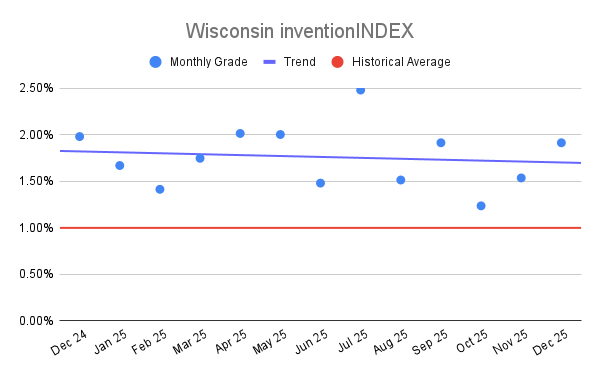 Wisconsin inventionINDEX December 2025
  Wisconsin inventionINDEX Novem
