

Quick Answer: Wisconsin Nonrefundable R&D Credit
The Wisconsin Research Expense Credit is primarily a nonrefundable tax credit that reduces state tax liability dollar-for-dollar. Unlike refundable credits, unused amounts are carried forward for up to 15 years to offset future taxes. While historically 100% nonrefundable, recent legislation allows for a partial refund (up to 25% for tax years starting 2024) of the current year's credit if it exceeds liability. The credit incentivizes in-state R&D activities and is governed by strict statutory rules aligning with federal IRC Section 41 but modified for Wisconsin-specific geography.
A nonrefundable tax credit is a fiscal instrument that reduces a taxpayer's liability dollar-for-dollar until the tax owed reaches zero. Any remaining credit amount cannot be paid out as a cash refund but must be carried forward to offset liabilities in future taxable years.
The conceptual and mechanical underpinnings of the Wisconsin Research Expense Credit are rooted in a fundamental distinction between revenue reductions and state expenditures. In the state’s accounting system, nonrefundable credits are classified as revenue reductions, meaning they represent potential tax collections that the state voluntarily foregoes to incentivize specific economic behaviors—in this case, the expansion of research and development (R&D) activities within Wisconsin's borders. Conversely, refundable credits are treated as state expenditures because they involve the direct disbursement of funds from state appropriations when the credit amount exceeds the claimant's tax liability. For the vast majority of its history since 1984, the Wisconsin Research Credit was 100% nonrefundable. This legacy has created a significant fiscal landscape where businesses, particularly large C-corporations, have accumulated massive carryforward balances. According to data from the Legislative Fiscal Bureau, in tax year 2020, C-corporations claimed over $655 million in research credits, yet only approximately $50.6 million was utilized as nonrefundable offsets against actual tax liabilities. This discrepancy highlights the critical nature of the nonrefundable carryforward as a deferred tax asset that businesses must manage over a 15-year statutory horizon.
Statutory Foundations and Legal Application
The legal authority for the Wisconsin Research Expense Credit is distributed across several chapters of the Wisconsin Statutes, categorized by the type of taxpayer entity. For individuals, partners, and members of limited liability companies, the credit is governed by § 71.07(4k). For corporate entities, including those filing under franchise or income tax, the relevant authority is § 71.28(4). Finally, insurance companies find their statutory basis in § 71.47(4). Despite these different citations, the core definition of "qualified research" and the mechanics of the nonrefundable nature are largely synchronized across the tax code.
The application of the law requires a precise understanding of how Wisconsin adopts and modifies federal standards. Wisconsin defines "qualified research expenses" by referencing Section 41 of the Internal Revenue Code (IRC). However, a significant statutory modification exists: for Wisconsin purposes, these expenses must be incurred for research conducted specifically within the state. This geographical restriction prevents businesses from applying expenses incurred in out-of-state facilities toward the Wisconsin credit, even if those activities contribute to a product sold globally. Furthermore, Wisconsin statutes incorporate a specific definition for "internal combustion engines" and "energy efficient products" to allow for enhanced credit rates.
Core Statutory Framework for Research Credits| Taxpayer Category | Statutory Authority | Administrative Schedule | Impact Type |
|---|---|---|---|
| Individuals/Fiduciaries | Wis. Stat. § 71.07(4k) | Schedule R | Income Tax Credit |
| Corporations (C-Corps) | Wis. Stat. § 71.28(4) | Schedule R | Franchise/Income Tax Credit |
| Insurance Companies | Wis. Stat. § 71.47(4) | Schedule R | Insurance Tax Credit |
| Combined Groups | Wis. Stat. § 71.255(6)(c) | Form 6CS | Inter-entity Sharing |
The law explicitly states that if the allowable amount of the claim exceeds the tax otherwise due, the amount not used to offset those taxes may be carried forward and credited against Wisconsin income or franchise taxes for the following 15 taxable years. This creates a rigorous "use it or lose it" timeline that has recently become a focal point of legislative debate, as many companies find themselves unable to generate sufficient taxable income within 15 years to exhaust their accumulated credits.
Revenue Office Guidance: Schedule R and Administrative Interpretation
The Wisconsin Department of Revenue (DOR) provides detailed administrative guidance through Publication 131 and the instructions for Schedule R, which is the primary form used to compute the credit. One of the most critical interpretations provided by the DOR is that the research credit itself is considered taxable income. This means that even if a taxpayer is unable to use the full amount of a nonrefundable credit to offset tax liability in the current year, they must still report the computed credit amount as income on their Wisconsin return for the year it was earned. This effectively "recaptures" a portion of the credit's value by increasing the taxable income base.
DOR guidance also clarifies the specific hierarchy of credit application. When a taxpayer has both prior-year carryforwards and a current-year credit, the nonrefundable carryforwards are generally applied first to the current year's liability. This "First-In, First-Out" (FIFO) approach is intended to help taxpayers utilize their oldest credits before they expire. Furthermore, the DOR emphasizes that the nonrefundable portion of the credit may be carried forward for 15 years but can never be used to compute a refundable portion in future years.
Detailed Breakdown of Qualified Research Activities (QRAs)The DOR aligns with federal law to establish a "four-part test" that every activity must pass to qualify for the nonrefundable credit.
- Section 174 Test: The activity must involve research and development costs in the experimental or laboratory sense, meaning the expenditures are for activities intended to discover information that would eliminate uncertainty concerning the development or improvement of a product.
- Technological in Nature Test: The process of discovering information must rely on principles of the physical or biological sciences, engineering, or computer science.
- Process of Experimentation Test: Substantially all of the activities must constitute a process of experimentation, involving the identification of uncertainty, the development of hypotheses, and the systematic evaluation of alternatives.
- Business Component Test: The research must be intended to result in a new or improved business component, which is defined as any product, process, computer software, technique, formula, or invention to be held for sale, lease, or license, or used in the taxpayer's trade or business.
Guidance from the DOR further clarifies that "qualified research expenses" include in-house research expenses (wages, supplies, and computer costs) and a specific percentage of contract research expenses. Wages must be paid to employees directly involved in research, including those in direct supervision or direct support of research activities. Supplies must be non-depreciable tangible property used in the research process; land and improvements to land are specifically excluded.
The Evolution of Credit Refundability
A transformative shift occurred in Wisconsin's tax policy beginning in tax year 2018. Recognizing that many innovative companies were unable to benefit from purely nonrefundable credits due to a lack of tax liability, the legislature introduced a "partial refundability" mechanism. This allows a portion of the current year's research credit to be issued as a cash refund if it exceeds the tax due.
Refundability Percentage ProgressionThe percentage of the research credit that can be claimed as a refund has increased incrementally through various budget acts:
| Legislative Act | Effective Date | Refundable Percentage |
|---|---|---|
| Pre-2018 Baseline | N/A | 0% (100% Nonrefundable) |
| 2017 Wisconsin Act 59 | Tax years after 12/31/2017 | Up to 10% |
| 2021 Wisconsin Act 58 | Tax years after 12/31/2020 | Up to 15% |
| 2023 Wisconsin Act 19 | Tax years after 12/31/2023 | Up to 25% |
This evolution significantly alters the economic utility of the credit. While the majority of the credit (75% for 2024 and beyond) remains nonrefundable and subject to the 15-year carryforward, the 25% refundable portion provides immediate liquidity for startups and capital-intensive firms. It is vital to note that the refund is only calculated on the "excess" credit after offsetting current taxes. The DOR defines the refundable portion as the lesser of: (a) the specified percentage of the current year’s credit, or (b) the credit remaining after subtracting the amount used to offset the current year’s tax liability.
Pass-Through Entity Dynamics
A common point of confusion in local guidance involves how partnerships, limited liability companies (LLCs) treated as partnerships, and tax-option (S) corporations handle the nonrefundable credit. DOR guidance is explicit: these entities cannot claim the research credit to offset their own tax liability. Instead, the credit is computed at the entity level based on the entity's qualified research expenses and then "passed through" to the partners, members, or shareholders.
The owners claim the credit on their individual or corporate tax returns in proportion to their ownership interests. For these owners, the credit remains subject to the same nonrefundable rules: it first offsets their personal Wisconsin tax liability, and any remaining portion is then evaluated for refundability (if it originated in the current year) or carried forward as a nonrefundable asset.
Special Rules for Combined Groups
For corporations that are members of a Wisconsin combined group, the treatment of nonrefundable research credits is governed by the principles of "unitary business" reporting and specific sharing elections under Wis. Stat. § 71.255(6)(c). Unlike other nonrefundable credits which can generally only be used by the member that earned them, research credits have special "sharing" permissions.
Mechanics of SharingA corporation that is a member of a combined group must first use its research credit (including nonrefundable carryforwards) to offset its own tax liability. After satisfying its own liability, the member may elect to share any remaining "sharable" credit with other members of the group. To be considered "sharable," the corporation must generally have been a member of that same combined group during the year the credit originated. If the credit originated before the implementation of combined reporting in Wisconsin (January 1, 2009), it is sharable if the corporation would have been a member of the group had the law been in effect.
This sharing mechanism is recorded on Form 6CS and allows a profitable member of a corporate group to absorb the nonrefundable credits of a member that is currently in a loss position or engaged in heavy R&D without current revenue. However, the DOR cautions that the refundable portion of the research credit is not sharable; it must be claimed on the combined return and refunded directly to the group's designated agent.
Technical Definitions for Enhanced Credits
The nonrefundable research credit in Wisconsin is "tiered," providing higher rates for specific industries that the state wishes to anchor locally. Specifically, activities related to "internal combustion engines" and "certain energy efficient products" qualify for a credit rate of 11.5% of excess QREs, compared to the standard 5.75%.
The law provides exhaustive definitions for these enhanced categories:
- Internal Combustion Engines: This includes substitute products such as fuel cells, electric drives, and hybrid drives. The statute defines the "frame" of an engine in granular detail, including the control modules, fuel train, heat exchangers, and exhaust train for generators, or the entire control system and drive train for trucks (excluding tires and comfort features).
- Energy Efficient Products: This applies to the design and manufacture of energy-efficient lighting systems, building automation and control systems, or automotive batteries for use in hybrid-electric vehicles.
If a business qualifies for both general research and an enhanced category, the DOR requires the completion of separate Schedules R for each type of activity to ensure the nonrefundable balances are tracked accurately.
Future Outlook: The 50-Year Carryforward Initiative
The most significant contemporary development in Wisconsin research credit law is the legislative effort to expand the carryforward period for unused nonrefundable credits from 15 years to 50 years. As of late 2025, Senate Bill 482 and Assembly Bill 494 have moved through the legislative process with overwhelming bipartisan support.
The rationale for this 50-year extension, as articulated in testimony by the Association of Equipment Manufacturers (AEM), is that the current 15-year window creates a "fiscal cliff" for large-scale innovators. When credits expire, companies are required under GAAP to write down the value of the deferred tax asset, which records a loss on their financial statements and negatively impacts their valuation. By extending the carryforward to 50 years, the state essentially ensures that these nonrefundable credits remain "on the books" as an asset for the duration of most corporate life cycles, providing much-needed certainty for multi-year capital investment decisions. If signed, this extension would likely apply retroactively to any existing credits that have not yet expired, potentially reviving millions of dollars in previously "distressed" tax assets.
Comprehensive Example and Step-by-Step Calculation
To demonstrate the interplay between tax liability, nonrefundable carryforwards, and the new 25% refundability rule, consider "Badger Innovation Corp," a C-corporation performing general research in Wisconsin for the tax year 2024.
Initial Data Points- 2024 Wisconsin QREs: $2,000,000.
- Prior 3-Year Average QREs: $1,600,000.
- Nonrefundable Carryforward from 2020: $50,000.
- 2024 Wisconsin Tax Liability (Gross): $80,000.
- Base Amount: 50% of the three-year average = $1,600,000 × 0.50 = $800,000.
- Excess QREs: $2,000,000 - $800,000 = $1,200,000.
- Current Year Credit: $1,200,000 × 5.75% = $69,000.
- Prior Year Carryforward (FIFO): The $50,000 carryforward is used first. Remaining tax liability = $30,000.
- Current Year Credit (Nonrefundable Offset): Badger Innovation uses $30,000 of its $69,000 current-year credit to eliminate the remaining liability. Total tax due = $0.
- Remaining Current Year Credit for Potential Refund/Carryforward: $69,000 - $30,000 = $39,000.
The refundable portion is the lesser of:
- Calculation A (The Cap): 25% of the total current year credit earned = $69,000 × 0.25 = $17,250.
- Calculation B (The Excess): The remaining current year credit after tax offset = $39,000.
- Actual Refund Issued: $17,250.
- The remainder of the current year credit that was neither used as a tax offset nor issued as a refund becomes a nonrefundable carryforward.
- Carryforward to 2025: $69,000 (Total) - $30,000 (Tax Offset) - $17,250 (Refund) = $21,750.
In this example, Badger Innovation Corp has effectively turned a potential $80,000 tax bill into a $0 bill and received a cash refund of $17,250, while still maintaining $21,750 in nonrefundable credits to protect against future tax liabilities for the next 15 years.
Compliance and Audit Rigor
Because nonrefundable credits are essentially "deferred revenue" for the taxpayer, they are subject to intense scrutiny from the DOR. A critical aspect of local guidance is the requirement to maintain records for the entire 15-year carryforward period, plus the statute of limitations for the year in which the credit is actually used. If a credit earned in 2024 is used to offset tax in 2038, the taxpayer must be able to produce original 2024 documentation (wages, project narratives, supply invoices) if audited in 2040.
The DOR specifically warns against including research funded by another person or entity (funded research) in the calculation, as this is a common area of audit adjustment. Furthermore, for combined groups, "qualified research expenses" are modified so that research funded by one group member and performed by another is considered a QRE of the member performing the research, ensuring that the credit is captured by the entity doing the actual work in Wisconsin.
Final Thoughts
The Wisconsin Research Expense Credit has transitioned from a rigid, nonrefundable revenue reduction tool into a multi-faceted incentive that balances long-term tax protection with immediate cash-flow benefits. The nonrefundable portion remains the "anchor" of the program, incentivizing established businesses to maintain their operations in Wisconsin to eventually realize the value of their carryforward assets. Meanwhile, the increasing refundable percentage (now at 25%) addresses the needs of the modern startup and tech-driven economy.
Taxpayers must carefully navigate the interaction between federal IRC 41 standards (specifically pre-2022 provisions, as Wisconsin has not adopted the amortization requirements of federal tax law change) and Wisconsin’s unique statutory modifications. By effectively leveraging Schedule R and the sharing provisions of Form 6CS, businesses can transform their Wisconsin research activities into a primary driver of tax efficiency and sustained innovation.
As the state moves toward a potential 50-year carryforward window, the message from the Wisconsin Department of Revenue and the legislature is clear: Wisconsin is committed to a long-term partnership with innovators, treating their research expenditures as a permanent pillar of the state’s economic foundation. Success in this environment requires not only technical ingenuity but also a meticulous adherence to the administrative and statutory documentation standards that protect these nonrefundable assets from erosion through audit.
Who We Are:
Swanson Reed is one of the largest Specialist R&D Tax Credit advisory firm in the United States. With offices nationwide, we are one of the only firms globally to exclusively provide R&D Tax Credit consulting services to our clients. We have been exclusively providing R&D Tax Credit claim preparation and audit compliance solutions for over 30 years. Swanson Reed hosts daily free webinars and provides free IRS CE and CPE credits for CPAs.
Are you eligible?

Why choose us?

Pass an Audit?

What is the R&D Tax Credit?
The Research & Experimentation Tax Credit (or R&D Tax Credit), is a general business tax credit under Internal Revenue Code section 41 for companies that incur research and development (R&D) costs in the United States. The credits are a tax incentive for performing qualified research in the United States, resulting in a credit to a tax return. For the first three years of R&D claims, 6% of the total qualified research expenses (QRE) form the gross credit. In the 4th year of claims and beyond, a base amount is calculated, and an adjusted expense line is multiplied times 14%. Click here to learn more.
Never miss a deadline again

Stay up to date on IRS processes

Discover R&D in your industry

R&D Tax Credit Preparation Services
Swanson Reed is one of the only companies in the United States to exclusively focus on R&D tax credit preparation. Swanson Reed provides state and federal R&D tax credit preparation and audit services to all 50 states.
If you have any questions or need further assistance, please call or email our CEO, Damian Smyth on (800) 986-4725.
Feel free to book a quick teleconference with one of our national R&D tax credit specialists at a time that is convenient for you.
R&D Tax Credit Audit Advisory Services
creditARMOR is a sophisticated R&D tax credit insurance and AI-driven risk management platform. It mitigates audit exposure by covering defense expenses, including CPA, tax attorney, and specialist consultant fees—delivering robust, compliant support for R&D credit claims. Click here for more information about R&D tax credit management and implementation.
Our Fees
Swanson Reed offers R&D tax credit preparation and audit services at our hourly rates of between $195 – $395 per hour. We are also able offer fixed fees and success fees in special circumstances. Learn more at https://www.swansonreed.com/about-us/research-tax-credit-consulting/our-fees/



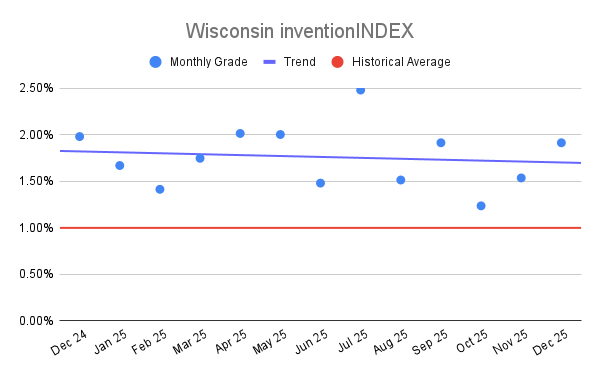 Wisconsin inventionINDEX December 2025
  Wisconsin inventionINDEX Novem
