

The refundable portion of the Wisconsin Research Credit is a statutory mechanism that allows eligible taxpayers to receive a direct cash refund for up to 25% of their current-year research credit that remains after offsetting their total state tax liability. This provision effectively converts a portion of the tax credit from a reduction in tax owed into a liquid asset, specifically benefiting organizations with substantial research expenditures but limited immediate tax liability.
The introduction of refundability into the Wisconsin tax code represents a significant shift in the state’s economic development policy, designed to incentivize innovation at the earliest and most capital-intensive stages of a company’s lifecycle. While the research credit has existed for decades as a nonrefundable incentive, the modern legislative focus on providing liquidity through refunds acknowledges that many high-growth, technology-driven firms, such as biotechnology startups and advanced manufacturers, often lack the net income required to utilize nonrefundable credits in their formative years. By allowing these entities to recover a portion of their Wisconsin-based research expenditures in cash, the state provides a direct subsidy that can be reinvested into further research, workforce expansion, or capital projects.
Historical Evolution and Legislative Foundation
The path to the current 25% refundability threshold has been defined by incremental legislative expansions, reflecting a growing bipartisan consensus on the value of supporting the state’s research and development (R&D) ecosystem. Prior to the 2018 tax year, the Wisconsin research credit was strictly nonrefundable, meaning any credit earned in excess of tax liability could only be carried forward to offset future taxes for a period of up to 15 years.
The first major shift occurred with the passage of 2017 Wisconsin Act 59, which introduced a 10% refundable component for tax years beginning after December 31, 2017. This initial foray into refundability was aimed at helping Wisconsin compete with other regional technology hubs that offered more flexible incentives. The legislature later increased this percentage to 15% for tax years beginning on or after January 1, 2021, and before January 1, 2024. The most recent and significant expansion was enacted through 2023 Wisconsin Act 19 (Senate Bill 70), which raised the refundable cap to 25% for tax years beginning after December 31, 2023.
| Tax Year Period | Maximum Refundable Percentage | Statutory Authority |
|---|---|---|
| Pre-2018 | 0% (100% Nonrefundable) | Pre-Act 59 Statutes |
| 2018 – 2020 | 10% | 2017 Wisconsin Act 59 |
| 2021 – 2023 | 15% | 2021 Wisconsin Budget |
| 2024 and beyond | 25% | 2023 Wisconsin Act 19 |
This historical progression illustrates the state’s commitment to the R&D sector. Industry advocacy groups, such as BioForward, were instrumental in the passage of the 25% increase, arguing that the increased refundability would allow Wisconsin-based firms to better compete for talent and reinvest in the state’s bio-health and manufacturing sectors.
Statutory Framework and Definition of Qualified Research
The legal authority for the research credit and its refundable portion is codified across several sections of the Wisconsin Statutes, depending on the type of taxpayer. Individuals and fiduciaries derive their authority from Wis. Stat. § 71.07(4k), while corporations are governed by § 71.28(4), and insurance companies by § 71.47(4). These statutes provide the fundamental framework for determining which activities qualify for the credit and how the refund must be calculated.
Adoption of Federal Standards with Wisconsin Specificity
Wisconsin generally follows the federal definition of “qualified research” found in Section 41 of the Internal Revenue Code (IRC). To qualify, a taxpayer’s activities must satisfy the four-part test established under federal law:
- Permissible Purpose: The research must be intended to develop a new or improved business component, focusing on performance, reliability, quality, or functional improvements.
- Elimination of Uncertainty: The taxpayer must intend to discover information that would eliminate uncertainty regarding the capability, method, or appropriate design of the product or process.
- Process of Experimentation: The activities must involve a systematic process designed to evaluate one or more alternatives to achieve the desired result, such as modeling, simulation, or trial and error.
- Technological in Nature: The process of experimentation must rely on principles of physical science, biological science, engineering, or computer science.
While the technical definition of research is federal, the geographic scope is strictly limited to Wisconsin. The statutes specify that “qualified research expenses” (QREs) only include expenses incurred for research conducted within the state of Wisconsin. This ensures that the state’s tax expenditures specifically incentivize in-state employment and capital investment.
Qualified Research Expenses (QREs)
The credit is calculated based on the sum of three primary categories of expenditures:
- Wages: Compensation paid to employees directly involved in research activities, including those who supervise or support such activities.
- Supplies: Tangible property consumed or destroyed in the research process, excluding land and depreciable improvements.
- Contract Research: Fees paid to third parties for research performed in Wisconsin on behalf of the taxpayer, generally limited to 65% of the total amount paid (or 75% for research consortia).
The Tiered Credit System
Wisconsin utilizes a tiered system that offers “enhanced” credits for research in specific sectors deemed essential to the state’s industrial core. The amount of the refundable portion is inherently tied to the total credit earned through these tiers.
General Research Rate
For the majority of businesses, the credit is equal to 5.75% of the amount by which the claimant’s QREs for the current year exceed 50% of their average QREs from the three prior years. This is often referred to as the incremental credit, designed to reward companies for increasing their R&D spend. If a taxpayer had no QREs in any of the prior three years—as is common for new startups—the credit rate is 2.875% of the total current-year QREs.
Enhanced Rates for Targeted Industries
To support its historical manufacturing base and emerging clean energy sector, Wisconsin offers an 11.5% credit rate for research activities related to:
- Internal Combustion Engines: This includes the design and development of traditional engines used in vehicles, maritime equipment, and industrial applications.
- Energy Efficient Products: Specifically targeting lighting systems, building automation, and advanced automotive batteries for hybrid or electric vehicles.
For startups in these enhanced sectors with no prior research history, the credit rate is 5.75% of current QREs.
Eligibility and Pass-Through Entity Considerations
The Wisconsin Department of Revenue (DOR) distinguishes between entities that compute the credit and those that may claim the refund. While the research is performed at the business level, the ultimate tax benefit often rests with the owners.
Entities Eligible for the Refund
The following persons or organizations are eligible to claim the 25% refundable portion:
- Individuals.
- Partners in a partnership.
- Shareholders of tax-option (S) corporations.
- Members of limited liability companies (LLCs).
- C-Corporations.
The Role of Pass-Through Entities (PTEs)
Partnerships, LLCs treated as partnerships, and S-corporations are generally prohibited from claiming the research credit at the entity level to offset their own taxes. However, these entities are responsible for performing the underlying research and computing the credit amount on their respective returns (e.g., Form 3 for partnerships or Form 5S for S-corporations).
Once computed, the credit flows through to the partners, members, or shareholders based on their ownership interests. These owners then report their share of the credit on their personal or corporate tax returns. The DOR provides this information through Schedule 3K-1 and 5K-1, which must clearly specify the owner’s share of the current-year credit to allow for the proper calculation of the 25% refundable portion on the owner’s own Schedule R.
Administrative Compliance: Schedule R and the Refund Calculation
Taxpayers must use Wisconsin Schedule R to report and calculate the research credit. The schedule is designed to bifurcate the credit into its refundable and nonrefundable components through a specific “lesser of” formula.
The Refundable Logic
For tax years beginning after December 31, 2023, the refundable portion is determined by comparing two distinct limits on the unused credit. The final refundable amount is the lesser of:
- 25% of the total current-year research credit.
- The unused portion of the current-year credit (total current-year credit minus the amount used to offset the current year’s tax liability).
This logic ensures that the refund is capped at 25% of the earned credit and only applies to the amount that was actually “left over” after paying taxes.
Line-by-Line Breakdown on Schedule R
- Line 16: Represents the total current-year research credit computed.
- Line 17: Calculates the maximum potential refund by multiplying Line 16 by 0.25.
- Line 18: Records the amount of the current-year credit used to offset the taxpayer’s income or franchise tax liability.
- Line 19: Determines the remaining unused credit by subtracting Line 18 from Line 16.
- Line 20: The final refundable portion—the lesser of Line 17 or Line 19.
Any amount remaining on Line 21 (Line 19 minus Line 20) becomes a nonrefundable carryforward that can be used for the next 15 years.
Interaction with Credit Carryforwards and Offset Order
A critical aspect of the DOR’s guidance involves the sequence in which credits must be applied. This priority of application can significantly impact the final cash refund.
The Rule of Prior Year Carryforwards
The DOR explicitly mandates that nonrefundable research credit carryforwards from prior years must be used to offset the current year’s tax liability before any of the current year’s credit is applied. This ordering rule is highly advantageous for taxpayers. By using “old” nonrefundable carryforwards to pay the tax bill first, the taxpayer preserves the “new” current-year credit, making it more likely that the current-year credit remains unused and therefore eligible for the 25% refund.
Non-Refundability of Carryforwards
While carryforwards help “clear the way” for a refund of the current-year credit, the carryforwards themselves can never be made refundable. Only the credit originating in the current taxable year is eligible for the 25% refund mechanism. Once a portion of a current-year credit is designated as nonrefundable and carried forward to the next year, it loses its “refundability” status forever.
Combined Group Dynamics and Restrictions
For corporations that are members of a Wisconsin combined group, the rules for sharing credits introduce additional layers of complexity.
Designated Agent and Refund Distribution
Under Wis. Admin. Code § Tax 2.61(10)(b), the refundable portion of the credit must be claimed on the combined return and is ultimately issued to the “designated agent” of the group. Unlike the nonrefundable portion of the credit, the refundable portion cannot be shared among other members of the group to offset their specific tax liabilities.
Sharing Nonrefundable Portions
A corporation in a combined group is permitted to share its nonrefundable research credit carryforwards with other members of the unitary group, provided they were members during the year the credit originated. However, the originating member must first use the credit to offset its own tax liability before the excess can be distributed to other members on a proportionate basis. Because the refundable portion remains restricted to the member that earned it, combined groups must engage in strategic tax planning to determine whether a member should claim the cash refund or share the nonrefundable portion with a profitable affiliate.
Practical Application: Comprehensive Example
To demonstrate the intersection of these various rules, consider a Wisconsin biotech firm in the 2024 tax year.
Taxpayer Data
- Current-Year Research Credit (Line 16): $200,000.
- Prior-Year Nonrefundable Carryforward: $50,000.
- Wisconsin Income Tax Liability: $60,000.
Step-by-Step Calculation
- First Offset: Apply the $50,000 carryforward against the $60,000 tax liability. The remaining tax liability is now $10,000.
- Second Offset: Apply $10,000 of the $200,000 current-year credit to eliminate the remaining tax liability. The tax owed is now zero.
- Maximum Refund Potential: Calculate 25% of the total current-year credit ($200,000 x 0.25 = $50,000).
- Available for Refund: The unused current-year credit is $190,000 ($200,000 – $10,000).
- Final Refund (Line 20): The lesser of $50,000 (25% limit) or $190,000 (unused amount). The taxpayer receives a $50,000 cash refund.
- Carryforward Calculation: The remaining nonrefundable portion to be carried to 2025 is $140,000 ($190,000 – $50,000).
Local State Revenue Office Guidance and Compliance Requirements
The Wisconsin Department of Revenue (DOR) provides extensive administrative resources, including Publication 131 and various “Common Questions” (FAQs), to ensure taxpayer compliance.
Audit and Documentation Standards
Given the cash-out nature of the refundable portion, the DOR maintains a high level of scrutiny regarding the qualification of research activities and expenses. Guidelines published by the DOR emphasize that the burden of proof rests with the taxpayer. Essential documentation for a successful claim includes:
- Contemporary Records: Project notes, lab journals, and technical reports that demonstrate the “process of experimentation”.
- Wage Apportionment: Detailed logs or time-tracking data that link specific employee hours to qualified research activities conducted within Wisconsin.
- Vendor Contracts: For contract research, taxpayers must provide contracts and invoices demonstrating that the work was performed in Wisconsin and that the taxpayer retained the substantial rights to the research.
Repeal of Personal Property Tax and Manufacturing Classification
Beginning in 2024, Wisconsin Act 12 repealed the personal property tax, which historically served as the basis for classifying an establishment as “manufacturing” for tax purposes. The DOR has clarified that any establishment classified as manufacturing prior to January 1, 2024, is presumed to remain engaged in manufacturing for purposes of claiming the credit. For new businesses, the taxpayer must submit a written request to the DOR’s Manufacturing & Utility Bureau to receive the classification required to potentially qualify for enhanced R&D rates.
Economic Impact and Future Outlook
The shift to a 25% refundable credit has significant implications for Wisconsin’s economic competitiveness. In high-cost sectors like pharmaceutical development and aerospace manufacturing, the ability to recover one-quarter of R&D costs in cash represents a substantial reduction in the net cost of innovation.
Supporting the “Burn Rate” of High-Tech Startups
For venture-backed startups, the refundable credit directly improves the company’s “burn rate”—the speed at which it consumes its investment capital. By receiving a refund check from the state, these companies can extend their operational runway, delaying the need for further dilutive equity financing. This makes Wisconsin a more attractive location for technical founders and investors.
Strategic Reinvestment
For mature manufacturers, the 25% refund serves as a catalyst for reinvesting in “Legacy” industries. For example, a manufacturer of internal combustion engines that earned an 11.5% credit but had no state tax liability due to the Manufacturing and Agriculture Credit (MAC) could now receive a cash refund to upgrade its Wisconsin testing facilities. This “synergy of credits” is a unique feature of the Wisconsin tax code that bolsters the state’s appeal to large-scale producers.
Final Thoughts
The refundable portion of the Wisconsin Research Credit is a powerful fiscal tool that bridges the gap between traditional tax relief and direct R&D subsidies. By increasing the refundable threshold to 25%, the state has signaled its intent to remain a leader in fostering innovation and industrial growth. To maximize the benefit of this provision, taxpayers must ensure rigorous adherence to the DOR’s documentation requirements, correctly apply the offset priority rules to preserve current-year refundability, and utilize the specialized rates available for engines and energy-efficient products. As the 25% refund becomes the standard for the 2024 tax year and beyond, it will likely serve as a cornerstone of Wisconsin’s strategy to attract, retain, and scale the world’s most innovative companies within its borders.





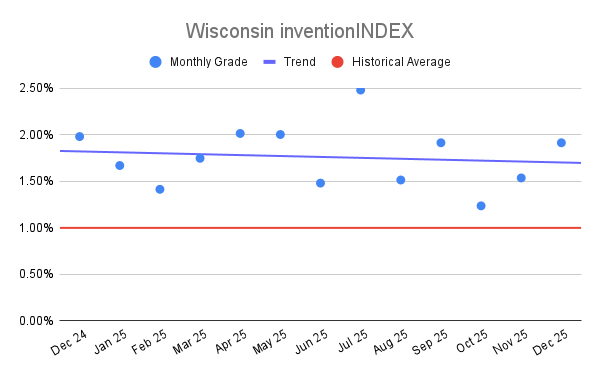 Wisconsin inventionINDEX December 2025
  Wisconsin inventionINDEX Novem
