

For tax years beginning after December 31, 2023, the refundable portion of the Wisconsin research tax credit has been increased to 25 percent of the current year’s earned credit. This change enables innovative businesses to receive a direct cash payment for up to one-quarter of their qualifying research expenses that exceed their annual state income or franchise tax liability.
The escalation of the refundable percentage from 15 percent to 25 percent represents a significant shift in Wisconsin’s fiscal strategy, transitioning the Research and Development (R&D) credit from a traditional tax offset into a hybrid incentive that acts as a direct subsidy for technological advancement. Historically, the primary challenge for capital-intensive industries and early-stage startups has been the “trapped credit” phenomenon, where high R&D expenditures generate substantial credits that cannot be utilized due to insufficient current-year profitability or the specificities of Wisconsin’s single-sales factor apportionment. By authorizing a 25 percent refund, the state legislature, via 2023 Wisconsin Act 19, has significantly lowered the after-tax cost of innovation, providing immediate liquidity that can be redeployed into personnel, equipment, and further experimentation. This evolution reflects a growing recognition of the competitive landscape in the Midwest, where states increasingly use refundable tax credits as a primary tool for business attraction and retention. The 25 percent threshold is not merely a quantitative increase; it is a qualitative change in how the state supports the lifecycle of a research project, ensuring that the economic “spillover effects” of innovation—such as job creation and intellectual property development—are rewarded regardless of a firm’s immediate tax position.
Legislative Context and Statutory Evolution
The modern Wisconsin research credit is established across several chapters of the Wisconsin Statutes to accommodate different taxpayer classifications. Specifically, Section 71.07(4k) governs the credit for individuals and pass-through entity owners, Section 71.28(4) applies to corporations, and Section 71.47(4) applies to insurance companies. The transition toward refundability has been a multi-stage process reflecting the state’s shifting economic priorities.
Prior to the 2018 tax year, the Wisconsin research credit was entirely nonrefundable. While this model benefited established and highly profitable corporations, it offered little immediate value to the manufacturing and biotech sectors, which often face long lead times between R&D investment and taxable revenue. The first break from this model occurred with 2017 Wisconsin Act 59, which introduced a 10 percent refundable component for tax years beginning after December 31, 2017. This was later increased to 15 percent by 2021 Wisconsin Act 58 for tax years beginning on or after January 1, 2021.
The current 25 percent regime was enacted under 2023 Wisconsin Act 19, the state’s executive budget act for the 2023-2025 biennium. This act amended Wis. Stat. § 71.28(4)(k) and its corresponding sections for individuals and insurers, specifically stating that for tax years beginning after December 31, 2023, the amount of the claim not used to offset tax due, up to 25 percent of the allowable current-year claim, shall be certified for payment to the claimant.
| Legislative Milestone | Effective Date (Tax Years) | Refundable Percentage | Statutory Reference |
|---|---|---|---|
| Pre-2018 Statutes | Before Jan 1, 2018 | 0% (Nonrefundable) | N/A |
| 2017 Wisconsin Act 59 | Jan 1, 2018 – Dec 31, 2020 | 10% | § 71.28(4)(k)1.a. |
| 2021 Wisconsin Act 58 | Jan 1, 2021 – Dec 31, 2023 | 15% | § 71.28(4)(k)1.b. |
| 2023 Wisconsin Act 19 | After Dec 31, 2023 | 25% | § 71.28(4)(k)1.c. |
This table illustrates the aggressive trajectory Wisconsin has taken to monetize R&D credits. The decision to reach 25 percent was heavily influenced by the accumulation of nearly $800 million in unused research credits held by corporations, which signaled that the nonrefundable nature of the credit was impeding its effectiveness as a real-time incentive.
Core Eligibility and Taxpayer Classifications
The refundable portion of the research credit is broadly available to participants in the Wisconsin economy, but the administrative mechanism for claiming the refund depends on the legal structure of the business.
Direct Claimants: Corporations and Individuals
C-corporations and individuals (including sole proprietors) claim the credit directly on their annual income or franchise tax returns using Schedule R. For these entities, the credit serves a dual purpose: it first eliminates any existing tax liability for the year, and any remaining portion is then evaluated for the 25 percent refund. If a C-corporation has zero tax liability, it can immediately access the full 25 percent of its earned credit as a cash refund, while the remaining 75 percent is carried forward as a nonrefundable credit for up to 15 years.
Pass-Through Entities: S-Corporations, Partnerships, and LLCs
Pass-through entities do not claim the credit or the refund at the entity level. Instead, the partnership, LLC, or tax-option (S) corporation must compute the credit based on its Wisconsin-based research activities and then provide each partner, member, or shareholder with their proportionate share of the credit via Schedule 3K-1 or 5K-1.
The individual owners then report this credit on their own Wisconsin tax returns. The refundability rules apply to the owner’s final tax position. For example, if a partner in a research-heavy medical technology firm receives a $50,000 credit share and has no personal Wisconsin tax liability, that partner is eligible for a $12,500 refund (25 percent of $50,000). This structure is particularly vital for startups, where the business itself is not yet profitable, but the founders or investors can benefit from the credit to offset other income or receive cash liquidity.
Entities Ineligible for the Refund
While the credit flows through most entities, the Department of Revenue clarifies that the entities themselves cannot claim the refund. Furthermore, certain non-profit or tax-exempt entities may only claim the credit to the extent they have unrelated business taxable income (UBTI). If a tax-exempt entity has no UBTI and thus no tax liability, the 25 percent refund mechanism still applies to the credit they earned from qualified research activities performed in Wisconsin.
Defining Qualified Research and Expenses
The eligibility for the 25 percent refund is predicated on the proper identification of Qualified Research Expenses (QREs). Wisconsin heavily leverages the definitions found in Internal Revenue Code (IRC) Section 41, but it imposes strict geographic and industry-specific constraints that are unique to the state’s tax code.
The Four-Part Test in a Wisconsin Context
To be eligible for the credit, the activities must pass the federal “Four-Part Test” while being physically performed within the state of Wisconsin.
- Permissible Purpose: The activity must relate to a new or improved function, performance, reliability, or quality of a business component.
- Elimination of Uncertainty: The taxpayer must intend to discover information that would eliminate uncertainty regarding the capability, method, or design of the business component.
- Process of Experimentation: The research must involve a systematic process of evaluating alternatives, such as through trial and error, modeling, or simulation.
- Technological in Nature: The process of experimentation must rely on the “hard sciences,” such as engineering, physics, chemistry, biology, or computer science.
The Wisconsin Geographic Requirement
The most critical distinction for the Wisconsin credit is that the expenses must be “incurred in Wisconsin”. If a company has a research lab in Madison and another in Chicago, only the Madison-based expenses qualify. In cases where research is conducted across state lines and the exact Wisconsin portion is difficult to isolate, the law requires a “reasonable allocation” to the state.
Included and Excluded Expenses
Eligible expenses for the Wisconsin credit include:
- Wages: Only the portion of wages paid to employees for time spent directly performing, supervising, or supporting research in Wisconsin.
- Supplies: Non-depreciable tangible property used in the research process within Wisconsin.
- Contract Research: Generally, 65 percent of the amount paid to third parties for research conducted in Wisconsin is qualifying. This is increased to 75 percent for payments to qualified research consortiums and 100 percent for certain payments to eligible small businesses or federal labs, following federal guidelines adopted by the state.
Wisconsin explicitly excludes compensation used to compute the development zones credit from being counted as a QRE for the research credit. This prevents the “stacking” of multiple state credits on the same dollar of wage expenditure.
Tiered Rate Structure and the 25% Refund Calculation
Wisconsin does not utilize a single credit rate. Instead, it offers a tiered incentive system that favors specific industrial sectors and the manufacturing of energy-efficient goods. The 25 percent refundable rule applies to all three of the following research credit categories.
General Research Credit
The standard rate for qualified research is 5.75 percent. This credit is calculated on the amount of QREs that exceed a “base amount,” which is typically 50 percent of the average QREs over the preceding three years. For startups with no prior QRE history, the rate is 2.875 percent of the current year’s total QREs.
Internal Combustion Engine (ICE) Credit
Wisconsin provides a “Super R&D” rate of 11.5 percent for research related to designing internal combustion engines for vehicles. The statutory definition of “internal combustion engine” is broad, including substitute products such as fuel cells, electric drives, and hybrid drives used in motorcycles, trucks, generators, and construction equipment. Startups in this sector qualify for a 5.75 percent rate on their total current-year spend.
Energy Efficient Products Credit
The 11.5 percent rate also applies to research involving the design and manufacturing of energy-efficient lighting systems, building automation and control systems, or automotive batteries for hybrid vehicles. Similar to the ICE credit, a 5.75 percent rate applies if there are no prior years of research activity.
| Activity Type | Credit Rate on Incremental Spending | Credit Rate for Startups (No Prior QREs) |
|---|---|---|
| General Qualified Research | 5.75% | 2.875% |
| Internal Combustion Engines | 11.5% | 5.75% |
| Energy Efficient Products | 11.5% | 5.75% |
The 25 percent refundable portion is calculated based on the total sum of credits earned across these three categories.
Administrative Guidance on the “Lesser Of” Computation
The Department of Revenue (DOR) provides specific guidance on how the 25 percent refund must be computed to ensure it does not exceed the statutory limits. This calculation is performed on Schedule R.
The Refund Formula
The refundable portion of the research credit for tax years after 2023 is the lesser of:
- 25 percent of the total current year research credit computed; or
- The remaining current year research credit after it has been used to offset the current year tax liability.
Ordering Rules: The Advantage for Taxpayers
A vital piece of local revenue office guidance concerns the order in which credits are applied. Wisconsin law mandates that nonrefundable credit carryforwards from prior years be used to offset the current year’s tax liability before the current year’s newly earned research credit is applied.
This ordering rule is mathematically advantageous. By exhausting nonrefundable carryforwards first, the taxpayer preserves as much of the current year’s credit as possible for the 25 percent refund calculation. This policy ensures that the 25 percent refund mechanism provides the maximum possible liquidity to the firm.
Computational Logic and the Cash Refund
If the current year’s credit is $100,000 and the tax liability is $0, the refund is the lesser of $25,000 (25% of 100k) or $100,000 (the remainder). Thus, the refund is $25,000.
However, if the current year’s credit is $100,000 and the tax liability is $90,000, the current credit first wipes out the tax liability, leaving a $10,000 remainder. The refund then becomes the lesser of $25,000 (25% of 100k) or $10,000 (the remainder). Thus, the refund is only $10,000.
Mathematical Example: The 25% Refund in Practice
To illustrate the interplay between tax liability, carryforwards, and the 25 percent refundable limit, consider the following comprehensive example for a Wisconsin manufacturer in the 2024 tax year.
Scenario: Advanced Engine Systems, LLC
- Entity Type: C-Corporation
- Current Year Qualified Research Expenses (QREs): $2,000,000
- Average QREs (Prior 3 Years): $1,200,000
- Current Year Wisconsin Tax Liability: $100,000
- Prior Year Research Credit Carryforward: $50,000
Step 1: Calculate the Current Year Credit
The company performs research related to internal combustion engines, qualifying for the 11.5 percent rate.
- Base Amount: $1,200,000 × 0.50 = $600,000.
- Incremental QREs: $2,000,000 – $600,000 = $1,400,000.
- Total Credit Earned: $1,400,000 × 0.115 = $161,000.
Step 2: Apply Credits to Tax Liability (Ordering Rule)
Following DOR guidance, the $50,000 nonrefundable carryforward is used first.
- Tax Due after Carryforward: $100,000 – $50,000 = $50,000.
- Tax Due after Current Credit: The current year’s $161,000 credit is applied to the remaining $50,000 liability.
- Final Tax Liability: $0.
- Remaining Current Year Credit: $161,000 – $50,000 = $111,000.
Step 3: Compute the 25% Refundable Portion
The refundable portion is the lesser of two calculations:
- 25% Cap: $161,000 × 0.25 = $40,250.
- Unused Current Credit: $111,000.
- Result: The refund is $40,250.
Step 4: Determine the Final Carryforward
- Total Unused Portion: $111,000 – $40,250 = $70,750.
- Carryforward Duration: This $70,750 is nonrefundable and can be carried forward for 15 years to offset future Wisconsin taxes.
| Item | Value |
|---|---|
| Current Year Research Credit | $161,000 |
| Used to Offset Current Tax | $50,000 |
| Remaining Current Credit | $111,000 |
| 25% Refundable Cash Award | $40,250 |
| Remaining Balance to 15-Year Carryforward | $70,750 |
This example demonstrates how a company with a $100,000 tax liability can still receive a $40,250 cash refund from the state, effectively turning their R&D spend into immediate capital.
Combined Reporting and Unitary Group Guidance
Wisconsin utilizes a combined reporting system for unitary businesses. This adds a layer of complexity to the 25 percent refundable calculation, as credits are generally considered attributes of the individual corporation that earned them.
Per-Member Computation
Each member of a combined group must compute its own research credit on a separate-entity basis using Schedule R. This includes establishing its own three-year average of QREs. The 25 percent refundable limit applies to the credit computed by each specific member.
Intra-Unitary Credit Sharing
While a corporation is not required to share its nonrefundable research credits, Wis. Stat. § 71.255(6)(c) allows a member to share its unused nonrefundable credits with other members of the unitary group. However, only the nonrefundable portion can be shared. A member must first use its research credit and any carryforwards to offset its own tax liability before the credits can be shared with other group members on a proportionate basis.
Performance vs. Funding Rules
For combined group members, the definition of QREs is slightly modified to prevent double-counting. If research is funded by one member but performed by another, the expenses are attributed to the member performing the research. The reimbursement payment from the funding member is neutralized and cannot be claimed as a QRE by the funder.
Filing Form 6
Combined groups report their refundable research credits on Form 6, Part III, line 13, rather than on the standard Schedule CR used by separate filers. The nonrefundable portion is reported on Form 6, Part V, line 1. This distinction is critical for combined filers to ensure the refund is properly processed by the Department of Revenue’s central systems.
Administrative Compliance: Forms and Add-Backs
To secure the 25 percent refund, taxpayers must adhere to a rigid set of documentation and filing procedures. Failure to follow these rules can result in the denial of the credit and potential penalties upon audit.
Filing Deadlines
The research credit must be claimed on a timely filed Wisconsin tax return (including extensions) within four years of the un-extended due date of the return. Amended claims are permitted within this four-year window.
Schedule R Mechanics
Every taxpayer claiming the research credit must file Schedule R.
- Lines 9-13: Used to record the prior three years of QREs to establish the base amount hurdle.
- Line 16: Represents the total credit computed for the current year.
- Line 17: This is the critical line for the 25 percent rule, where the Line 16 amount is multiplied by 0.25 to find the maximum possible refund.
- Line 20: The final refundable portion is determined here, using the “lesser of” logic.
Schedule CF and Carryforward Tracking
For the 75 percent of the credit that remains nonrefundable (as well as any portion of the 25 percent that could not be refunded because it was used to offset tax), taxpayers must file Schedule CF.
- Schedule CF is used to track the “vintage” of each credit year.
- Because Wisconsin uses a 15-year carryforward period, the state requires taxpayers to use a first-in, first-out (FIFO) method to ensure the oldest credits are used before they expire.
The “Add-Back” Requirement: Credits as Income
A unique and often overlooked provision of Wisconsin revenue guidance is that the research credit is itself considered taxable income.
- The entire amount of the credit computed on Schedule R for the year must be reported as an addition to income on the Wisconsin return in the year it is computed.
- This applies to both the refundable and nonrefundable portions, and it is true even if the nonrefundable portion is carried forward and not used for several years.
| Entity Type | Wisconsin Return Form | Add-Back Line for Credit Income |
|---|---|---|
| Individuals | Form 1 or 1NPR | Schedule AD |
| C-Corporations | Form 4 or 6 | Form 4, Part II / Form 6, Part II |
| S-Corporations | Form 5S | Schedule 5K, Line 1 |
This “add-back” requirement effectively reduces the net value of the credit by the taxpayer’s effective tax rate, as the state is taxing the very incentive it is providing.
Economic Policy: Addressing the Deferred Tax Asset Problem
The rationale behind the 25 percent refundable portion is deeply rooted in the financial reporting requirements of large corporations. Under Generally Accepted Accounting Principles (GAAP), unused tax credit carryforwards are recorded as Deferred Tax Assets (DTAs) on a company’s balance sheet.
The Write-Down Risk
If a company generates millions in Wisconsin R&D credits but lacks the state tax liability to use them, it must evaluate whether those credits will likely expire after 15 years. If the probability of expiration is high, GAAP requires a “valuation allowance” or a write-down of the asset. These write-downs are recorded as losses on publicly available financial statements, which can damage a company’s stock price and perceived financial health.
The 25% Refund as a Solution
By making 25 percent of the credit refundable, the state of Wisconsin has essentially guaranteed that at least one-quarter of the R&D incentive will be realized as cash immediately. This drastically reduces the need for valuation allowances and DTA write-downs, making Wisconsin a much more attractive environment for firms with massive R&D budgets but global sales footprints. It ensures that the state’s tax policy is supportive of a company’s “bottom line” in a way that nonrefundable credits cannot.
The Future of Wisconsin R&D: SB 482 and the 50-Year Carryforward
Even with the 25 percent refundable component in place, the Wisconsin Legislature is currently considering a monumental expansion of the research credit’s utility via Senate Bill 482 (SB 482) and Assembly Bill 494 (AB 494).
Extending the 15-Year Horizon
Under current law, any nonrefundable research credit not used within 15 years expires and is lost. SB 482 proposes to increase this carryover period from 15 years to 50 years.
Strategic Implications of a 50-Year Carryforward
A 50-year carryforward would essentially make the research credit a permanent asset. This would:
- Eliminate Valuation Allowances: Almost no company would need to write down their Wisconsin R&D credits if they had half a century to use them.
- Incentivize Long-Cycle R&D: Industries like aerospace and pharmaceutical development, which may take 20 years to bring a product to market, would have total certainty that their early-stage R&D credits would remain available once they reach profitability.
- Retroactive Benefits: The bill specifies that the 50-year extension would apply retroactively to any existing credits that have not yet expired, providing an immediate boost to the balance sheets of Wisconsin manufacturers.
As of the end of 2025, SB 482 has gained significant traction, having been recommended for passage by the Senate Committee on Agriculture and Revenue. While it does not change the 25 percent refundable percentage, it fundamentally alters the value of the remaining 75 percent.
Industry Deep Dive: Internal Combustion and Energy Efficiency
The 25 percent refund is particularly impactful for the sectors qualifying for the 11.5 percent “Super R&D” rate. These sectors are the backbone of Wisconsin’s manufacturing economy and are currently undergoing rapid technological transitions.
Internal Combustion and “Substitute Products”
The higher rate for internal combustion engines was originally intended to support Wisconsin’s traditional engine manufacturing base. However, the statutory inclusion of “substitute products” like fuel cells, electric drives, and hybrid drives means that the 11.5 percent rate (and the subsequent 25 percent refund) is a primary driver for the state’s transition to green transportation.
A company developing a new electric motorcycle or a hydrogen-powered industrial generator in Wisconsin can claim 11.5 percent of their incremental R&D costs and receive 25 percent of that back as a refund, even if they haven’t sold a single unit yet.
Energy Efficiency and Building Automation
The energy-efficient products credit targets the “smart building” and battery sectors. This includes R&D for:
- Building automation and control systems that optimize HVAC and lighting.
- Automotive batteries specifically designed for hybrid vehicles.
- Energy-efficient lighting systems.
By offering the 25 percent refund on these high-rate credits, Wisconsin has positioned itself as a hub for the “clean-tech” manufacturing sector, providing the liquidity necessary for the high-risk, high-reward nature of energy innovation.
Local State Revenue Office Audit and Documentation Guidance
The Wisconsin Department of Revenue (DOR) maintains a high standard for auditing research credit claims, especially those involving large refunds. The DOR Customer Service Bureau and individual audit teams provide specific guidance on the records taxpayers must retain to defend their 25 percent refundable claim.
Project-Based Recordkeeping
Taxpayers should not simply rely on general ledger accounting. The DOR expects a nexus between specific research projects and the associated costs.
- Wages: Contemporaneous time-tracking or project-allocation logs that show exactly which employees worked on which projects and for how long.
- Qualified Research Expenses: Invoices and receipts for supplies, with clear documentation that they were used “directly and exclusively” in a research process.
- Scientific Evidence: Technical reports, innovation logs, photographs of testing, and protocols that prove a “process of experimentation” took place.
Statute of Limitations for Record Retention
Standard revenue office guidance suggests retaining records for at least four years from the date the return was filed. However, if a credit is being carried forward, the records for the year the credit was generated must be kept for as long as the credit remains on the books plus the statutory period for the year it is finally used.
| Record Type | Retention Period Guidance |
|---|---|
| Returns with Carryforwards | 21 years from extended due date |
| Audit Determination Records | 10 years from final determination |
| General R&D Records | 15 years (length of carryforward) |
This long-term retention requirement is essential because the DOR can audit the validity of a credit generated in 2024 when it is used to offset tax in 2035.
Final Thoughts
The 25 percent refundable percentage for the Wisconsin research credit, effective for tax years beginning after December 31, 2023, represents the most significant enhancement to the state’s corporate incentive suite in over a decade. By moving from a 15 percent to a 25 percent threshold, the state has effectively doubled the original refundable capacity established in 2018, providing a direct response to the “trapped credit” problem that has historically plagued Wisconsin’s largest and most innovative employers.
This policy does more than just provide cash; it aligns Wisconsin’s tax code with the modern financial reality of global R&D. By allowing companies to monetize a meaningful portion of their credits, the state mitigates the risk of financial statement losses and valuation allowances, thereby improving the “site selection” attractiveness of Wisconsin for high-tech investments.
For the taxpayer, the 25 percent refund is a powerful tool for cash flow management, particularly when combined with the 11.5 percent “Super R&D” rates and the favorable ordering rules that prioritize nonrefundable carryforwards. As the state looks toward a possible 50-year carryforward future, the 25 percent refund remains the immediate gold standard for state-level R&D incentives, ensuring that the spirit of experimentation and technical discovery continues to find a fertile and financially supportive home in Wisconsin.





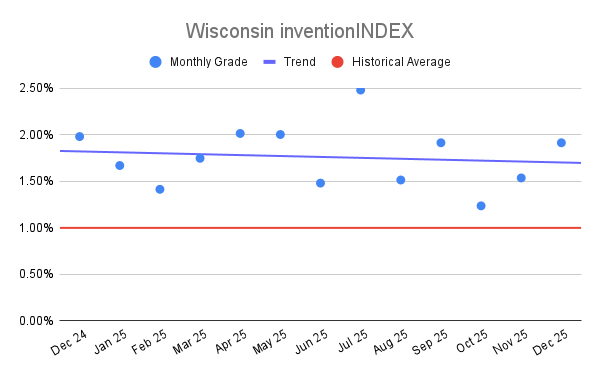 Wisconsin inventionINDEX December 2025
  Wisconsin inventionINDEX Novem
