

A combined group is a unified tax-reporting unit composed of corporations under 50% or more common control that are engaged in a unitary business. In the Wisconsin R&D credit framework, it serves as the mechanism for sharing nonrefundable credits between group members to lower the aggregate tax burden of the integrated enterprise.
The transition to a combined reporting regime in Wisconsin, which became effective for taxable years beginning on or after January 1, 2009, represented a paradigm shift in the state’s approach to corporate franchise and income taxation. Prior to this implementation, Wisconsin utilized a separate entity filing system where each legal corporation was viewed as a distinct taxpayer, regardless of its economic integration with parent or subsidiary entities. The move to a combined reporting system, codified primarily under Wisconsin Statute § 71.255, was designed to accurately capture the economic reality of modern, multi-tiered corporate structures and to ensure that income derived from a unitary business is fairly apportioned to the state. In the specific context of the Wisconsin Research and Development (R&D) tax credit, the combined group structure is not merely a reporting convenience but a fundamental pillar that governs how credits are calculated, allocated, shared, and ultimately utilized to offset the state tax liabilities of an entire economic enterprise.
The Statutory Definition and Construction of a Combined Group
At its core, a combined group is defined by the Wisconsin Department of Revenue (DOR) and the state legislature as the group of all persons whose income and apportionment factors are required to be taken into account under the unitary business principle. The legal foundation for this is found in § 71.255(1)(a), which establishes the "combined group" as the central unit for determining a member's share of net business income or loss apportionable to Wisconsin. To determine whether a corporation must be included in a combined group, the DOR provides a three-tiered test that examines common control, the existence of a unitary business, and the application of "water’s edge" rules.
The Standard of Common Ownership and ControlThe first prerequisite for the formation of a combined group is the presence of a "commonly controlled group". Wisconsin law provides a rigorous definition of common control, primarily centered on the ownership of stock representing more than 50% of the voting power of the corporations involved. The statutes identify three primary configurations of such groups. First, a parent-subsidiary chain exists where a parent corporation owns more than 50% of the voting power of at least one other corporation, and subsequent corporations in the chain are similarly owned. Second, a brother-sister configuration occurs where two or more corporations are owned by a common owner—regardless of whether that owner is an individual, a trust, or another corporation—who possesses more than 50% of the voting power of each. Third, the law accounts for "stapled entities," where the interests in two or more corporations cannot be transferred separately, effectively creating a single economic unit for control purposes.
The Department of Revenue’s guidance emphasizes that the determination of "voting power" is not restricted to a simple tally of shares of record. Under Tax 2.61(3)(d), the DOR may look beyond the formal corporate records to express or implied agreements that restrict a shareholder's ability to vote or mandate that they vote in a specific manner. This ensures that the combined group accurately reflects the actual locus of economic control rather than mere legal form.
| Group Type | Statutory Basis | Primary Control Mechanism |
|---|---|---|
| Parent-Subsidiary | § 71.255(1)(c)1 | Vertical chain with >50% voting power ownership |
| Brother-Sister | § 71.255(1)(c)2 | Horizontal ownership by a common person or entity |
| Stapled Entities | Tax 2.61(3)(d)2 | Interests that cannot be separately transferred |
| Controlled Group Election | § 71.255(2m) | 10-year binding election to treat all members as unitary |
Once common control is established, the second test requires that the corporations be engaged in a "unitary business". Wisconsin defines a unitary business as a single economic enterprise where the components are sufficiently interdependent, integrated, and interrelated through their activities so as to provide a synergy and mutual benefit. This definition is intended to be construed to the broadest extent permitted by the U.S. Constitution, drawing upon decades of federal case law that established the "three unities" and the "flow of value" tests.
The Wisconsin Administrative Code under Tax 2.62 provides an analytical framework for identifying a unitary business, focusing on several key indicators of interdependence. Functional integration is evidenced by centralized support functions such as centralized purchasing, marketing, advertising, accounting, and, critically for this analysis, centralized research and development (R&D) departments. When a parent corporation maintains a central lab that provides technical assistance and proprietary materials to subsidiaries, those entities are likely engaged in a unitary business. Furthermore, "unity of use" is identified through centralized management, interlocking directorates, and common employee training programs, which suggest a shared executive force directing the entire enterprise.
The DOR also looks for a "flow of value," which exists when participants contribute in a non-trivial way to each other’s profitability or are dependent on each other for achieving business objectives. This includes intercorporate sales, leases, and the lending of funds or guaranteeing of loans. In the absence of clear functional integration, a group may still be considered unitary if it makes a "controlled group election" under § 71.255(2m). This election allows a commonly controlled group to treat all of its members as part of a single unitary business for a binding ten-year period, effectively bypassing the fact-specific inquiry into functional integration in exchange for administrative simplicity.
The Water's Edge Limitation and Global ExclusionsThe third test in the formation of a combined group is the "water's edge" rule, which generally limits the combined group to domestic corporations. Under § 71.255(2)(d), corporations where 80% or more of their worldwide income is "active foreign business income" are excluded from the combined report. These "80/20" corporations are deemed to be operating outside the domestic economic sphere for combination purposes, although they must still compute and apportion their Wisconsin income from the unitary business on a separate entity basis. This prevents the distortion of state income by excluding foreign operations that do not have a substantial economic nexus with the domestic unitary enterprise.
The Wisconsin Research and Development Tax Credit: Scope and Modifications
The Wisconsin research credit, primarily governed by § 71.28(4), is designed to incentivize investment in high-technology, manufacturing, and biotech sectors within the state. While the credit is fundamentally based on the federal research credit defined in Section 41 of the Internal Revenue Code (IRC), Wisconsin has enacted significant modifications that tailor the benefit to the state’s economic priorities.
Definition of Qualified Research Expenses (QREs)To qualify for the Wisconsin credit, expenses must meet the federal "four-part test" under IRC § 41(d): the research must be technological in nature, intended to develop a new or improved business component, involve a process of experimentation, and aim to eliminate technical uncertainty. However, Wisconsin law strictly limits "qualified research expenses" (QREs) to those incurred for research conducted specifically within the State of Wisconsin. This geographical limitation is absolute; no out-of-state activities can be attributed to the Wisconsin credit calculation.
A critical distinction between Wisconsin and current federal law lies in the state’s adoption of the IRC. Wisconsin generally references the IRC as amended to December 31, 2022, but it has explicitly not adopted the changes introduced by Section 13206 of the Tax Cuts and Jobs Act (TCJA). Consequently, while federal law now requires the amortization of R&D expenses over five years, Wisconsin continues to allow the immediate expensing of these costs for purposes of the state credit calculation, following the pre-2022 federal provisions.
| Expense Category | Wisconsin Treatment | Statutory Reference |
|---|---|---|
| In-house Wages | 100% of wages for research, supervision, or support in WI | § 71.28(4)(ad)4 |
| Research Supplies | 100% of tangible property costs used in WI R&D | § 71.28(4)(ad)4 |
| Computer Leasing | Amounts paid for computers used in WI research | § 71.28(4)(ad)4 |
| Contract Research | Generally 65%; 75% for consortia; 100% for universities | § 71.28(4)(ad)4 |
The Wisconsin credit utilizes a tiered rate structure that distinguishes between general research and specialized technological fields. The standard credit rate is 5.75% of the excess of current-year QREs over a base amount. For research related to internal combustion engines and certain energy-efficient products (such as hybrid vehicle batteries or building automation systems), the credit rate is doubled to 11.5%.
The base amount is generally 50% of the average QREs for the three preceding taxable years. If a taxpayer had no QREs in any of those three years, they are treated as a "startup" and may claim a credit equal to 2.875% of their current-year QREs (or 5.75% for the enhanced categories) without calculating an excess over a base.
The mathematical representation of the credit calculation for a general research claimant is:
$$ \text{Credit} = 0.0575 \times \left( \text{QRE}_{\text{current}} - \left( 0.50 \times \frac{\text{QRE}_{t-1} + \text{QRE}_{t-2} + \text{QRE}_{t-3}}{3} \right) \right) $$
Research Credit Mechanics within the Combined Group Structure
When corporations operate as a combined group, the determination of the R&D credit involves a complex interaction between individual member activities and group-level sharing.
The Performer Principle and Intercompany FundingOne of the most vital rules regarding R&D credits in a combined group is the "Performer Principle". For combined group members, the definition of QREs is modified so that research funded by one member but performed by another member is considered the QRE of the corporation performing the research. In this scenario, the funding arrangement is effectively ignored. The member performing the research includes the actual costs (such as wages and supplies) in its own Schedule R calculation, while the funding member may not compute any credit on the same expenses. This rule prevents the "contract research" discount (the 65% limitation) from applying to work done within the same unitary business, ensuring the full economic cost of the research is captured by the group.
The Sharing of Nonrefundable Research CreditsWhile credits are generally viewed as attributes of the specific corporation that generated them, § 71.255(6)(c) provides an exception allowing combined group members to share certain nonrefundable research credits. This sharing is elective; a corporation is not required to share its credits and may choose to carry them forward for its own future use.
To be eligible for sharing, a credit must be "sharable". A corporation can generally only share its research credits if it was a member of the same combined group during the year the credit originated. For credits originating prior to 2009, they are sharable if the corporation would have been a member of that same group had combined reporting been required at that time. The DOR clarifies that the mere addition of new members or the departure of old members does not create a "new" combined group for sharing purposes.
The 7.9% Tax Limitation on Shared CreditsThe amount of shared credit that a member can utilize to offset its tax liability is strictly capped. Under the instructions for Form 6CS, the maximum amount of a member’s tax liability that may be offset by shared research credits is limited to the tax attributable to that member’s share of combined unitary income. This is calculated by multiplying the member's share of combined unitary income by the statutory corporate tax rate of 7.9%.
The priority of credit application follows a specific order:
- Individual Application: Each member must first apply its own available credits (including its own R&D credits and carryforwards) against its gross tax liability.
- Separate Entity Priority: Credits must be used against tax liability arising from "separate entity items" (those reported on Form N) before they can offset the tax from combined unitary income.
- Sharing of Remainder: Only after a member has exhausted its own credits can it receive shared credits from other members to offset any remaining tax on its share of combined unitary income.
The Evolution of Credit Refundability in Wisconsin
The Wisconsin R&D credit has evolved from a purely nonrefundable credit to a hybrid model that provides significant direct cash benefits to claimants. This refundability is a critical feature for research-heavy firms that have not yet achieved profitability or that have substantial credit carryforwards.
Progression of the Refundable PercentageThe legislature has incrementally increased the refundable portion of the research credit over the last several years. For tax years beginning after December 31, 2017, the credit became 10% refundable. This was increased to 15% for years beginning on or after January 1, 2021. Most recently, for tax years beginning after December 31, 2023, the refundable portion has been increased to 25%.
The Non-Sharable Nature of Refundable CreditsA vital distinction in combined group guidance is that the refundable portion of the credit cannot be shared among group members. Administrative rule Tax 2.61(10)(b) mandates that refundable credits computed by a member must be claimed on the combined return and are refunded directly to the group’s "designated agent".
The refundable amount is the lesser of two values:
- 25% of the total current-year research credit computed on Schedule R.
- The portion of the current-year credit that remains after offsetting the member's own current-year tax liability.
It is important to note that prior-year credit carryovers have no bearing on the current year's refundable calculation, although they are applied to current tax liability before the current year's credit is considered for its refundable portion. Any unused portion of the research credit that is not refundable may be carried forward for 15 years.
| Tax Year Start Date | Refundable Percentage | Carryforward Period |
|---|---|---|
| Pre-2018 | 0% (Nonrefundable) | 15 Years |
| 2018 - 2020 | 10% | 15 Years |
| 2021 - 2023 | 15% | 15 Years |
| 2024 and Later | 25% | 15 Years |
Revenue Office Guidance: Forms, Schedules, and Filing Procedures
The Wisconsin Department of Revenue provides exhaustive guidance through its publications and form instructions to ensure compliance with combined reporting and research credit rules.
The Role of the Designated AgentThe "designated agent" is the central administrative entity for the combined group. The agent is responsible for filing the master combined return (Form 6), making estimated tax payments on behalf of all members, and receiving correspondence and refunds from the DOR. The designated agent must have its own nexus in Wisconsin or be the parent of a federal consolidated group that includes members with Wisconsin nexus.
Navigating the Essential Filing Forms- Form 6 (Wisconsin Combined Corporate Franchise or Income Tax Return): This is the primary return for the group. It aggregates the income of all members, applies apportionment factors, and reports the collective tax liability.
- Schedule R (Wisconsin Research Credits): Each member of the combined group that conducts research must complete its own Schedule R to compute its individual credit based on its own QREs. The results from Schedule R are then brought over to Form 6.
- Form 6CS (Wisconsin Sharing of Research Credits): This is the mandatory form for calculating the pro-rata allocation of shared credits. It prevents the group from exceeding the 7.9% tax offset cap for any individual member.
- Form N (Wisconsin Nonapportionable and Separately Apportioned Income): This form is used to report "separate entity items"—income or losses that are not part of the unitary business and thus are not subject to combination. R&D credits must be applied to tax from Form N items before they can be shared.
- Schedule CF (Carryforward of Unused Credits): Taxpayers use this schedule to track the 15-year carryover of nonrefundable credits, ensuring that the oldest credits are used first (the FIFO method).
The Form 6CS Sharing Logic: A Step-by-Step Computational Analysis
The logic of Form 6CS is designed to ensure that the sharing of research credits is equitable and complies with the statutory caps. The process involves several steps of aggregation and proportional allocation.
First, the group identifies which members have "sharable credits" and how much of those credits they are willing to share. A member with $100,000 in credits might choose to share only $50,000, keeping the rest for its own future years. This amount is entered on Line 1 of Form 6CS.
Second, the form establishes the "Tax Ceiling" for each receiving member. The member’s share of combined unitary income (found on Form 6, Part III) is multiplied by 7.9%. This represents the maximum amount of tax that can be legally offset by shared credits from other members.
Third, the form calculates the "Remaining Tax Liability" for each member by taking its gross tax and subtracting any of its own credits already used. The result is the "available tax room" for shared credits.
Fourth, the group calculates an "Aggregate Sharing Percentage". If the total credits offered for sharing by all members (the sum of Line 1) are greater than the total available tax room of all receiving members, a percentage is derived:
$$ \text{Sharing \%} = \frac{\sum \text{Remaining Tax Liability of All Members}}{\sum \text{Total Credits Offered for Sharing}} $$
If the tax liability exceeds the available credits, the percentage is simply 100%.
Finally, each sharing member’s Line 1 amount is multiplied by this percentage to determine the final amount of credit that is effectively "shared" and moved to Form 6, Part V to offset the group’s tax.
Comprehensive Practical Example: R&D Credit Dynamics in a Three-Member Group
To synthesize these complex rules, consider a hypothetical combined group—Unitary Tech Group—consisting of three members: Alpha Corp (the R&D hub), Beta Corp (the Manufacturing arm), and Gamma Corp (the Distribution subsidiary). All are calendar-year C-corporations engaged in a unitary business.
Step 1: Alpha Corp Computes its Individual Credit (Schedule R)Alpha Corp conducts all the research for the group. In the current year, it incurs $1,000,000 in qualified wages for Wisconsin-based researchers. Its average QREs for the three prior years was $800,000.
- Alpha’s Base Amount: 50% × $800,000 = $400,000.
- Alpha’s Excess QREs: $1,000,000 - $400,000 = $600,000.
- Alpha’s Computed Credit: 5.75% × $600,000 = $34,500.
Alpha Corp has no tax liability of its own because it is a pure research center with zero revenue.
- Refundable Portion: Alpha calculates the 25% refundable amount: 25% × $34,500 = $8,625. This amount is not sharable and will be refunded to the designated agent.
- Nonrefundable Portion: The remaining $25,875 ($34,500 - $8,625) is nonrefundable and eligible for sharing. Alpha elects to share the full $25,875 with the group.
Beta Corp and Gamma Corp have the following positions on the combined return:
| Corporation | Share of Unitary Income | Gross Tax (7.9%) | Own Credits Used | Remaining Liability |
|---|---|---|---|---|
| Beta Corp | $100,000 | $7,900 | $0 | $7,900 |
| Gamma Corp | $500,000 | $39,500 | $30,000 (Other Credits) | $9,500 |
- Total Offered for Sharing (Line 1): $25,875 (from Alpha).
- Total Available Tax Liability (Line 2f): Beta’s $7,900 + Gamma’s $9,500 = $17,400.
- Aggregate Sharing Percentage (Line 3): Since shared credits ($25,875) exceed available liability ($17,400), the percentage is:
$$ \frac{$17,400}{$25,875} = 67.2464\% $$ - Final Shared Credit: Alpha Corp effectively shares $17,400 (67.2464% × $25,875) with the group.
- Beta Corp receives $7,900 in shared credit, reducing its tax to zero.
- Gamma Corp receives $9,500 in shared credit, reducing its remaining tax to zero.
- Carryforward: Alpha Corp retains the unused $8,475 ($25,875 - $17,400) as a nonrefundable carryforward for future years.
Detailed Local Guidance on Recordkeeping and Audit Risk
The Wisconsin Department of Revenue maintains a rigorous audit program for R&D credits, particularly within combined reporting groups where intercompany flows can obscure the origin of research activities.
Documentation of Wisconsin NexusTaxpayers must maintain contemporaneous records that prove research was performed in Wisconsin. This includes employee W-2 forms, time logs that distinguish between research and non-research tasks, and detailed project descriptions. If an employee works in multiple states, their wages must be apportioned to the Wisconsin credit based on the actual time spent on qualified research within state borders.
Managing Intercompany Funding EvidenceUnder the "Performer Principle," the DOR requires clear evidence of which entity actually employed the researchers and purchased the supplies. If a parent corporation "funds" a subsidiary's research, the audit trail must show the actual expenses incurred by the subsidiary. Any markup or profit margin included in intercompany billings must be excluded from the QRE calculation, as the credit is based on the underlying cost of the research to the unitary enterprise, not the internal transfer price.
Retention of Carryforward SubstantiationBecause the nonrefundable credit has a 15-year carryforward period, taxpayers must retain the original documentation supporting the credit for as long as the carryforward remains open, plus the period of the statute of limitations for the year in which the carryforward is finally utilized. This can lead to record-retention requirements spanning nearly two decades. The DOR recommends maintaining project-level folders that include "discovery" documents, laboratory notebooks, and evidence of experimentation to survive a "four-part test" challenge during an audit.
Strategic Implications of Combined Reporting on R&D Investment
The combined reporting framework significantly influences how large corporate groups plan their R&D investments and legal entity structures in Wisconsin.
Maximizing Credit Utilization through Controlled Group ElectionsA group with high-profit members and separate, research-heavy members may find that their credits are "trapped" if they cannot meet the functional integration test for a unitary business. In such cases, the 10-year controlled group election is a powerful tool. By electing to be treated as a single unitary business, the group ensures that all R&D credits can be shared across the entire commonly controlled group, regardless of whether the manufacturing arm and the research lab are technically "integrated" under the functional tests. This provides certainty in tax planning and ensures that no credit goes unused due to a lack of individual member tax liability.
Impact of Corporate Reorganizations and DispositionsWhen a member leaves a combined group, it generally retains its own credit attributes, including carryforwards. However, the "sharable" status of those credits in a new group depends on the specific circumstances of the departure. If a subgroup of two or more corporations leaves together and immediately forms a new combined group, they may continue to share their attributes. Conversely, if a single corporation is sold to an unrelated group, its credits may become "non-sharable" in the new group because it was not a member of that group when the credits originated. This makes the tax-attribute profile of a subsidiary a major factor in M&A negotiations and corporate restructuring.
The Geography of Research PerformanceThe "geographical lock" of the Wisconsin credit (the requirement that research be performed in-state) coupled with the combined reporting rule creates a strategic incentive to concentrate R&D personnel within Wisconsin-based subsidiaries. Because the performer claims the credit, and the credit can then be shared with any member of the combined group that has Wisconsin income, a corporation can effectively "import" the tax benefits of Wisconsin R&D to offset the sales-based tax liability of its out-of-state members that have Wisconsin nexus.
Final Thoughts: The Interdependent Future of R&D and Combined Reporting
The Wisconsin regulatory environment for combined groups and research credits is one of the most sophisticated in the United States. By linking the availability of tax incentives to the unified economic enterprise rather than the individual legal entity, the state has created a system that rewards genuine economic integration and large-scale industrial investment.
For the corporate tax professional, success in this environment requires a dual focus on micro-level documentation—ensuring every hour of a researcher's time is tracked—and macro-level structural planning—ensuring that the combined group and unitary business designations are optimized for maximum credit sharing. As the refundable portion of the credit reaches its 25% maturity in 2024 and beyond, the Wisconsin R&D credit will continue to serve as a vital engine of liquidity and growth for the state’s most innovative enterprises, provided they can navigate the meticulous guidance of the Department of Revenue and the rigorous requirements of combined reporting.





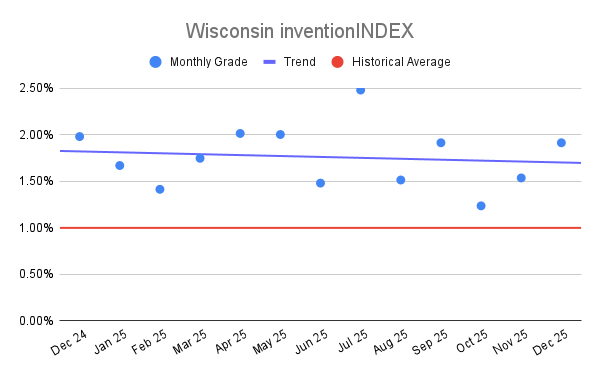 Wisconsin inventionINDEX December 2025
  Wisconsin inventionINDEX Novem
