

Expenses incurred for research conducted in this state refer to qualified research costs—specifically wages, supplies, and contract expenses—directly attributable to activities physically performed within the borders of Wisconsin. Under the state’s tax framework, this geographic limitation serves as a primary eligibility gatekeeper, excluding all out-of-state expenditures regardless of their functional relationship or benefit to Wisconsin-based innovation projects.
The Statutory Architecture and Legislative Intent of Wisconsin Research Credits
The Wisconsin Research and Development (R&D) Tax Credit is not a mere mirror of the federal credit provided under Internal Revenue Code (IRC) Section 41. Instead, it is a targeted economic instrument designed to catalyze local industrial growth and technical innovation through a strictly territorial lens. The primary legal basis for this credit resides in Wisconsin Statutes, specifically sections 71.28(4) for corporations and 71.47(4) for insurance companies. These statutes define "qualified research expenses" by referencing the federal code but immediately impose a critical geographic restriction: the expenses must be incurred by the claimant for research conducted within the physical boundaries of Wisconsin. This distinction is fundamental because it transforms the credit from a general incentive for innovation into a specific incentive for Wisconsin-based labor and infrastructure.
The legislative history of these provisions reflects an evolving commitment to high-tech sectors. For example, 2011 Wisconsin Act 131 and 2015 Wisconsin Act 55 introduced and refined various tiers of the credit, including enhanced rates for specific industries like internal combustion engine design and energy-efficient product manufacturing. The overarching goal is the creation of a "sticky" innovation ecosystem where companies do not just headquarter in the state but also perform the high-value, high-complexity work of R&D within its borders. By mandating that research be "conducted in this state," the legislature ensures that tax expenditures directly support the Wisconsin workforce and the development of local intellectual property, rather than subsidizing work outsourced to other states or countries.
The Wisconsin Department of Revenue (DOR) further clarifies this through its administrative guidance, most notably Publication 131, which serves as the definitive manual for taxpayers seeking to navigate the interplay between state and federal rules. The DOR emphasizes that the location of the activity is the "determinative factor" in eligibility. This means that even if a Wisconsin-domiciled company pays for research, the associated costs are only "qualified" if the research work is physically occurring at a Wisconsin laboratory, manufacturing plant, or office. This strict nexus requirement distinguishes Wisconsin from states that might allow for broader apportionment or the inclusion of out-of-state costs that benefit in-state production.
Deciphering Qualified Research Expenses (QREs) in the Wisconsin Context
To understand the meaning of "expenses incurred for research conducted in this state," one must first master the baseline definition of Qualified Research Expenses (QREs) as established by the federal government and then apply the Wisconsin-specific modifications. Under IRC Section 41(b), QREs are categorized into in-house research expenses and contract research expenses. In-house expenses include wages paid to employees for qualified services and the cost of supplies used in the conduct of qualified research. Contract research expenses generally represent a percentage of the amounts paid to third parties for research performed on the taxpayer's behalf.
Wisconsin’s modification of these federal rules is primarily geographic. While federal law allows for QREs incurred anywhere in the United States, Wisconsin Statutes restrict eligibility to those expenses "incurred for research conducted in this state for the taxable year". This phrase contains two essential components: the "incurred" component, which relates to the financial obligation and timing of the expense, and the "conducted" component, which relates to the physical location of the research activity.
The Impact of Federal Non-ConformityA critical nuance in the current Wisconsin regulatory environment is the state’s decision not to conform to certain changes introduced by the federal Tax Cuts and Jobs Act (TCJA) of 2017. Specifically, Section 13206 of P.L. 115-97 modified IRC Sections 41, 174, and 280C, requiring the capitalization and amortization of research and experimental expenditures for tax years beginning after December 31, 2021. Wisconsin has explicitly declined to adopt these changes for the purposes of the R&D tax credit.
Consequently, for Wisconsin purposes, the "pre-2022 federal provisions apply". This creates a situation where the expenses used to calculate the Wisconsin credit may differ significantly from the figures used on the federal tax return. In the federal context, domestic research must be amortized over five years, whereas for the Wisconsin credit calculation, the taxpayer continues to use the immediate expensing standards that existed prior to the TCJA. This divergence necessitates a detailed "Wisconsin modification" on the state income tax return to account for the difference in treatment between the state credit base and the federal taxable income.
| Provision Category | Federal Treatment (Post-2021) | Wisconsin Treatment |
|---|---|---|
| Expense Timing | Amortization over 5 years (domestic) | Immediate expensing for credit calculation |
| Geographic Scope | United States and U.S. Territories | Specifically within Wisconsin borders |
| Section 174 Basis | Required Capitalization | Pre-2022 expensing rules |
| Supply Eligibility | Restricted by new 174 rules | Based on traditional use-in-research standards |
Functional Analysis of In-State Labor: Wages and Qualified Services
Wages typically represent the most significant portion of any R&D credit claim. In Wisconsin, the "conducted in this state" requirement applies to wages by looking at where the employee is physically located when they perform "qualified services". The DOR defines qualified services through three primary functional lenses: engaging in research, direct supervision, and direct support.
Engaging in ResearchThis category involves the actual performance of experimentation or laboratory work. For these wages to qualify as "incurred for research conducted in this state," the researcher must be physically present in a Wisconsin facility. If a Wisconsin-based biotech firm employs a scientist who works from a laboratory in California, those wages are excluded from the Wisconsin credit because the research is not conducted in Wisconsin, despite the firm being headquartered in Madison.
Direct SupervisionDirect supervision refers to the immediate, first-line management of qualified research activities. This includes the management of a lab team or a group of software developers. Guidance from the DOR and federal precedents (such as Suder v. Commissioner) indicate that while general administrative supervision is excluded, technical supervision is a qualified service. For Wisconsin credit purposes, the supervisor must be physically located in Wisconsin. An out-of-state executive who provides high-level strategic oversight from an office in Chicago does not qualify for the Wisconsin credit, even if they are managing a Wisconsin-based team, because their supervisory service is not "conducted in this state".
Direct SupportDirect support includes activities that are essential to the research process but do not constitute experimentation themselves. Examples provided in administrative guidance include a machinist in a Wisconsin shop machining a part for an experimental prototype or a laboratory assistant in Green Bay cleaning specialized testing equipment. Technical sales personnel may also qualify if they are working with company engineers in Wisconsin to assess equipment needs and develop new system requirements. However, general and administrative functions—such as payroll processing, human resources, or time tracking—are strictly excluded from the definition of direct support.
The 80% "Substantially All" Rule in a Territorial ContextWisconsin adopts the federal "substantially all" rule for wage calculations, but with a territorial twist. If "substantially all" (defined as 80% or more) of the services performed by an employee during the taxable year constitute qualified services, then 100% of the wages paid to that employee are considered QREs. However, in the Wisconsin context, these services must not only be "qualified" but must also be performed within Wisconsin.
If an employee spends 90% of their time on qualified research, but divides that time equally between a facility in Wisconsin and a facility in Michigan, the "substantially all" rule applies to the type of work, but the geographic limitation still restricts the claimable wages to the 45% actually performed in Wisconsin. Only the wages paid for the qualified services performed within Wisconsin borders are eligible for the state-level credit.
Consumables and Tangible Assets: The Supply Chain of Innovation
For supplies to be considered "expenses incurred for research conducted in this state," they must be consumed or used in the performance of qualified research activities occurring within Wisconsin. This category includes all tangible property other than land and improvements to real property, and property of a character subject to the allowance for depreciation.
The critical factor for supplies is the location of their use, not the location of their purchase. A company that buys specialized silicon wafers from a supplier in Japan but uses them in a cleanroom in Appleton, Wisconsin, to develop a new semiconductor component can include the cost of those wafers as a Wisconsin QRE. Conversely, if those same wafers are shipped to a facility in Texas for testing, they are excluded from the Wisconsin calculation.
Documentation for supplies must be rigorous. The DOR requires taxpayers to maintain records that link the purchase of specific materials to a research project located in the state. This often involves tracking shipping manifests, warehouse logs showing the movement of goods to Wisconsin research sites, and project logs detailing the consumption of these materials during experimentation.
| Supply Category | Inclusion Status | Jurisdictional Requirement |
|---|---|---|
| Lab Chemicals | Qualified | Must be consumed in a WI-based lab. |
| Prototype Materials | Qualified | Must be utilized in WI-based prototype assembly. |
| Computer Hardware | Generally Excluded | Capitalized/Depreciable assets are not "supplies". |
| Software Licenses | Potentially Qualified | If not capitalized and used for in-state R&D. |
The Nuances of Contract Research in Wisconsin
Contract research represents one of the most complex areas of the Wisconsin R&D credit, primarily because it involves the intersection of third-party activity and the state's geographic mandate. Under Wisconsin law, a contract research expense is generally defined as 65% of the amount paid to any person (other than an employee) for qualified research performed in Wisconsin. This percentage increases to 75% for payments made to a "qualified research consortium"—a tax-exempt organization organized primarily to conduct scientific research.
The Three-Part Test for Third-Party ResearchTo be considered a "qualified research expense" in the first place, contract research must pass a three-part test established by federal treasury regulations and adopted by Wisconsin through IRC reference. The expense must be paid pursuant to an agreement that:
- Is entered into prior to the performance of the research: The DOR will disallow expenses based on verbal agreements or contracts signed after the work has begun.
- Provides that the research be performed on behalf of the taxpayer: The taxpayer must maintain the rights to the research results. If the contractor retains all intellectual property, the payment is considered a purchase of a product rather than a contract for research.
- Requires the taxpayer to bear the expense even if the research is not successful: The payment must be "at risk." If the contract provides that the taxpayer only pays if a specific result is achieved (a contingent payment), it does not qualify as an R&D expense.
Once the three-part test is satisfied, the "conducted in this state" requirement must be met. The third party must physically perform the research within Wisconsin. If a Wisconsin company hires a research firm in Illinois to perform a study, 100% of that cost is excluded from the Wisconsin credit, even if the results are used to improve a product manufactured in Milwaukee.
If the contractor performs work both inside and outside the state, the claimant is responsible for obtaining a breakdown of where the work was performed. Only the portion of the payment attributable to the work performed in Wisconsin (subject to the 65% limit) is included in the Wisconsin QREs. Administrative guidance emphasizes that prepaid research expenditures are not eligible for the credit until the actual research services are performed. This "performance-based" timing ensures that the credit is claimed in the year the Wisconsin labor and facility usage actually occurred.
Multistate Apportionment and Reasonable Allocation Methodologies
For enterprises with operations spanning multiple jurisdictions, the task of isolating "research conducted in this state" requires sophisticated allocation methodologies. Wisconsin Statutes explicitly state that if a portion of qualified research expenses is incurred partly within and partly outside the state, and the amount incurred in Wisconsin cannot be accurately determined, a portion shall be "reasonably allocated" to the state.
Reasonable Allocation StandardsThe DOR does not mandate a single, rigid formula for allocation, acknowledging that different businesses have different record-keeping capabilities. However, a "reasonable" allocation must be based on objective data that reflects the geographic reality of the research effort. Common methodologies include:
- Labor Hour Ratios: This is often considered the "gold standard" for wage allocation. By dividing the total hours spent on a specific R&D project by Wisconsin-based employees by the total hours spent on the same project by all employees, a percentage is derived that can be applied to total project costs.
- Sales Factor Apportionment: In cases where a multistate taxpayer cannot directly trace costs, some guidance suggests looking toward the Wisconsin sales factor—the ratio of the taxpayer's sales in Wisconsin to its total sales. However, this is generally seen as a secondary method and may be scrutinized if more direct data (like payroll records) is available.
- Occupancy and Square Footage: For overhead costs that directly support research (like utilities or rent for specialized labs), an allocation based on the square footage of the Wisconsin-based research space compared to the total facility footprint is often used.
It is a core tenet of Wisconsin tax law that expenses incurred entirely outside of Wisconsin cannot be allocated to the state under any circumstances, even if those expenses were intended for the benefit of research occurring within Wisconsin. This "all-or-nothing" geographic rule prevents companies from using broad apportionment formulas to pull out-of-state costs into the Wisconsin credit base.
Industrial Tiers and Enhanced Incentive Structures
To further drive investment in high-impact sectors, Wisconsin provides a tiered rate structure. While the general credit for increasing research activities is 5.75% of the excess QREs, certain activities qualify for an 11.5% rate. For these enhanced rates, the "conducted in this state" requirement is even more pivotal, as the DOR closely audits the nature of the activity to ensure it falls within the narrow statutory definitions.
Tier 1: General ResearchThe standard credit applies to any qualified research as defined in IRC Section 41, provided it is conducted in Wisconsin. The credit is 5.75% of the excess of current year Wisconsin QREs over a base amount (generally 50% of the 3-year average).
Tier 2: Internal Combustion EnginesAn enhanced credit of 11.5% is available for research related to the design and manufacturing of internal combustion engines for vehicles. The statutes provide broad definitions for what constitutes an "internal combustion engine," explicitly including substitute products such as fuel cells, electric drives, and hybrid systems. The term "frame" is also defined with specificity for motorcycles and trucks to ensure that research related to the structural integrity and drivetrain of these vehicles is captured.
Tier 3: Energy Efficient ProductsA second 11.5% tier is available for research related to the design and manufacturing of:
- Energy-efficient lighting systems.
- Building automation and control systems.
- Automotive batteries for use in hybrid-electric vehicles that reduce the demand for natural gas or electricity.
The enhanced rates represent a significant "tax expenditure" for the state, and as such, the DOR requires distinct reporting for each type of research. A claimant must use a separate Schedule R for each category of research being conducted. This separation allows the state to track the efficacy of its targeted incentives and ensures that general R&D costs do not "leak" into the enhanced rate categories.
| Research Category | Base Rate | Enhanced Rate | Primary Target |
|---|---|---|---|
| General R&D | 5.75% | N/A | All innovative sectors. |
| Startups (General) | 2.875% | N/A | No QREs in prior 3 years. |
| IC Engines/EVs | N/A | 11.5% | Automotive and heavy machinery. |
| Energy Efficiency | N/A | 11.5% | Lighting, HVAC, Green Tech. |
| Startups (Enhanced) | N/A | 5.75% | No QREs in prior 3 years. |
The Fiscal Lifecycle of the Credit: Refundability and Carryforwards
The utility of the Wisconsin R&D credit has been significantly bolstered by the transition toward refundability. Historically, the credit was nonrefundable, meaning it could only be used to offset a taxpayer's actual tax liability. This limited the credit's value for startups and firms in cyclical downturns.
The Evolution of RefundabilityBeginning with tax years after December 31, 2017, the legislature introduced a refundable component. This allows a portion of the "unused" credit (the amount that exceeds the current year’s tax liability) to be paid to the taxpayer as a refund. The percentage of the credit that is refundable has increased over time, reflecting a legislative desire to provide immediate liquidity to R&D-heavy firms.
- 2018–2020: 10% of the computed credit was refundable.
- 2021–2023: 15% of the computed credit was refundable.
- 2024 and beyond: 25% of the computed credit is refundable.
The refundable portion is calculated as the lesser of the statutory percentage (e.g., 25% for 2024) of the total credit or the amount of the credit remaining after subtracting the current year’s tax liability.
Carryforward ProvisionsAny portion of the credit that is not used to offset tax and is not refunded can be carried forward for up to 15 years. This carryforward period ensures that the investment in Wisconsin-based research provides long-term value, even if the company takes several years to reach profitability. It is important to note that the 15-year clock begins in the year the expense was incurred, not the year the credit was first used.
Credits as Taxable IncomeA distinctive feature of Wisconsin tax law is the requirement that the research credit be reported as income in the year it is computed. This "add-back" requirement applies to the full amount of the credit computed on Schedule R, regardless of whether the credit is used, refunded, or carried forward. The rationale is that because the taxpayer has already deducted the R&D expenses (the "wages" and "supplies") from their income, receiving a tax credit for those same expenses constitutes a recovery of the deduction, which must be taxed to avoid a double benefit.
Administrative Compliance, Documentation, and Audit Standards
The DOR’s audit bureau aggressively monitors R&D credit claims, particularly regarding the "conducted in this state" requirement. Because the credit is based on a modification of federal law, federal documentation standards (as found in IRC Section 41 and associated regulations) serve as the floor, but Wisconsin-specific records are required to prove the geographic nexus.
Contemporaneous Documentation RequirementsThe DOR emphasizes that documentation must be "contemporaneous"—meaning it must be created at the time the research is performed. Studies conducted years after the fact based on interviews or "best estimates" are frequently disallowed during field audits. To defend a claim of "research conducted in this state," a taxpayer must maintain a robust evidence locker, including:
- Innovation Logs and Testing Protocols: Records showing the systematic nature of the research, the uncertainties identified, and the experimental results.
- Detailed Payroll and Time Records: Documentation that links specific employees to specific R&D projects and, crucially, confirms their physical presence at a Wisconsin site.
- Third-Party Evidence: For contract research, taxpayers must provide copies of the underlying contracts, invoices, and a summary of the work performed by the contractor, clearly stating that the work was conducted in Wisconsin.
- Project Governance: Minutes from management meetings, status reports, and project approval documents that demonstrate the company’s ongoing investment in Wisconsin-based innovation.
A typical field audit involves an examination of the taxpayer's books and records, often at the place of business. Auditors look for a "cause-and-effect relationship" between the costs incurred and the research activities conducted. If an auditor determines that an employee’s work was only "indirectly" related to research (such as time-tracking or general budgeting), those wages will be stripped from the QRE base. If the audit results in an adjustment, the taxpayer has six levels of appeal, beginning with the DOR’s Resolution Unit and potentially extending to the Wisconsin Tax Appeals Commission and the state court system.
Litigation and Interpretive Disputes: The Lawton Precedent
The complexities of the Wisconsin research credit have occasionally led to significant litigation, which in turn provides further guidance on the meaning of "expenses incurred." One of the most important recent cases is CA Lawton Co. v. Wisconsin Department of Revenue, which addressed the legal timing requirements for claiming carry-forward credits.
In the Lawton case, the taxpayer sought to claim research credits for expenses incurred between 2002 and 2006 on its 2011 and 2012 returns. The Department of Revenue denied the claim, arguing that a research credit cannot be carried forward unless it is first "computed and claimed" on a tax return filed within four years of the unextended due date for the year in which the expense was incurred.
The Petitioner argued that the four-year statute of limitations should only apply to the use of the carry-forward credit to offset current income. However, the Tax Appeals Commission sided with the Department, noting that if taxpayers were allowed to "wait and see" for 15 years before reporting their R&D expenses, the state would have no way to audit the validity of the research activity. This case established a critical compliance rule: to preserve the right to "expenses incurred for research conducted in this state," a taxpayer must report those expenses on a Schedule R within four years of the year the work was performed, even if the company has no tax liability and cannot use the credit immediately.
Treatment of Combined Groups and Pass-Through Entities
The "conducted in this state" mandate takes on additional layers of complexity within sophisticated corporate structures. For combined group members and pass-through entities (PTEs), the credit calculation must be performed at the level of the entity actually doing the work.
Combined Group SharingUnder Wisconsin’s combined reporting rules (s. 71.255(6)(c)), research credits are generally considered attributes of the individual corporation that performed the research. However, a corporation may share its nonrefundable research credits with other members of the same combined group, provided it was a member of that group in the year the credit originated.
A significant modification exists for intra-group funding: research funded by one group member but performed by another is considered a QRE of the member performing the research. The reimbursement from the funding member is not considered a QRE for that funding member. This rule ensures that the credit remains tethered to the location of the physical activity (the performing member's Wisconsin facility) and prevents the "funding" exclusion from stripping the credit from a unitary group that is effectively performing the research in-house through a subsidiary.
Pass-Through Entity Flow-ThroughPartnerships, S-corporations, and LLCs treated as partnerships are not eligible to use the research credit to offset tax liability at the entity level. Instead, these entities use Schedule R to calculate the credit based on the R&D activities they conduct in Wisconsin. The computed credit is then prorated among the partners, members, or shareholders based on their ownership interests and reported on their respective Schedules 3K-1 or 5K-1.
For these owners, the "conducted in this state" rule means that their eligibility for the credit is entirely dependent on the underlying entity’s ability to prove its Wisconsin geographic nexus. If a partnership has three partners (one in Wisconsin, one in Illinois, and one in Florida), all three can potentially claim their share of the Wisconsin R&D credit, but only if the partnership can demonstrate that the research expenses were incurred for work conducted in Wisconsin.
Comprehensive Case Study: Applied Robotics Wisconsin, Inc.
To synthesize the diverse requirements of the "Expenses Incurred for Research Conducted in This State" provision, we present a multi-year analysis of a hypothetical firm, Applied Robotics Wisconsin, Inc. (ARWI).
Phase 1: Identifying Qualified Activities and LocationsIn the 2024 tax year, ARWI, a C-corporation, undertook a project to develop an autonomous warehouse drone capable of navigating low-light environments. The company operates a primary engineering hub in Waukesha, Wisconsin, but also utilizes a software testing team in India and a specialized camera vendor in California.
2024 Total Expenditures:
- Wages (WI Engineering Hub): $2,000,000 paid to 20 engineers physically located in Waukesha.
- Wages (India Software Team): $500,000 paid to contractors in Bangalore.
- Supplies (WI Lab): $400,000 in carbon-fiber frames and lithium batteries used in the Waukesha lab.
- Contract Research (CA Vendor): $600,000 paid to a California firm to develop a new lens.
- Contract Research (Madison University): $200,000 paid to a University of Wisconsin-Madison research consortium.
Historical Wisconsin QREs:
- 2023: $1,800,000
- 2022: $1,600,000
- 2021: $1,400,000
ARWI must apply the "conducted in this state" filter to its federal QREs.
- Wages (WI): The $2,000,000 for Waukesha-based engineers is fully includable.
- Wages (India): The $500,000 is excluded (not conducted in WI).
- Supplies: The $400,000 used in the Waukesha lab is fully includable.
- Contract Research (CA): The $600,000 for California development is excluded (not performed in WI).
- Contract Research (UW-Madison): 75% of the $200,000 paid to the consortium is includable ($150,000) because the work was performed in Wisconsin.
Total 2024 Wisconsin QREs:
$$QRE_{2024} = \$2,000,000 (\text{Wages}) + \$400,000 (\text{Supplies}) + \$150,000 (\text{Contract}) = \$2,550,000$$
Phase 3: Calculating the Base Amount and CreditThe base amount is 50% of the 3-year average of Wisconsin QREs.
$$\text{Average} = \frac{\$1,800,000 + \$1,600,000 + \$1,400,000}{3} = \$1,600,000$$
$$\text{Base Amount} = \$1,600,000 \times 0.50 = \$800,000$$
Since the drone uses hybrid drives and energy-efficient lighting for its sensors, ARWI claims the enhanced 11.5% rate.
$$\text{Excess QREs} = \$2,550,000 - \$800,000 = \$1,750,000$$
$$\text{Total Computed Credit} = \$1,750,000 \times 0.115 = \$201,250$$
Phase 4: Application of Refundability and Add-BackAssuming ARWI has a 2024 Wisconsin tax liability of $100,000.
- Tax Offset: Use $100,000 of the credit to eliminate tax.
- Remaining Credit: $\$201,250 - \$100,000 = \$101,250$.
- Maximum Potential Refund (25% of Total): $\$201,250 \times 0.25 = \$50,312.50$.
- Actual Refund: The lesser of the remaining credit or the potential refund.
- Refund Amount: $50,312.50.
- Carryforward: $\$101,250 - \$50,312.50 = \$50,937.50$ (available for 15 years).
- Income Modification: ARWI must report the full $201,250 as income on its Wisconsin Form 6.
Final Thoughts
The "conducted in this state" mandate ensures that the Wisconsin R&D credit remains a high-integrity, high-impact incentive. As the state continues to increase refundability, the credit will likely attract a larger share of early-stage venture-backed companies that prioritize cash flow over long-term carryforwards.
For professional practitioners, the key to success in this domain is the abandonment of "allocative estimation" in favor of "direct tracking." In the modern era of hybrid and remote work, companies can no longer assume that a Wisconsin payroll record equates to a Wisconsin research wage. The physical location of every researcher must be tracked at the project level. Furthermore, as Wisconsin remains non-conformant with federal TCJA amortization rules, firms must maintain two sets of R&D books—one for federal compliance and one for Wisconsin credit maximization.
Ultimately, "Expenses Incurred for Research Conducted in This State" represents a covenant between the taxpayer and the people of Wisconsin: in exchange for a substantial tax subsidy, the taxpayer commits to building the future of technology within the state's borders. Mastery of this provision allows firms to capture significant value while contributing to the long-term economic resilience of the Wisconsin innovation landscape.





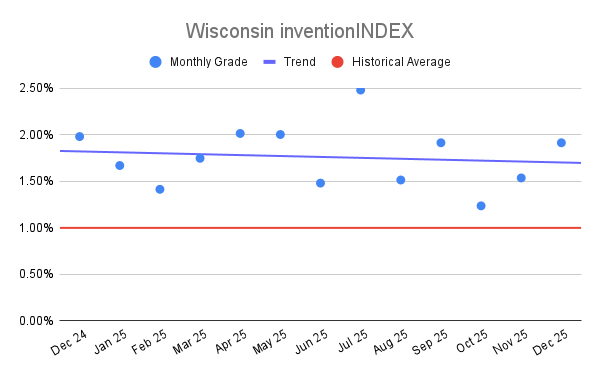 Wisconsin inventionINDEX December 2025
  Wisconsin inventionINDEX Novem
