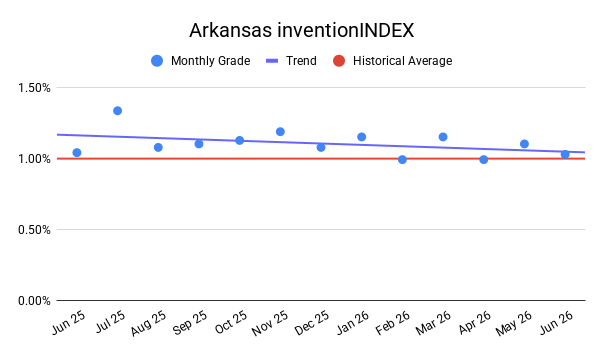
May 2026: 1.10% (C+ grade)
Backend Editor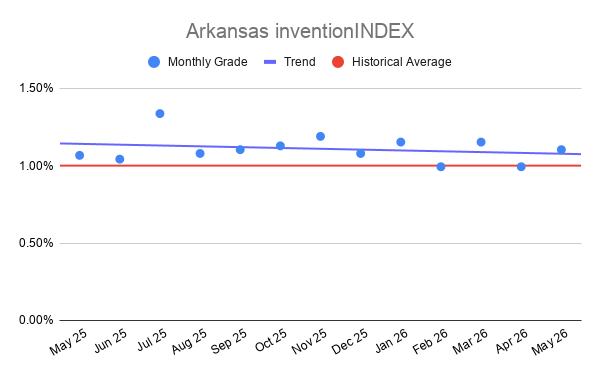 Arkansas inventionINDEX May 2026: 1.10% (C+ grade)
The inventionINDEX measures innovation output by comparing GDP growth with patent production growth.
Anything over C grade is positive sentiment; anything under C is negative outlook/sentiment. Using that sentiment, it is possible to observe trends over time, and also compare states/countries. In doing so, we can predict which states have the best chance to recover economically from the pandemic (or any other economic incident that may occur).
Historical Arkansas inventionINDEX Scores
The Arkansas inventionINDEX score for the past 12 months is shown in the table below.
| Month | inventionINDEX SCORE |
|---|---|
| May 2026 | 1.10% |
| April 2026 | 0.99% |
| March 2026 | 1.15% |
| February 2026 | 0.99% |
| January 2026 | 1.15% |
| December 2025 | 1.08% |
| November 2025 | 1.19% |
| October 2025 | 1.13% |
| September 2025 | 1.10% |
| August 2025 | 1.08% |
| July 2025 | 1.34% |
| June 2025 | 1.04% |
| May 2025 | 1.07% |
``The Arkansas inventionINDEX scores from the first half of 2026 reveal a landscape of moderate stability, characterized by fluctuating performance that mirrors broader long-term economic cycles. In May 2026, the index recorded a score of 1.10% with a C+ rating, marking a slight recovery from the 0.99% C- floor seen in both April and February of the same year. When compared against the preceding 60-month horizon, this recent performance sits comfortably near the historical median, though it remains notably constrained compared to the robust activity observed in previous years. This pattern suggests that while the regional innovation ecosystem is maintaining a resilient baseline, it is currently navigating a transitional phase rather than experiencing a rapid breakout.``
``A broader examination of the historical data underscores significant historical volatility, pinpointing clear benchmarks that put current numbers into perspective. The absolute zenith of the past five years occurred in late 2023, driven by a remarkable peak in October 2023 at 1.94% with an A+ rating, which directly followed an exceptional August performance of 1.45%. Conversely, the historical nadir is anchored in October 2022, when the index bottomed out at a critical 0.76% with a D- rating. Evaluating the current 2026 trajectory against these historical extremes shows that the index has successfully insulated itself from past severe macroeconomic shocks, yet it still struggles to recapture the intense momentum that defined the late 2023 boom.``
``Securing higher grades on the inventionINDEX yields profound positive outcomes for the regional economy, acting as a catalyst for sustained commercial growth. When the index climbs into the A and B ranges, it signals a fertile environment for intellectual property development, increased venture capital deployment, and heightened entrepreneurial confidence. These elevated scores typically reflect robust patenting activity and tech transfer efficiency, which attract outside corporate investment and foster high-wage employment opportunities. Ultimately, a strong index ranking validates local innovation initiatives, strengthens public-private partnerships, and positions the region as a competitive hub for cutting-edge industries.``
``Conversely, prolonged stagnation or a descent into lower grades carries troubling negative implications for long-term economic competitiveness. Dips into C- or D territories indicate underlying friction within the ecosystem, such as capital constraints, regulatory bottlenecks, or a decline in high-value research and development outputs. When the index consistently registers depressed scores, it can erode investor confidence, leading to capital flight and a potential brain drain as top-tier technical talent migrates to more dynamic markets. Addressing these lower-tier ratings requires a concerted reassessment of innovation infrastructure to ensure that temporary market contractions do not solidify into permanent structural declines.``
Discussion:
In May, the Arkansas inventionINDEX scored a positive sentiment which was lower than the previous year’s average but outperformed the downward trend for the year. This is similar to the prior 12 months, which experienced a slight downward trend.
As the economy continues to stabilize in the post-pandemic era, it remains uncertain whether any backlog of applications still exists or if the department has returned to normal processing timelines. The inventionINDEX could also be affected by lingering consequences from the pandemic, such as company closures, reduced workforces, and limited R&D capabilities, which may still be impacting current operations.
Learn More:
Are you thinking of patenting any of your bright ideas? Did you know your research work could be eligible for the R&D Tax Credit and you can receive up to 14% back on your expenses? To find out more, please check out our free online eligibility test.
Swanson Reed’s Arkansas office provides R&D tax credit consulting and advisory services to Little Rock, Fort Smith, Fayetteville, Springdale, Jonesboro, North Little Rock, Conway, Rogers, Pine Bluff and Bentonville
Feel free to book a quick teleconference with one of R&D tax specialists if you would like to learn more about R&D tax credit opportunities.
Who We Are:
Swanson Reed is the largest Specialist R&D tax credit advisory firm in the United States. With offices nationwide, we are one of the only firms globally to exclusively provide R&D tax credit consulting services to our clients. We have been exclusively providing R&D tax credit claim preparation and audit compliance solutions for over 30 years.
Swanson Reed hosts daily free webinars and provides free IRS CE and CPE credits for CPAs. For more information please visit us at www.swansonreed.com/free-webinars or contact your usual Swanson Reed representative.