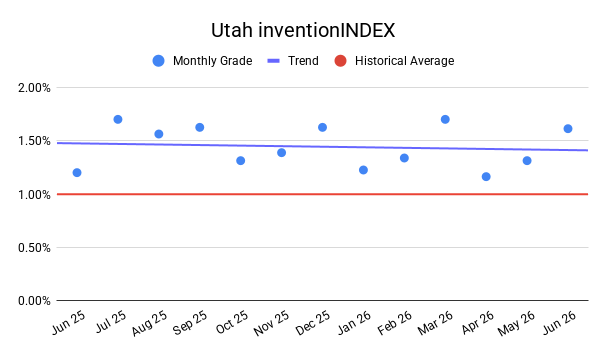
May 2026: 1.31% (B- grade)
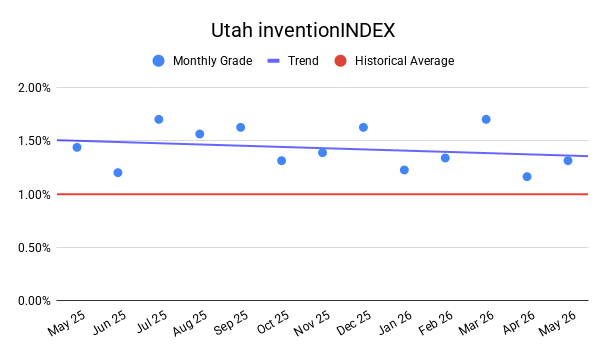
Utah inventionINDEX May 2026: 1.31% (B- grade)
The inventionINDEX measures innovation output by comparing GDP growth with patent production growth.
Anything over C grade is positive sentiment; anything under C is negative outlook/sentiment. Using that sentiment, it is possible to observe trends over time, and also compare states/countries. In doing so, we can predict which states have the best chance to recover economically from the pandemic (or any other economic incident that may occur).
Historical Utah inventionINDEX Scores
The inventionINDEX score for Utah for the past 12 months is shown in the table below.
| Month | inventionINDEX SCORE |
|---|---|
| May 2026 | 1.31% |
| April 2026 | 1.16% |
| March 2026 | 1.70% |
| February 2026 | 1.34% |
| January 2026 | 1.23% |
| December 2025 | 1.63% |
| November 2025 | 1.39% |
| October 2025 | 1.31% |
| September 2025 | 1.63% |
| August 2025 | 1.56% |
| July 2025 | 1.70% |
| June 2025 | 1.20% |
| May 2025 | 1.44% |
An analysis of the Utah inventionINDEX over the past sixty months reveals a landscape characterized by both remarkable innovation and cyclical moderation. The most recent data point from May 2026 indicates a score of 1.31%, earning a B- rating. This represents a noticeable dip when compared to the historical average of approximately 1.47% for the observed period. The index has experienced significant fluctuations since May 2021, illustrating the dynamic nature of regional inventive output. While a B- suggests a respectable level of continuous development, it also highlights an opportunity for renewed strategic focus to elevate the state’s innovation metrics back to previously achieved benchmarks.
To contextualize the current standing, it is helpful to examine the historical peaks and valleys within the dataset. The absolute zenith of the past five years occurred in November 2023, boasting an unprecedented score of 2.89% and a prestigious A+ rating. Conversely, the index faced its most significant contraction less than a year later in August 2024, plummeting to 0.99% with a C- rating. Recent months have shown a mixed trajectory, with March 2026 achieving a commendable 1.70% (A-) before tapering off to the current 1.31%. This volatility suggests that while the foundational capacity for high-level invention remains intact, sustaining that momentum requires ongoing support and investment.
Securing a higher grade on the inventionINDEX carries profound positive outcomes for the local economy and its broader reputation. Elevated scores, such as the A and A- ratings seen in late 2023 and early 2024, signal a robust ecosystem of research, development, and commercialization. These periods of high performance typically attract increased venture capital, incentivize top-tier talent to remain in or relocate to the area, and foster collaborative partnerships between universities and the private sector. A consistently high rating serves as a vital economic catalyst, positioning the region as a premier hub for technological advancement and forward-thinking enterprises.
Conversely, the negative implications of a lower score warrant careful consideration. When the index dips into the C range or consistently hovers at the lower end of the B spectrum, it may indicate systemic barriers impeding creative output, such as funding shortfalls or regulatory hurdles. A prolonged downward trend can lead to an erosion of investor confidence, prompting capital to flow toward competing markets with more favorable innovation metrics. Furthermore, lower grades might reflect a stagnation in intellectual property generation, ultimately hindering long-term economic diversification and resilience in an increasingly competitive global landscape.
Discussion:
In May, the Utah inventionINDEX scored a positive sentiment which was lower than the previous year’s average and underperformed the downward trend for the year. This is in contrast to the prior 12 months, which experienced an upward trend.
As the economy continues to stabilize in the post-pandemic era, it remains uncertain whether any backlog of applications still exists or if the department has returned to normal processing timelines. The inventionINDEX could also be affected by lingering consequences from the pandemic, such as company closures, reduced workforces, and limited R&D capabilities, which may still be impacting current operations.
Learn More:
Are you thinking of patenting any of your bright ideas? Did you know your research work could be eligible for the R&D Tax Credit and you can receive up to 14% back on your expenses? To find out more, please check out our free online eligibility test.
Swanson Reed’s Utah office provides R&D tax credit consulting and advisory services to Salt Lake City, West Valley City, Provo, West Jordan, Orem, Sandy, Ogden, St George, Layton and Taylorsville
Feel free to book a quick teleconference with one of R&D tax specialists if you would like to learn more about R&D tax credit opportunities.
Who We Are:
Swanson Reed is the largest Specialist R&D tax credit advisory firm in the United States. With offices nationwide, we are one of the only firms globally to exclusively provide R&D tax credit consulting services to our clients. We have been exclusively providing R&D tax credit claim preparation and audit compliance solutions for over 30 years.
Swanson Reed hosts daily free webinars and provides free IRS CE and CPE credits for CPAs. For more information please visit us at www.swansonreed.com/free-webinars or contact your usual Swanson Reed representative.