The United States Patent and Trademark Office recently issued an advanced aerospace patent to Equinox Innovative Systems. The invention, titled “Unmanned aerial vehicle tethered with optical fiber” (U.S. Patent No. 12,617,560), marks a transformative step forward in persistent aerial communication and surveillance solutions.
This proprietary technology addresses a critical challenge in drone-based remote operations by establishing an ultra-high bandwidth communication link via a physical deployment cable. Rather than limiting performance through localized wireless interference or suffering severe signal degradation across extended wire networks, the system utilizes integrated optical fibers within the tether to deliver seamless, real-time data streaming and continuous ground-supplied power to the aircraft.
Why the Invention Is So Innovative
The core innovation of this patent lies in its ability to completely bypass the physical limitations governing traditional tethered drones. Standard unmanned aerial vehicle systems that rely on copper coaxial cables or digital electrical lines experience substantial signal attenuation, often losing up to 20 decibels of signal strength over distances exceeding 100 feet. Equinox Innovative Systems solves this problem by embedding fragile optical fibers alongside power delivery components within a specialized flight tether. By utilizing a Radio-over-Fiber system, the platform can support massive, bidirectional data streams, such as multi-input multi-output cellular configurations and LTE bands, across hundreds of feet of elevation without experiencing data decay. This architecture allows the drone to remain airborne indefinitely while functioning as a reliable, ultra-high-speed network infrastructure point.
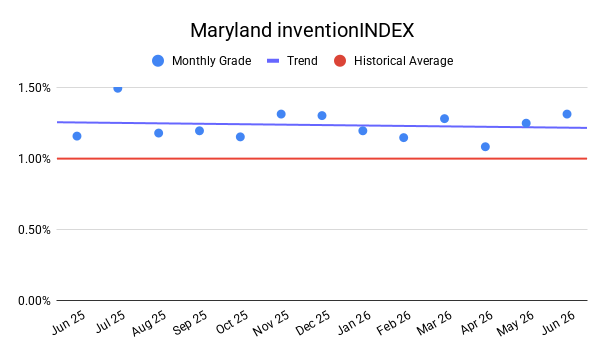
Maryland State Patent of the Month: June 2026
This groundbreaking advancement has earned Equinox Innovative Systems the title of Maryland State Patent of the Month for June 2026. Based out of Columbia, Maryland, and closely integrated with regional defense solutions, Equinox Innovative Systems highlights the state’s expanding dominance in tactical aerospace engineering and military intelligence technologies. The award emphasizes the profound practical and tactical importance of the invention. Whether serving as an instant cellular relay tower in natural disaster zones or executing long-duration maritime surveillance operations for defense forces, this technology provides critical overhead infrastructure with a minimal logistical footprint. By securing this utility patent, the Maryland-based firm has provided a robust solution to a major global communication problem, showcasing how local engineering talent can drive national security and public safety infrastructure forward.
U.S. R&D Tax Credit Eligibility for Practical Applications
The practical applications and ongoing physical refinements of this fiber-tethered drone platform establish a strong baseline for eligibility under the U.S. Research and Development (R&D) Tax Credit framework of Internal Revenue Code Section 41. To qualify, a project must successfully fulfill a four-part test requiring a technical purpose, the elimination of structural uncertainty, a structured process of experimentation, and a clear reliance on core engineering sciences. The extensive mechanical and electrical engineering required to construct this system meets these requirements perfectly. The technical team had to overcome significant design obstacles, such as engineering a custom spooling mechanism capable of deploying and retracting the tether without snapping the delicate glass optical fibers under high wind shear. They also had to optimize wave-division multiplexing to synchronize real-time transmissions across a moving, airborne aerial platform while dealing with complex thermal management issues within the combined power-and-data line. These iterative design, prototyping, and analytical modeling workflows represent qualified research activities, meaning that the engineering wages, software testing tools, and materials consumed during development can be claimed to offset federal tax liabilities.